• Shrines of Philadelphia
    • St. Katharine Drexel
    • Miraculous Medal
    • St. John Neumann
    • St. Rita of Cascia
    • Our Lady of Czestochowa
    • St. Gianna Molla
  • Sacred Places
  • Art, Film, Poetry
  • Saints
  • Music
  • Services

Shrine Tower

~ Saints, Shrines and Sacred Places

Shrine Tower

Category Archives: Saints

Guest Post: The Ascension of Our Lord in Catholic Art

24 Wednesday May 2017

Posted by Brian in Saints

≈ 4 Comments

Tags

Ascension of our Lord, Catholic art, Enluminure, Garofalo, Giotto, Mantegna

Enluminure_Drogon_c

Enluminure: The Sacramentary of Drogo (800-900 AD), one of the gospel illustrated manuscripts from the Carolingian Revival.

The Ascension is one of the most central elements of the Catholic faith, referenced in the Apostles’ Creed. The Resurrection of Jesus and his path to Heaven is intrinsic to His role as Son of God. Jesus ascended 40 days after the Resurrection, and it is one of the most important dates in the Church calendar after Holy Week and Christmas. This year Ascension Thursday is May 25th, a holy day.

Since the teachings of the Church revolve around particular aspects of Jesus’ life and teachings (as well as broader concepts in Catholic theology), especially His eternal life, His dying for our sins, life after death and the victory of good over evil, the Ascension has gained a principal place in the minds of the faithful down throughout the centuries.

In times of hardship, Catholics have looked to the Ascension as an example of the promise of eternal salvation. This has rung true since the early days of the Church, through the Middle Ages to the modern era, when many Catholic communities faced persecution and hardship.

As a result, there is a particularly rich body of Catholic art celebrating the Ascension. The relevance of the Ascension, along with the artistic history of the Church and its followers, makes the Ascension one of the most common themes seen in the corpus of Catholic art. Several of the most famous Catholic artists, especially during the Renaissance period, created inspiring works enjoyed not only by those interested in art but by any of the faithful, especially around the joyous period following Easter.

Other Mediums

Interestingly, other persons in the history of the Church have been depicted in their Ascension, such as Saint John and, of course, the Assumption of Mary. Also, several mediums aside from paintings have been used, notably sculpture, engravings and icons. The types of scenes depicted also vary, and all schools of art have produced works on the topic since about 300 A.D.

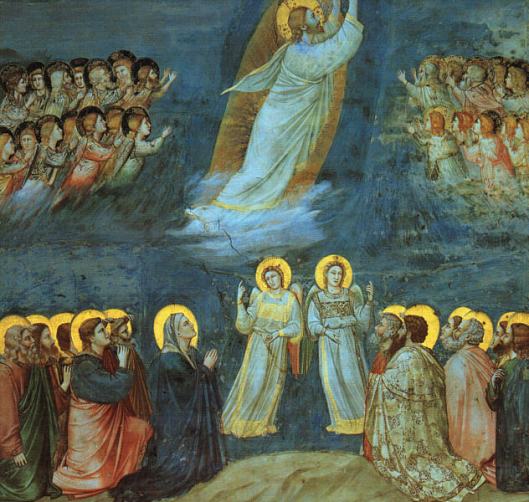
Giotto Scrovegni 38 Ascension

Giotto di Bondone “The Ascension” c.1305 located at Scrovegni Chapel, Padua, Italy

Types of Works

The two main types of works produced can typically be classed as relating to either the earthly perspective of the Ascension or the arrival of Jesus in heaven itself. From the earthly perspective, it is interesting that most scenes depict a broad range of figures in the Church, even those that would not have been there to witness it (such as Paul, who was not a Christian at the time of the Ascension, and Mary, who was not believed to have been present). Artists did this to emphasize the importance of Jesus’ ascension applied to all of Christ’s followers, not just those who were present.

In many works, there are symbolic depictions of Jesus common in other portrayed scenes of his life. However, these characteristics became particularly relevant and widespread in Ascension portrayals.

This level of standardization across Ascension scenes is notable for those with an interest in comparative art, since the small differences but many similarities between works can inform us about details of the period when they were produced or the opinions of the artists. As an extreme example, if you compare the Ascension in Catholic versus Eastern Orthodox art, you will note the Eastern tradition always has Mary present, which reflects their belief that Mary was there when Jesus ascended.

There are small details of the Ascension that vary from work to work that can provide interesting comparisons. For example, after the Renaissance, the angels are often not part of the image in most cases, whereas earlier, including angels was considered mandatory.

In the post-Renaissance era, Christ is alternatively shown with a banner in his right hand, or using it to make a blessing. In his left hand, he might have a parchment, scroll or Gospel. The action of the right hand is commonly interpreted to mean that he is blessing the entire community of believers, while the book or scroll he holds in his left represents the need to spread the word of the Lord.

Other details of the Ascension scene have changed significantly over the centuries. It was only starting around the 4th century that the Ascension becomes popular in Christian art. Until then, Jesus’ miracles were much more common material for artistic representation.

The same can be said for the Crucifixion, which was even less commonly depicted than the Ascension. Scholars believe that it may have been due to the many theological conferences and debates between 300 AD and 450 AD that caused the change in art. The turmoil regarding the difference among the various churches throughout the then known world brought Ascension scenes to the forefront as a means to help unify the Church.

Whatever the reason, after this time, it became one of the most popular scenes. In many cases, the artist includes a mountain with the Hand of God aiding Jesus in His ascent.

His feet visible through the clouds is a common element, along with His footprints in rocks along the mountains. The Ascension is commonly held to have taken place on the Mount of Olives near present-day Bethany.

The Ascension has been depicted in many manuscripts, especially in the period of 700-1500, in many reliefs commonly up until around 800 (including the first known depiction of the scene), and of course, the many paintings included painted scenes on church domes.

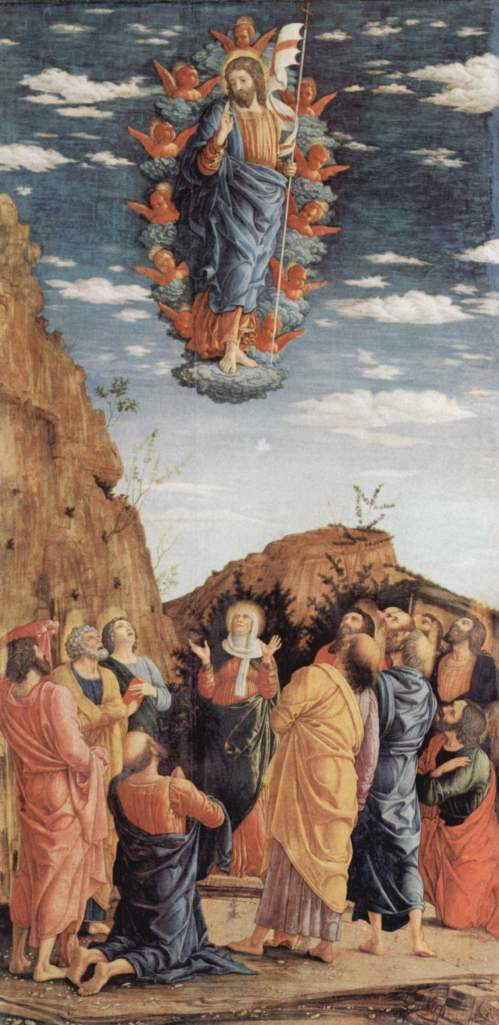
Andrea_Mantegna_

Andrea Mantegna “The Ascension” 1461 Florence, Italy

Northern Europe

Works by Giotto, Mantegna and Garofalo are among the most famous Ascension works. Given that Northern Europe was mainly Protestant after the 15th century and the Reformation, there are fewer works from artists in those countries.

However, in earlier times, there was a common theme in Northern Europe of depicting the feet of Jesus, extending from the clouds while he is on his way to heaven.

Final Thoughts

The Ascension, along with the events of Holy Week, is a good time for reflection for Catholics. This is not only because of the amount of art that exists that can help the faithful gain a better sense of the significance of the event, but also because it contains many components that are central to the faith and comes at the end of the most important time of year for Catholics: the challenges of Lent and the contemplative events of Holy Week.

Catholics understand that the Ascension is a crucial part of our faith. We are fortunate there is such a rich body of art celebrating the event. Ascension art strikes a good balance with the more somber scenes of crucifixion and Via Dolorosa (the road Jesus walked through Jerusalem to on His way to the crucifixion).

The works of some of the greatest artists in history are dedicated to helping us celebrate the important role of the Ascension in Catholic belief. This offers an excellent opportunity to learn more about our faith, in addition to gaining a deeper appreciation of Church art.

Guest Post:
Megan Dahle is a Catholic blogger and internet retailer at DiscountCatholicProducts.com. Her writing emphasizes prayer life, traditions and forms of worship. This is Megan’s second post on the ShrineTower blog.

Enamored with The Holy Mass – My Favorite Parts

15 Monday May 2017

Posted by Brian in Saints

≈ 10 Comments

Tags

Angels, Bread of Life, Catechism, Consecration, Eucharist, Immaculate Conception Cathedral, Laudate, Liturgy, Martin Erspamer, Most Blessed Sacrement Church, Oration Prayers, Padre Pio, Sacred Art, Sanctus:, St. Basil the Great Church, The Mass, USCCB

last supper 15

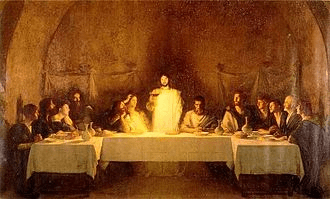
The Last Supper by Bouveret 1896

The Lord has done great things, and leaving us with the Holy Mass ranks up there with creating the universe, creating life and writing the scriptures. In each Mass offered in the world, Jesus comes down from Heaven to be present in us. As mere mortals we partake in the Mass, knowing a mystery is occurring but our soul probably sees what our minds cannot.

There is a lot going on in the Mass. If you look at the source of who’s talking, the direction or target of the communication, it covers a large number of people and heavenly spirits. There’s thanksgiving, offerings, prayers, statements of purpose and addresses. My focus is on the parts of the Mass that standout for me personally, not trying to set one part of the liturgy above the others. It’s actually quite complex when analyzed.

Of course with 2,000 years of edits, clarification and tender loving inputs, it truly is Gods gift to mankind. With the thrones of angels and saints present and God speaking through the bible readings, the Mass is a celebration of epic spiritual proportions.

1. The Seen and Partly Seen are Present

holy mass cover best 1

We enter the Mass in the company of others all around us; saints, souls, God and of course . . . people.  Maybe the non visible participants are tougher to acknowledge, but over time you can tell they are there, we are told they are there and if we listen, we know God is there, for he said “Where two or three are gathered together in my name, there am I” (Matthew 18:20). And the people you see face to face with the newly design churches, they are our neighbors and friends.

Entering the Mass with an open mind and heart, you sense there is something special going on here, there is an order involved and there is a story being told and a certain spiritual presence felt. By acknowledging those participating in the Mass, seen and unseen, we are in essence communicating and praying with them to God.

2. Sacred Art Abounds: God Speaks, Artist Listens, We Benefit and Engage

overview blessed sacrament

Most Blessed Sacrament Church, Bally PA, founded in 1741. Photo: @shrinetower

When entering the Church, I’d be remiss not to acknowledge those beings represented in the icons, stained glass windows and sculptures of the physical space.  Acknowledging and praying with the patrons of the church is the courteous thing to do. We are in their spiritual space. So we can acknowledge the saints we see in the art; and the saints we don’t see, but want to invite to participate. Asking these heavenly bodies to bring our offering requests to the front of the altar personalizes and maximizes the benefits we receive from the Holy Mass.

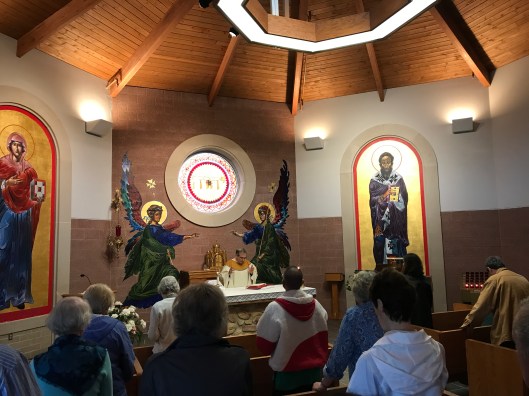
Basil the Great Mass

St. Basil the Great Chapel, Kimberton PA. Built circa 2005. Nothing but love here.

The Holy Mass at a small country chapel is where we begin. Shown are two Guardian Angels (St. Raphael and St. Michael) guarding the Tabernacle; above is a YHVH window “I Am” in Byzantine style based on a 4th century icon. Saint Basil and Saint Macrina, the patrons, are on each side.

St. Basil the Great Church and Chapel, Fr. Gary Pacitti; presider and pastor; Archbishop Charles J. Chaput, ninth Archbishop of Philadelphia. Wall icons in the chapel by Russian iconographer Niko Chocheli .

This is my Body This is My Blood Lalo Garcia
Resurrection, Santa Rosa Catholic Church San Benradino CA
Gift of Our Lady of Guadelupe Church, Oxnard CA

Sacred art in a sacred place; Santa Rosa Catholic Church, San Fernando CA. Top: This is my body… this is my blood by Lalo Garcia.

3. The Bible Embedded in the Mass: God Talking to Us

St-Johns-Bible3

Saint John’s Bible. Calligrapher Donald Jackson produced a hand-written, hand-illuminated Bible using parchment and quill. I have a copy that I treasure.

The Mass does not change in structure yet the content of the readings changes by religious calendar, including Holy Days, saint feast days and memorials. At each Mass, the Old Testament and the associated New Testament is read aloud, or in Eastern Catholic rite’s Divine Liturgy sung aloud, making the Mass invigorating, slipstream new and one of God’s ways of talking to us.

The variety of teachings we get from the Liturgy of the Word readings makes us think, meditate, ponder and witness the Last Supper. Mass readings can be found at USCCB and/or the free app Laudate.
laudate

Laudate

Scott Hahn, in his book, Reasons to Believe, says that the Mass is the Church’s fulfillment of an explicit command of Jesus, recorded in the Gospel and in St. Paul’s First Letter to the Corinthians (11:23-25):

“For I received from the Lord what I handed on to you, that the Lord Jesus on the night he was betrayed, took bread, and when He had given thanks, He broke it, and said, ‘This is my body which is for you. Do this in memory of me.’

In the same way, he took the cup saying, ‘this cup is the new covenant in my blood. Do this, as often as you drink it, in remembrance of me.”

4. Ringing the Bells: Signal to the Faithful (a miracle is taking place)
padre pio at Mass 2

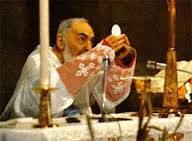
Mystic St. Padre Pio; Elevation of the Host at the Holy Mass. I’m sure bells were ringing!

The ringing of the bells at consecration is steeped in centuries of tradition. The bell ringing is optional today, yet in the middle ages when one could not hear or see parts of the Mass, the bells signified the consecration, the raising of the host and the raising of the chalice to the congregation. In a large cathedral, the bell ringing would have been a functional necessity. Also, the bells signified the larger tower bells be rung, signifying to the world, a miracle is taking place!

800px-Crepescular_rays_in_saint_peters_basilica

Crepuscular rays Saint Peter’s Basilica, built 1596-1625 Vatican City. Bells were ringing here.

In today’s world, the ringing of the bells shows reverence to that part of the Mass.  It’s a special feeling with the gifts raised and a good place to shift to an adulation prayer, like the Jesus Prayer.

holy spirit

Holy Spirit

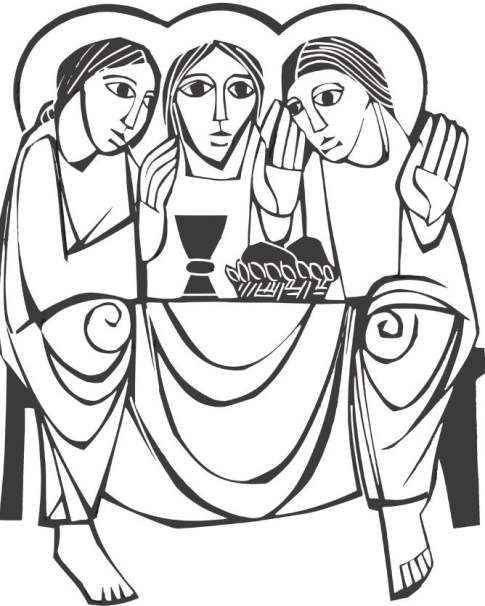
The first ringing of the bells is during the The Eucharistic Prayer with the Epiclesis, an invocation calling upon the Holy Spirit to bless the offerings of bread and wine.  This section was modified in 2011 and the new updated Roman Missal, and now packs a powerhouse prayer with “send down your spirit like the dewfall”. Sacred poetry at it’s best. The full verse the priest says at consecration with hands extended over the chalice and paten are:

Make holy, therefore, these gifts, we pray by sending down your Spirit upon them like the dewfall, so that they may become for us the Body and Blood of our Lord Jesus Christ.
open my lips

Illustration by Martin Erspamer OSB

The process of the Mass is such that water and wine are turned into the body and blood of Christ, or consecrated, so he is truly present in the Eucharist. This substance change process is key and is called transubstantiation.

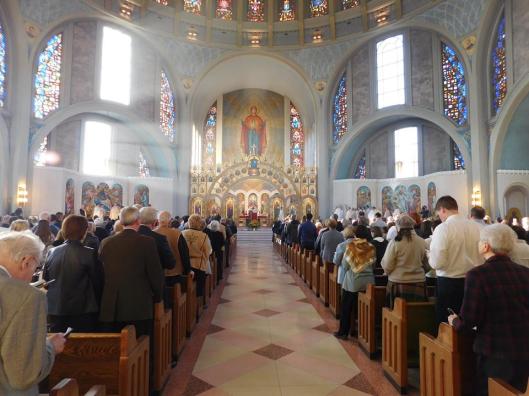
typical cathedral phila

Immaculate Conception Cathedral, Eastern Catholic Church 2016

The bible reference: “truly, truly, I say to you, unless you eat the flesh of the Son of Man and drink his blood, you have no life in you. Whoever feeds on my flesh and drinks my blood has eternal life, and I will raise him up on the last day. For my flesh is true food and my blood is true drink “(John 6:53-55).

With the elevation of the host is the second ringing of the bells:

Take this all of you and eat of it, for this is my Body, which will be given up for you.

I like this prayer since the priest starts in the third person, “At the time he was betrayed and entered willingly into his passion…”, and then the priest switches into the first person, “take this all of you and eat of it…” representing Jesus Christ.
chalice and host

As Ray Takacs of St. Agnes Church in Irwin PA says, “When I first realized this shift in speaking from third to first person, I was utterly amazed to realize that Jesus is speaking to us through the priest, just as he spoke to the Apostles at the Last Supper over 2000 years ago!”

Walking with them  Jesus explained the Scriptures; sitting with them at table “he took bread, blessed and broke it, and gave it to them.” Christ is present in each Mass.

The third ringing of the bells is the raising of the chalice:

Take this all of you and eat of it, for this is my Blood, the blood of the new and everlasting convent, which will be given up for you.

Padre Pio at Mass

St. Padre Pio, presider Holy Mass

St. John Chrysostom declares:

It is not man that causes the things offered to become the Body and Blood of Christ, but he who was crucified for us, Christ himself. The priest, in the role of Christ, pronounces these words, but their power and grace are God’s. This is my body, he says. This word transforms the things offered.

A side note: an opportunity exists to be an adult alter server in the mass, especially when no school is involved and it’s a daily Mass. I remember being asked to serve one morning, after an initial hesitation, I accepted. It was a day of significant realization of the power and glory of the Mass, and the day I became an altar server. It does take some getting used to, but being close to the altar and ringing the bells is enlightening. As the Eastern Catholics say in the Mass, “be attentive”, you never know when you will be asked to serve.

5. Sacred Poetry in the Oration Prayers

The Oration Prayers are some my favorite prayers in the Mass and include: The Collect, The Prayer over Offerings, The Prayer after Communion.

The Collect

An oration prayer is said by the priest alone. The collect or opening prayer is part of the Introductory rite.  Here is a collect from St. Mark’s feast day:

“O God, who raised up Saint Mark, your Evangelist,
and endowed him with the grace to preach the Gospel,
grant, we pray,
that we may so profit from his teaching
as to follow faithfully in the footsteps of Christ.
Who lives and reigns with you in the unity of the Holy Spirit,
one God, for ever and ever.”

The collect is a unique short prayer, referencing the first reading and the Saint of the Day or an event. It is found in the Roman Missal, which is the sacred book used by the priest during The Holy Mass at the altar. Some of the nicest prayers in the world are there.

MissalFrontPage

The Oration Prayers in the Roman Missal.

During a seminar, the monks at our local Abbey showed us how the collect is created based on the first reading, typically from the Old Testament. We then created our own collect and shared with the classmates! What a great experience to delve into how the Mass verbiage is created. So much depth and so beautiful. Here is a short collect I created in this class:

O Most High,
Dwell in our hearts so that we
May answer “yes” to
Your Call to Holiness.

An entire blog of collects was created by BlueStone blogger. For each day of the year she created a collect. She shares her method,  “the verses are arranged in trios, all in harmony with an image of Christ, followed by a prayer consisting of five elements found in church liturgy known as “collects”:  the address, the doctrine, the petition, the aspiration and the pleading.” What a site by this collect writer!

Prayer Over the Offerings

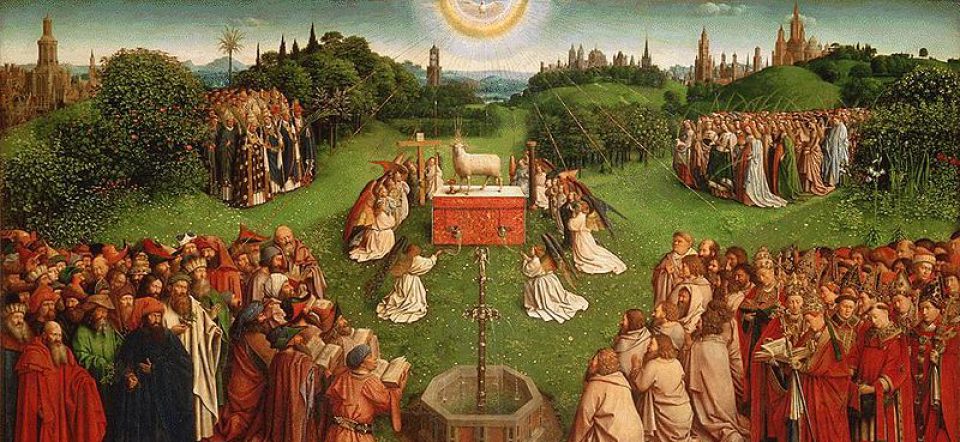
Lamb of god 2 medieveal

“Adoration of the Lamb” by Jan Van Eyck 1432 Ghent Alterpiece. Detail: The red altar where the lamb stands reads, “Behold the Lamb of God, which taketh away the sins of the world” and “Jesus the way, the truth, and the life”, both quotes from Gospel of John. In this image and in the book of Revelation the Lamb is Jesus. Directly around the Lamb on the altar are angels who are carrying the instruments in the Passion scenes, like the cross and crown of thorns. More detail here.

The Prayer over the Offerings from the Liturgy of the Eucharist changes daily and is intoned by the priest over the offerings of bread and wine usually brought to the altar by the people. The prayer is sung (or read) by the priest after the people say “May the Lord accept the sacrifice at your hands, for our good and the good of all His Holy Church”. Here is the unique Prayer over Offerings from the May 11th Mass taken from the Roman Missal. (Sample)

May our prayers rise up to you, O Lord,
together with your sacrificial offerings,
so that purified by your graciousness,
we may be conformed by the mysteries of your mighty love.
Through Christ our Lord.

At the Offertory, our petitions for families and friends, living and passed, and offerings for peace in the world are carried by angels to the Altar of the Lord. (Catalina Rivas)

Prayer After Communion
mass with people

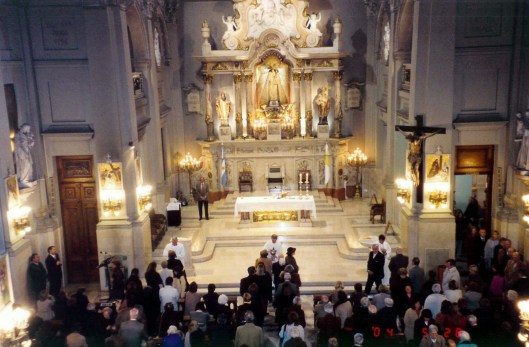
The Prayer after Communion is from the Communion rite of the Mass after the people have received Holy Communion. The priest starts, saying “Let us pray”, and then says the Prayer after Communion.

An example of the Prayer after Communion from the Roman Missal for May 11th (Sample):

Almighty ever-living God
who restore us to eternal life
in the Resurrection of Christ,
increase in us, we pray, the fruits of this paschal Sacrament
and pour into our hearts the strength of this saving food.
Through Christ our Lord.

6. The Power Statement

three lights upper pantocrator

“For the kingdom, power and glory are yours now and forever.” (MT6:13)

My favorite statement, “kingdom, power and glory…” said by the congregation after the Our Father in the Communion Rite is so powerful it resonates in each Mass as a way to praise God. By the power of the Holy Spirit and by the power of the words of Christ, the bread and wine have become the body and blood of Christ. Christ is really and mysteriously made present.

lincoln cathedral majestic

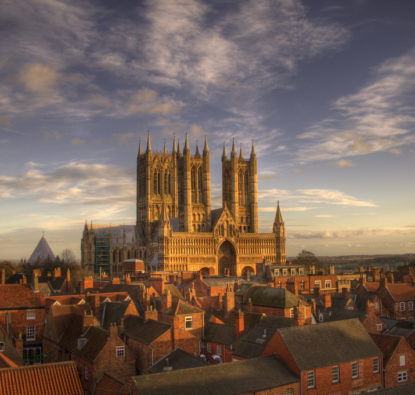
Medieval Lincoln Cathedral England, from 1088. Was the tallest building in the world for 238 years (1311–1549). A sign of power.

Rituals and symbols abound in the Mass, and in the Church. Try to look for an icon, or stained glass window and sing praise to the meaning behind the image.

The angels surround and help the priest when he is celebrating Mass. ~ St. Augustine

7. The Invitation to Communion
The Eucharist Source and Summit LTP by Lalo Garcia

The Eucharist Source and Summit LTP by Lalo Garcia

The Invitation to Communion prayer became part of the Mass dogma very recently, in 2011 when the Roman Missal was revised. In Church history timeline it’s brand new! It is the last prayer before receiving communion.

The priest says, “…Blessed are those that are called to the supper of the Lamb”. We are lucky, we are being called by God.

The next words are spoken by the congregation in preparation for the Divine encounter and are stunning, filled with meaning.

Lord I am not worthy that you should enter under my roof, but only say the word and my soul shall be healed.

This Invitation to Communion prayer is actually a scriptural response spoken by a Roman centurion when he asked Jesus to heal his sick servant in Matthew 8:8. The centurion replied, “Lord, I do not deserve to have you come under my roof. But just say the word, and my servant will be healed.”

Bread of Life

“Bread of Life Image” by artist Carol Pascale. Twitter @TheBread_OfLife

Mystic Saint Theresa of Jesus (Avila) in her book Interior Castle talks about the different kinds of  rooms inside our souls. “Under my roof” is where the soul resides with God, within our soul and being.

When we receive Holy Communion, Heaven is opened to us and we are in the presence of God in all His magnificence. And because God is present, all of Heaven – Mary, the angels and all the saints – are present as well. I like to think that for a brief moment, a window has opened up to heaven and all present at Mass are united with each other and with everyone in heaven.
– from Unraveling the Mysteries of Holy Mass: Part 6 – St. Agnes Church

What miracles of miracles! If the angels could be jealous of men, they would be so for one reason – Holy Communion!

– Quote from St. Maximillian Kolbe

catalina rivas

Catalina Rivas of Mexico, apparently received messages from Jesus and Mary related to the Mass. Imprimatur from local Bishop.

At the time to receive Communion, Jesus spoke to Catalina, “The Last Supper was the moment of the greatest intimacy with my own. In establishing the Eucharist, I made myself a prisoner of love, to remain with you until the end of the world and not leave you as orphans.” As the priest prayed the Prayer after Communion, Jesus continued, “I have died for love and I am risen. For love, I await each of you, and for love I remain with you.”

8. What the Angels Say

There are many references to Angels and what they have said, and one of their renowned statements is captured in the Mass known as the Sanctus:

Holy Holy Holy Lord God of Hosts,
Heaven and earth are full of your glory.
Hosanna in the highest.
Blessed is he who comes in the name of the Lord.
Hosanna in the highest.

We find this Angelic song in the bible:

“Holy, holy, holy Lord God of hosts.” Isaiah 6:3

8And the four living creatures, each of them with six wings, are full of eyes all around and inside. Day and night without ceasing they sing, “Holy, holy, holy, the Lord God the Almighty, who was and is and is to come.” Revelation 4:8

9The crowds that went ahead of him and that followed were shouting, “Hosanna to the Son of David! Blessed is the one who comes in the name of the Lord! Hosanna in the highest heaven!” Matthew 21:9

“The Sanctus reminds us that all creatures in Heaven and on earth owe thanksgiving to God.” – Ray Takacs, St Agnes Catholic Church, N. Huntingdon, PA

The Ascension by Giotto Scrovegni Chapel

Ascension (with angels) by Giotto 1303 – 1305 Scrovegni Chapel in Padua

Thousands of Angels are present at the Mass. Inviting favorite saints and angels to participate in the Mass may sound uncommon, but is a polite and forward gesture.

As St. John Chrysostom says, “the sanctuary is filled with countless angels who adore the divine victim immolated on the altar.”

Per Catalina Rivas vision: At the preface as the assembly sang “Holy, Holy, Holy”, everything behind the priest disappeared. Then, at the moment of the Consecration, thousands of angels appeared to the priest’s right, dressed in brilliant white robes. On his left, a multitude of the people appeared dressed in multicolored robes. All were singing together with the people. Mary said, “These are the saints of Heaven, among them are the souls of your relatives who already enjoy the presence of God.” Then, Mary appeared to the right and slightly behind the priest. She was suspended above the floor, kneeling with hands folded in prayer. She said, “It surprises you to see me behind the priest. This is how it should be. I have not been given the gift of the priests to be able to perform the Miracle of bringing my Son to the world.”

Catalina said of her vision, “As the priest prayed the words of the Consecration, he grew in stature and became enveloped in brilliant light. Then as he raised the large host the priest took on the features of Jesus, Himself. At that moment, the host began to grow and upon it was the face of Jesus, smiling at all present”. The Virgin Mary said, “This is the miracles of miracles. At the moment of the Consecration, all here are taken to Calvary, at the instant of the Crucifixion.”

teresa ecstasy

St. Teresa Ecstasy

Once, St. Teresa was overwhelmed with God’s goodness and asked Our Lord “How can I thank you?” Our Lord replied, “Attend one Mass.”

overview of immaculate conception cathedral

Closing

The power of the Mass is that a group of people are praising God, giving thanks and asking for favors and spiritual gifts. The Gospel passage, “For where two or three gather in my name, there am I with them.” really stands out here. Matthew 18:20

They say the Mass doesn’t change but people change in their spirituality over the course of a lifetime. I happen to believe this. In the coming years, my favorite sections may be different, as well as yours. Many come back to the Mass. They see the value. They are influenced by the Holy Spirit.

As mentioned, this post is not meant to be all inclusive of the sections of the Mass, and has no relation to importance of each part. It’s only my favorite parts where I get extra feeling and happiness out of the Mass in singing the praises to God. I am sure if you go to Mass or plan on going, or have gone in the past, you may have favorite parts as well.

Quite possibly, when our time is done, we will be rewarded by witnessing every Mass we attended and actually seeing the Angels and Saints around the priest giving praise to God!

Resources:

USCCB United States Conference of Catholic Bishops

The Roman Missal 3rd edition 2011
Unraveling the Mysteries of Holy Mass: Parts 1-7 by Ray Takacs
Catechism of the Catholic Church part two The Celebration of the Christian Mystery
Give Us This Day – Daily Prayer Guide specific to the Mass
Most Blessed Sacrament Roman Catholic Church, Bally PA
St Basil the Great Parish, Kimberton PA
Catalina Rivas, of Merida, Mexico. Although she has an imprimatur of the local Bishop, there is no ruling from the Vatican.  Her writings are summarized in her book, “Live…The Holy Mass”.
Saint John Paul II Canonization Day

27 Thursday Apr 2017

Posted by Brian in Our Lady of Czestochowa, Saints

≈ 1 Comment

Tags

canonization, Our Lady of Czestochowa Shrine, Pauline Fathers, Saint, Saint John Paul II, Shrine, St. Faustina, St. John XXIII, St. Paul the Hermit, The National Shrine of Our Lady of Czestochowa

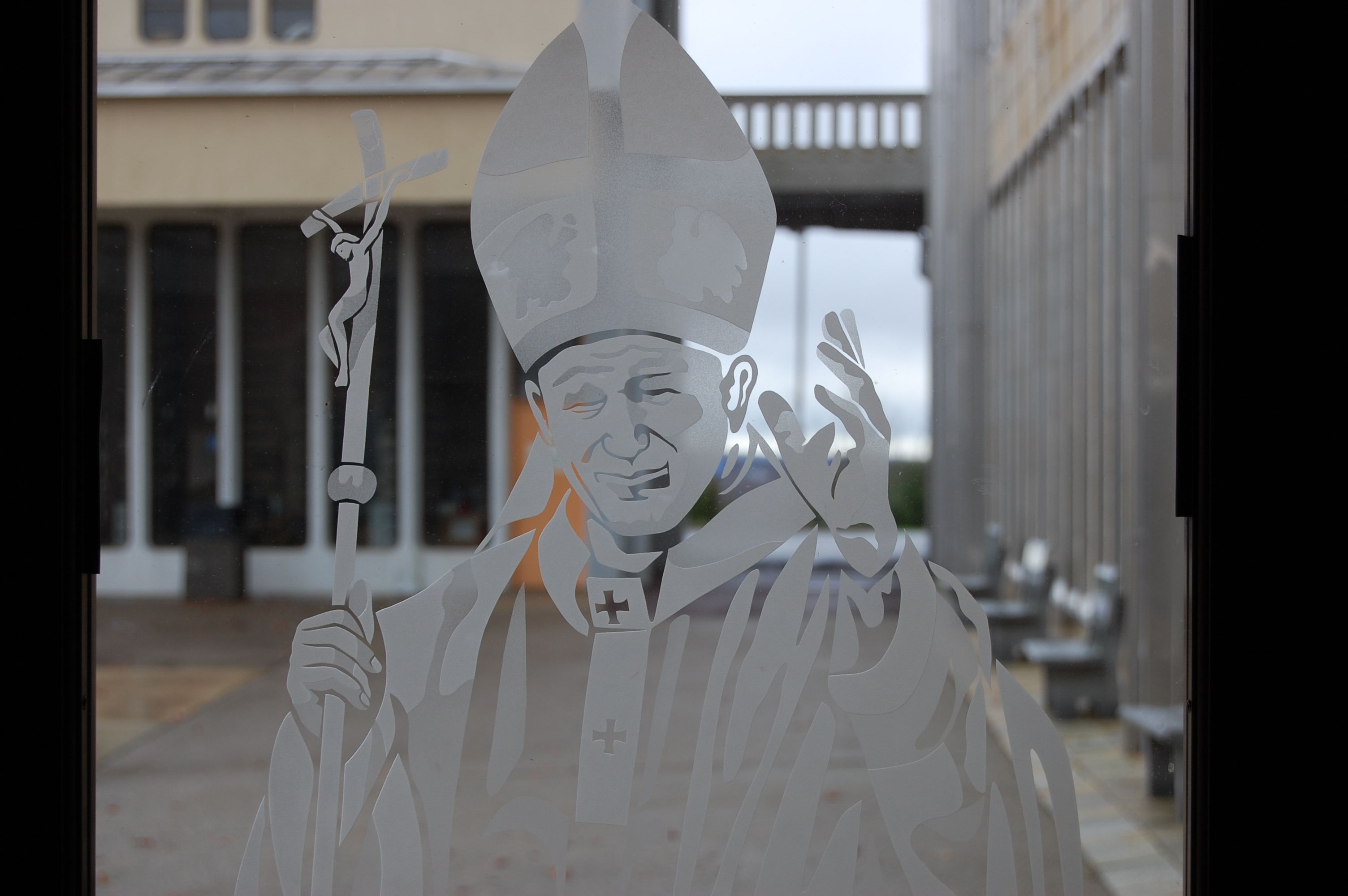
Saint John paul II

Saint John Paul II, The National Shrine of Our Lady of Czestochowa, Philadelphia Pennsylvania.

Yes, April 27 is the day St. Pope John Paul II was canonized. He attended the Second Vatican Council initiated by Pope John XXIII, who also was canonized on this day.

Born Karl Wojtyla, Pope John Paul was an actor, poet, athlete, playwrite, priest and philosopher.

As Charles Chaput, Archbishop of the Archdiocese of Philadelphia stated: He proved by his life the words of St. Irenaeus that “the glory of God is man fully alive.”

outside with JP2

St. John Paul II visited the Shrine of Our Lady of Czestochowa on two occasions while a cardinal. Karol Cardinal Wojtyla first visit was in 1969 and again in 1976 while attending the Eucharistic Congress held in Philadelphia. He became the 264th Pope of the Catholic Church two years later in 1978. John Paul II was the first non Italian pope since Pope Adrian VI who died in 1523.

saint JP II COAT OF ARMS
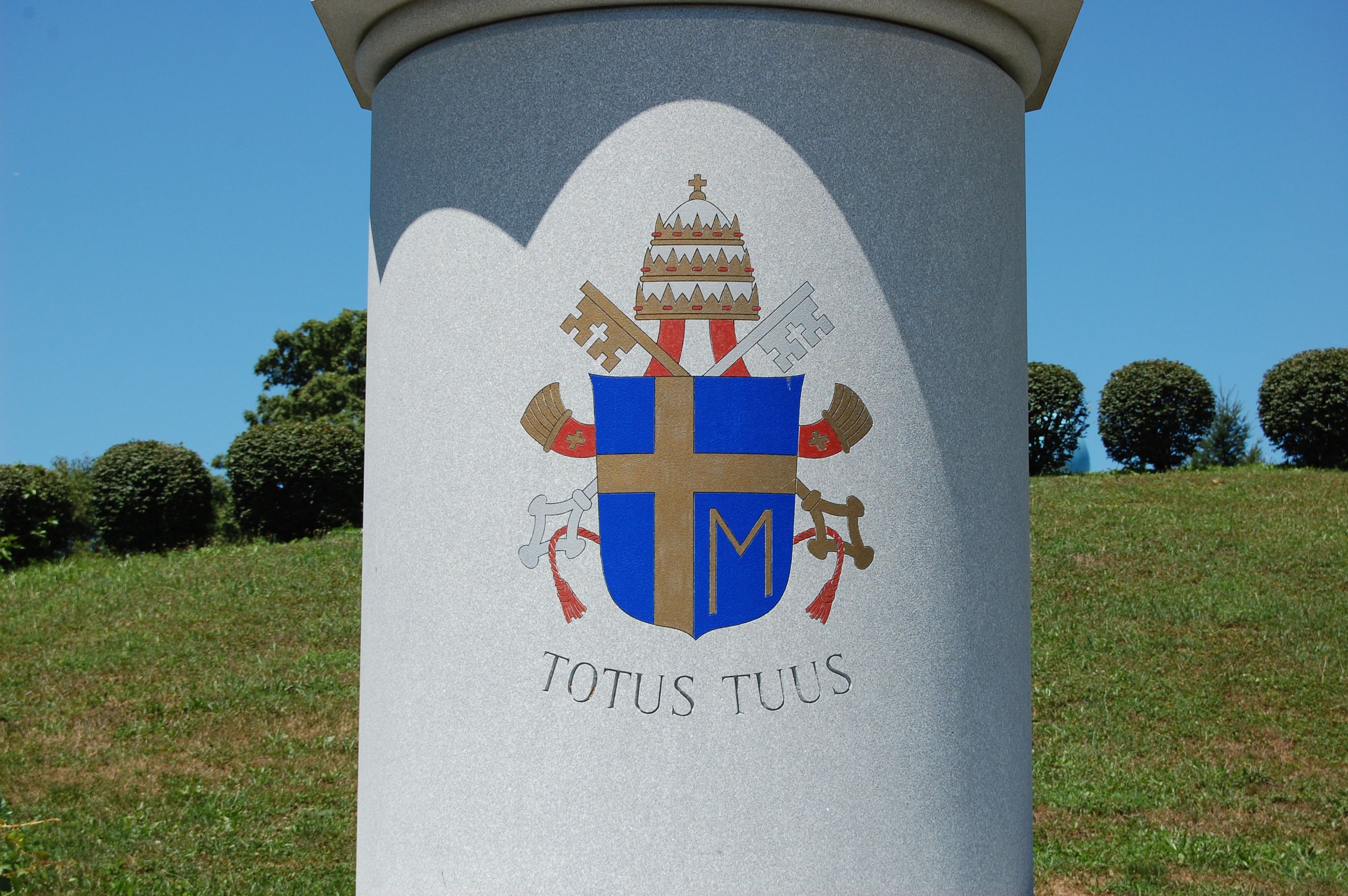
Coat of Arms of Pope John Paul II with the Marian Cross. The Letter M is for Mary, the mother of Jesus, to whom he held strong devotion.

john paul at the door full view

John Paul II created Divine Mercy Sunday which is celebrated on the first Sunday after Easter. It is originally based on the devotion to the Divine Mercy that Saint Faustina Kowalska reported as part of her encounter with Jesus.

St. Faustina Kowalska, a Polish nun reported visions and visitations from Jesus and conversations with Him. She could read souls!

sainte-faustine_int

John Paul II beatified Sr. Maria Faustina Kowalska on April 18, 1993 and canonized her on April 30, 2000.

DSC_0314

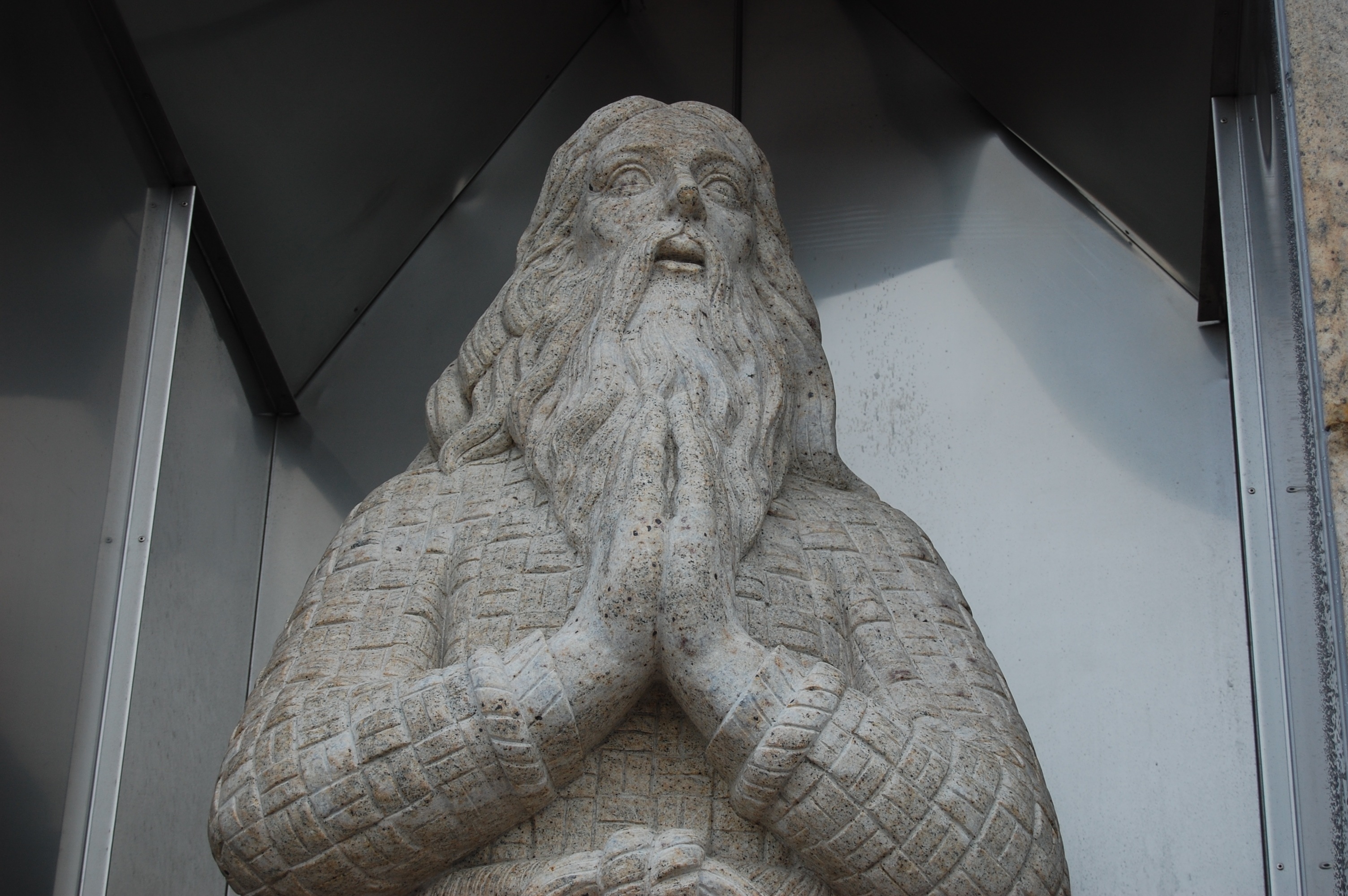
St. Paul the Hermit, a strong influence at the Shrine of Our Lady of Czestochowa.

The Pauline Fathers, like John Paul II, have a strong devotion to the Blessed Virgin Mary. Their main monastery is in Czestochowa, Poland, where they continue to reside. The Pauline Order received permission from the Holy See to establish a monastery in Doylestown, Pennsylvania, and subsequently built Our Lady of Czestochowa Shrine.

upper church 2

In the main church is the Miraculous Icon of Our Lady of Czestochowa, which was blessed by Pope John XXIII on February 10, 1962, who also became a saint. The Icon of Our Lady hangs behind the altar in the main nave and depicts the Holy Trinity. God the Father, with His arms stretched out like the wings of a large bird, enfolds Jesus Christ and all God’s people. Above them is shown a dove, the symbol of the Holy Spirit. Below them, a choir of angels, with their golden horns, extol the glory of God.

chapel of divine mercy
The Chapel of Divine Mercy, within The National Shrine of Our Lady of Czestochowa, Philadelphia Pennsylvania. John Paul II died on the vigil of Divine Mercy Sunday, April 2, 2005.

sign
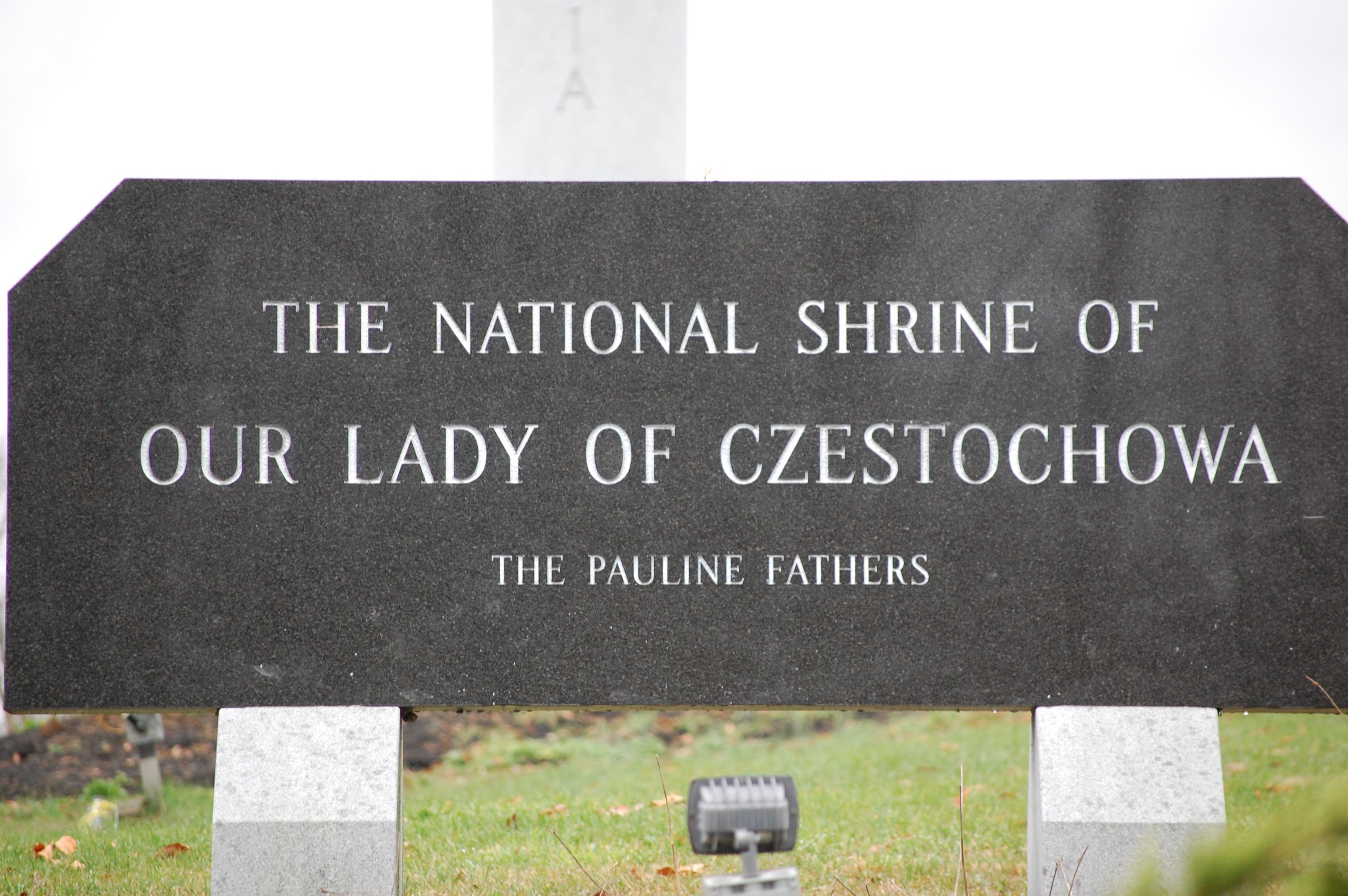
Entrance to the shrine complex.

john paul at the door
Saint John Paul II
Feast day is October 22nd, the anniversary of his inauguration to Pope in 1978.

World Day of the Sick and Our Lady of Lourdes

11 Saturday Feb 2017

Posted by Brian in Saints

≈ 2 Comments

Tags

Our Lady of Lourdes, Saint, Shrine, St. Bernadette, World Day of the Sick

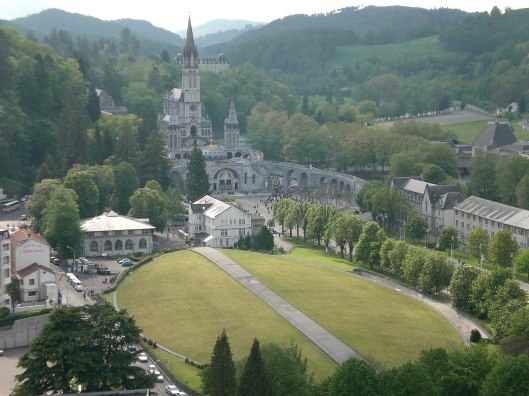
World Day of the Sick feast day on February 11 coincides with Our Lady of Lourdes from the many healings reported at the shrine.

shrine-at-lourdes-2Shrine at Lourdes in France.

our-lady-of-lourds
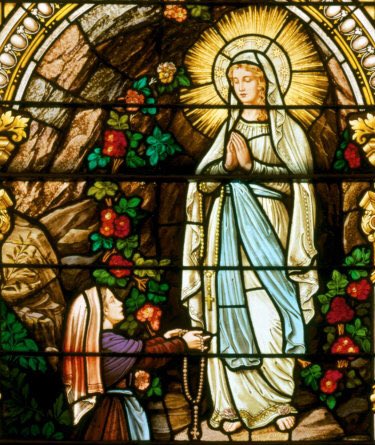
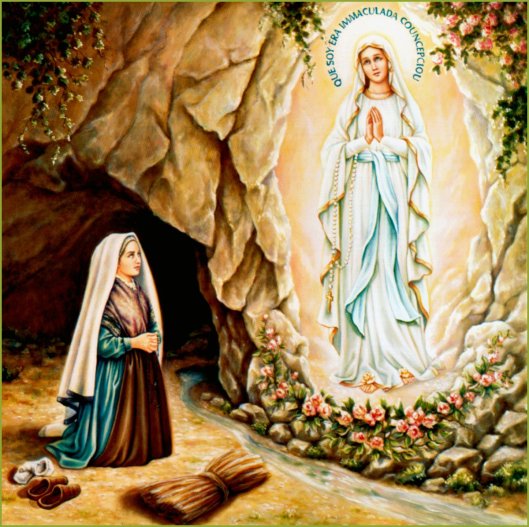
There were eighteen apparitions of the Blessed Virgin Mary to St. Bernadette Soubiroux between February and July 1858.

early-bernadette

A young Bernadette as a French peasant girl. (actual photo)

lourders-2

There was a spring flowing near the grotto where the 9th apparition, where the Lady suggested that Bernadette take a drink. There have been many cures of ailments here, even though Bernadette said there was nothing special in the water, only that it allowed pilgrims to have faith through prayer.

grotto
Grotto with small stream at Lourdes France.

chapel
During the 13th apparition, Bernadette was told to build a chapel at the grotto.
Current chapel built up over the years is now a major pilgrimage destination for Catholics.

actual-photo-of-face-at-time-of-death
close-up-face
body

On left, actual photo of St. Bernadette at passing. On right incorruptible body and her incorruptible face.

pope-benedict-xvi-lourdes-france_large

Pope Bendedict XVI resigned on this date due (February 11) to poor health. Here is Pope Benedicts homily at Lourdes in 2008. Below his prayer at Lourdes ending the homily:

“Because you are the smile of God, the reflection of the light of Christ, the dwelling place of the Holy Spirit,

Because you chose Bernadette in her lowliness, because you are the morning star, the gate of heaven and the first creature to experience the resurrection,

Our Lady of Lourdes, with our brothers and sisters whose hearts and bodies are in pain, we pray to you!” – Pope Benedict

Eastern-Rite Veneration: Mother of God

01 Wednesday Feb 2017

Posted by Brian in Saints

≈ Leave a comment

Tags

Basil Center, Eastern Catholic Church, Mother of God, Theotokos, Ukrainian Catholic Cathedral of Immaculate Conception, Virgin Hodegetria

Special Veneration to Our Mother of God

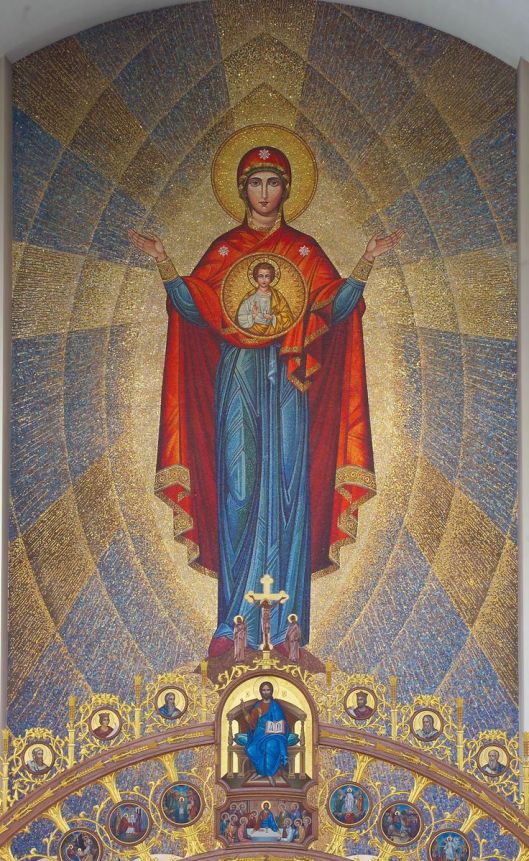
mary at Immaculate concept large He who is mighty has done great things for me, and holy is his name.

Mary with the prophets and Christ Enthroned over the last Supper at the Ukrainian Catholic Cathedral of Immaculate Conception in Philadelphia PA. Photo credit: Cathedral of Immaculate Conception.

The Mother of God has an exalted place of honor in Byzantine devotion. She participates in the very life of God as the human medium, by which God is communicated to man through the Incarnation.

Apocryphal writings of the second century relate that the icon of the Blessed Mother painted by St. Luke was the first icon. – Byzantine Catholic Archaparchy of Pittsburgh.

theotokos basil center
Theotokos or “God bearer” Mary, Mother of God with Jesus. Basil Center, Jenkintown PA.

Icons becomes a “manifestation of divine life” among men, a “transfigured vision” of divine mysteries, and a ”vision of the invisible” (Hebr. 11 :1)

O Mary, conceived without sin, pray for us who have recourse to Thee!

theotokos holy trinity chapel“Theotokos with child. We see the Holy Virgin as a lamp of living light, shining upon those living in darkness” from Mother of God by C. Douchwat. Holy Trinity Chapel.
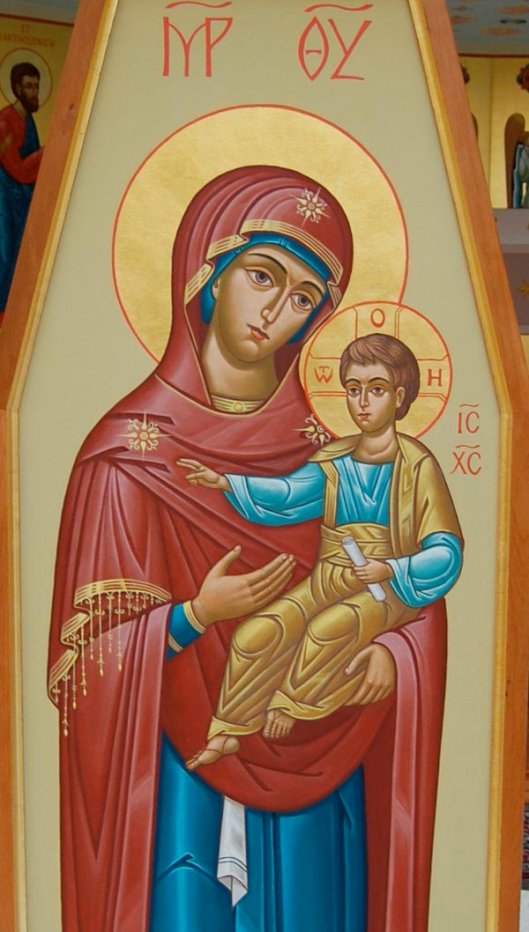
Hail, Mary, full of grace, the Lord is with You. Blessed are You among women and blessed is the fruit of Your womb, Jesus. (13th century)

Holy Mary, Mother of God, pray for us sinners now and at the hour of our death. Amen. (St. Bernardine of Siena added this in 1427)

mary theotokos best htc

Virgin Hodegetria, Mother of God. We magnify you, the true Theotokos, your incorruptibly gave birth to God the Word. Holy Trinity Chapel.

We fly to your patronage, O Holy Mother of God;
despise not our petitions in our necessities,
but deliver us from all dangers, O glorious and blessed Virgin. (3rd century)

Virgin Pammakaristos

Virgin Pammakaristos pointing to Christ Child; mosaic mid 11th century. Patriarchal Church of St. George, Istanbul.

The Virgin is portrayed in the  iconographic type of the Hodegetria and is one of the surviving examples of traditional Byzantine art.

nativity 1

Dormition of the Theotokos, Holy Trinity Chapel.

In the Dormition of the Theotokos,  Jesus is standing in center with a small child representing the Soul of Mary. Holy Trinity Chapel, Basil Center, Jenkintown PA.

When leaving an Eastern Catholic Church, the Dormition of Mary is usually the last icon viewed.

The Feast of the Dormition (falling asleep) is a major feast in the Byzantine Tradition that commemorates the falling asleep ( natural death) of Mary,  Mother of God.

Soul of MARY

Above, a closeup of Dormition of Mary icon, with Jesus holding the Soul of Mary. From Holy Trinity Chapel.

Theotokos, in your death you did not forsake the world. You are the Mother of Life. Pray for us, Mary.

Mother of God Theotokos of Pochayiv
Mother of God Icon at Our Lady of Pochayiv Grotto, Basil Center, Jenkintown, Pennsylvania. Highly venerated icon in the Orthodox Church. Original in Pochayiv Lavra monastery, Ukraine since 1597.

originalpochaev

Original Our Lady of Pochaev icon in Ukraine (1597)

Miracles abound with this icon.

Many of these miracles are the result of the veneration of the icon of Our Lady of Pochaev. It first arrived in the region as a gift of Metropolitan Neophit to Anna Hoyska, an important patron of the Church, in 1559. The icon shows our Lady, wearing a crown, and holding the infant Jesus. In her other hand “she holds the end of her veil.” This being a ‘tenderness’ icon, Jesus and Mary’s face touch, while Jesus gives a blessing with his hand. To Mary’s right are the prophet Elijah and Saint Myrna, while to her left are St. Stephen and the Reverend Abraymey. Mary’s face is described as being “beautiful but sad.” The icon itself is 29 x 23 cm, and made out of red pitched cypress. The origin of the icon remains a mystery. – International Marian Research Institute at University of Dayton

our-lady-of-pochaev-micnicols

Our Lady of Pochaev by William Hart McNichols, recently rewritten from original. Given as a gift to the Russian Orthodox Monastery of Saint Sergius of Rodonezh Lavra in Magadan, Far East, Russia.

Special prayer of the Blessed Mother of Pochaev in a home:

Rejoice, O Glory of the universe.
Rejoice, O Temple of the Lord.
Rejoice, O Mountain overshadowed by the Holy Ghost.
Rejoice, O Refuge of all.
Rejoice, O Golden Candelabrum.
Rejoice, O Honorable Glory of all Christians.
Rejoice, O Mary, Mother of Christ God.
Rejoice, O Paradise.
Rejoice, O Divine Altar.
Rejoice, O Cloud.
Rejoice, O Golden Urn.
Rejoice, O Hope of All.

Byzantine Catholic Devotion: Three Holy Hierarchs

30 Monday Jan 2017

Posted by Brian in Saints

≈ 2 Comments

Tags

Basil Center, Eastern Christianity, St. Basil, St. Gregory the Theologian, St. John Chrysostom, Three Holy Hierarchs

Meet the Three Holy Hierarchs

3HolyHierarchs

The Three Holy Hierarchs. Author unknown.

The Three Holy Hierarchs; St. Basil the Great,  St. John Chrysostom, St. Gregory the Theologian, are giants in Eastern Christianity. St. Gregory the Theologian is known for purity and profundity of his language, St. Basil for his understanding of the Holy Spirit and St. John Chrysostom for his elegant homilies. They all lived in the east, near Cappadocia (Turkey) at the same time in the 4th century.

Folklore has it that each of the three holy Hierarchs appeared in a vision to Saint John Mauropus, the Metropolitan of Euchaïta. “As you see, the three of us are with God and no discord or rivalry divides us…If they (people) honor us thus as being with and in God, we give them our word that we will intercede for their salvation in our common prayer.”

All three Eastern Church Fathers have their feast day in January. In the Roman Catholic west, they are Doctors of the Church. January 30 is feast of the Three Holy Hierarchs.

St. Basil the Great

basil the great HTC

St. Basil the Great, Holy Trinity Chapel, Jenkintown Pennsylvania

St. Basil the Great is a powerhouse in Eastern Christianity. In Basil’s family of ten siblings, five became saints as well as his grandmother, St. Macrina and his mother, St. Emellia.

“Examine the actions of each day, advance in virtue, that you may become a companion of the angels.” – St. Basil the Great (adapted)

Basil went to Egypt and learned from ascetic hermits, who lived in caves, in the monastic way of life.  Basil returned to his home in Cappadocia living as a monk in a small community, dividing his time between prayer, meditation on the bible and manual labor. Basil believed that when one is living with others in a monastery, the grace bestowed on each individual becomes the common possession of the group.

One bit of advice by St. Basil on monasticism that can apply to religious and secular:

Prayers are recited early in morning so your first movements are for God. “I remembered God and was delighted.” Psalm 77

Basil Family basil-mary-macrina-mother-gregory1The Basilian Family (l-r) Basil; Macrina the Younger; Mother of God; Macrina the Elder; Gregory of Nyssa. From St. Basil’s “Pillar of Fire” Faith, The Sisters of the Order of St. Basil the Great. Jesus, Lover of Humanity Province, Love of Knowledge and Wisdom. Basilian Spirituality Center. @basilcenter

An academia priest from Temple University told our congregation that St. Basil created the Glory Be to The Father prayer, one of the most widely said prayers in history. Many people are unaware that Basil created this prayer. More here.

Pope Francis has always identified with Basil’s teachings. St. Basil the Great was quoted by Pope Francis in the LaudatoSi encyclical,“If the world has a beginning … we must inquire who gave it this beginning, who was its Creator”.

basil #LaudatoSi- If the world has a beginning..we must inquire who gave it this beginning, who was its Creator."“Silence is the beginning of purifying the soul.” This Saint Basil the Great icon is an original, written by the famous Georgian iconographer Niko Chocheli from the former Soviet Union, in St. Basil the Great Church Chapel, Kimberton PA.
Basil wrote On The Holy Spirit, defining the Holy Trinity as One God in Three Persons, a complex theology topic even today. #StBasiltheGreat

“It is impossible to recognize Christ, image of the invisible God, unless the Spirit enlightens you.” – St. Basil

Well after his death, the Council of Chalcedon described Basil as “the great Basil, minister of grace who has expounded the truth to the whole earth”, thereby giving him the name Basil the Great!

ephram the poet

St. Ephraim the Syrian was a clairvoyant who actually met St. Basil. In a vision he saw a pillar of flame to heaven and a voice, “Such is the Great Basil!” Ephraim is also “The greatest poet of the patristic age and perhaps the only theologian/poet to rank beside Dante” – per Murray.

“Do nothing at all unless you begin with prayer.”

Here is what St. Basil had to say:

“To you will I pray, O Lord: In the morning you will hear my voice, I will stand before you and will see”

“Intimacy with the Lord is achieved by cheerful readiness to do the will of God.”

“With the words of Scripture we feed our faith, we lift up our hope, we confirm our confidence.”

St. John Chrysostom

St.-John-Chrystostom Haggia Sophia

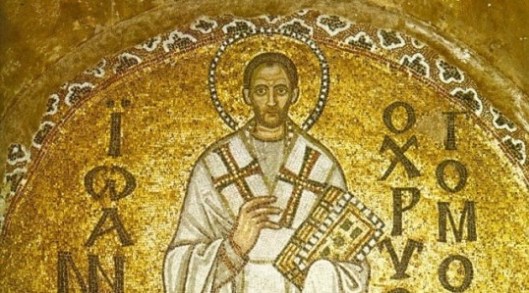
St. John Chrysostom, from Hagia Sophia Turkey

haggue sopia ?

Hagia Sophia

St. John Chrysostom prayers are used extensively in the Eastern Byzantine Catholic and Orthodox churches liturgy, showing the respect he garners. Also, St. Basil’s words are used in the Divine Liturgy ten times throughout the year, but most of the year it is St. John’s.

“I am not worthy Lord, for you to come under my roof, yet you wish to dwell in me” – St. John Chrysostom

St. John took Matthew 8:8 “But the centurion replied to Him, “Lord, I am not worthy to have You come under my roof, but only say the word, and my servant will be healed” and added his own beautiful prayer, “Lord my God, I know that I am not worthy, nor sufficient, that you should come under the roof of the house of my soul, for it is entirely desolate and in ruins, and you do not have a worthy place in me to lay your head. But as you humbled yourself from on high for our sake, do likewise also for my unworthiness.”

East meets West:

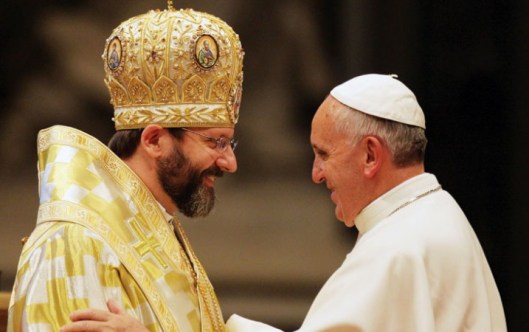
Shevchuk-Francis

His Beatitude Sviatoslav Shevchuk, Major Archbishop of the Ukrainian Greek Catholic Church, meeting with Pope Francis in Rome.

In addition to one of the Three Holy Hierarchs in the east, in the west, St. John Chrysostom is among the 33 “Doctors of the Church,” and remembered especially for his extensive and profound teachings on the subject of the Holy Eucharist. Along with St. Joseph, he was named co-patron of the Second Vatican Council by Pope Saint John XXIII a major event.

“Prayer is a place of refuge for every worry, a foundation for cheerfulness, a source of happiness.” St. John #StJohnChrysostom

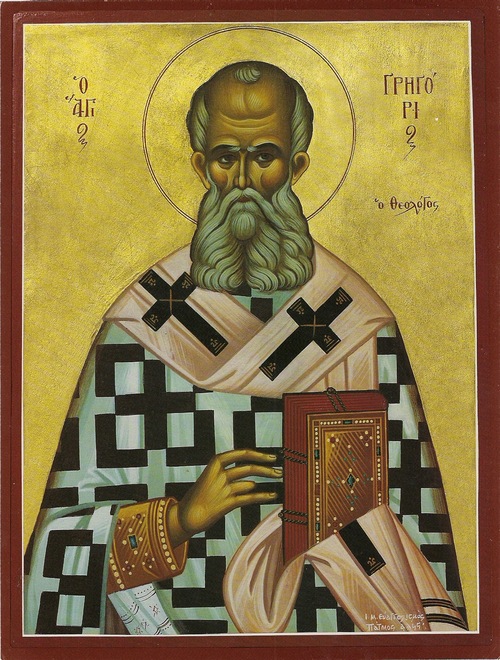
St. Gregory the Theologian

St. Gregory the Theologian

St. Gregory the Theologian

“Let us become like Christ, since Christ became like us. He assumed the worse that He might give us the better; He became poor that we might be rich” – Gregory the Theologian

St. Gregory of Nazianzus, who is called the Theologian, was born in Nazianzus in Cappodocia in 325 A D. He was the Archbishop of Constantinople.

Becoming or imitating Christ is the basis for theosis, an Eastern Christian theology concept.  Saint Peter wrote in the bible that we are called “to become partakers of the Divine nature.” St Basil also described man as the creature who has received the order to become a god.

After his baptism at age 30, Gregory the Theologian joined his friend Basil in a newly founded monastery. He and Basil fought Aryanism, which denied the divine nature of Jesus Christ. They also defined the Trinity in their great sermons. #StGregorytheTheologian

The Three Holy Hierarchs are the great intercessors for us in Heaven.

“Let us become as Christ is, since Christ became as we are; let us become gods for his sake, since he became man for our sake.” – St. Gregory the Theologian


Eastern-Rite Veneration: “Channels of Divine Grace”

26 Thursday Jan 2017

Posted by Brian in Eastern Byzantine Catholic, Saints

≈ 3 Comments

Tags

Holy Trinity, Holy Trinity Chapel, icons, Pantocrator, veneration

Icons: “Channel of Divine Grace”

our lady of the sign

Our Lady of the Sign. “The Lord will give you a sign. The virgin will be with child and give birth to a son. Is 7:14.  Holy Trinity Chapel.

“What the Gospels explains by means of words, the iconographer shows by means of his works.” Saint Basil the Great

Iconography has been used for centuries as a means of communicating theology with the use of images. Especially in the early days of the church, when many could not read, this was extremely beneficial.

Veneration of icons is a common Byzantine practice, respect being paid not to the painting itself but to the person it represents. Some icons are believed to be the means of obtaining miracles, and people pray in front of them for healing or other assistance.

Icons are considered ‘windows into heaven.’

jesus at HTC

Christ the Teacher icon. O God, we pray that the whole creation will in all things be restored to your Son, the King of the Universe. Holy Trinity Chapel.

An image, says St. Thomas Aquinas, connotes three simultaneous qualities: likeness to prototype, derivation from it, and similarity of species with it. Likeness alone is not enough … The underlying idea of the icon is the manifestation of the hidden.

Metropolitan Seraphim explains the role of the icon in prayer this way:

“If you stand before the Redeemer’s icon or that of the Mother of God, stand as if you were before the Lord Jesus Christ Himself or before the Blessed Virgin Mary. Keep your intelligence without any representation, for there is a great difference between standing before the Lord in His very presence and representing Him to the imagination.

In the latter case, attention is not given to prayer directly, but is held by traditional impressions which only skim the surface of our consciousness.”

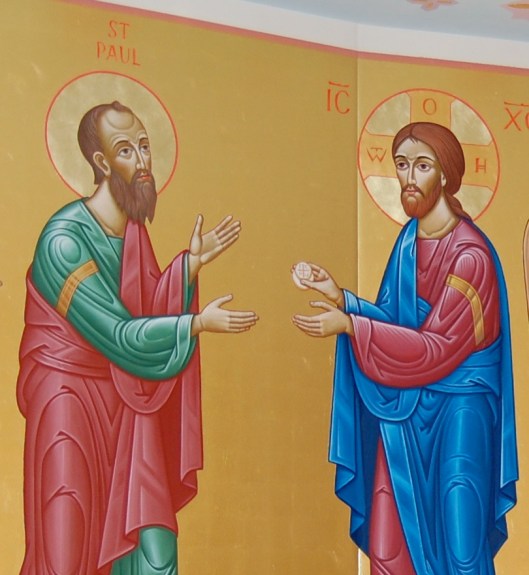
eucharist st paul and JesusThe Eucharist icon. Jesus with St. Paul. Holy Trinity Chapel.
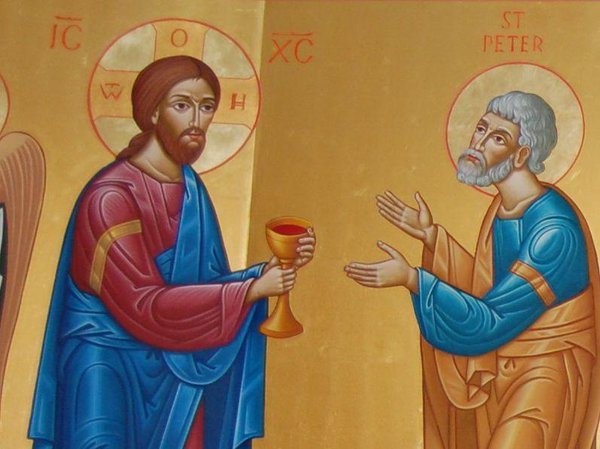
st. peter and jesus HTCEucharist icon. Jesus with St. Peter. Holy Trinity Chapel.
#SaintPeter with Jesus; “But who do you say that I am?” Peter said “You are the Christ, the Son of the living God.”

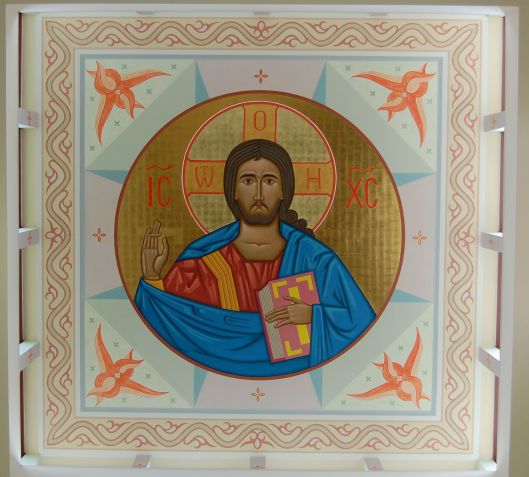
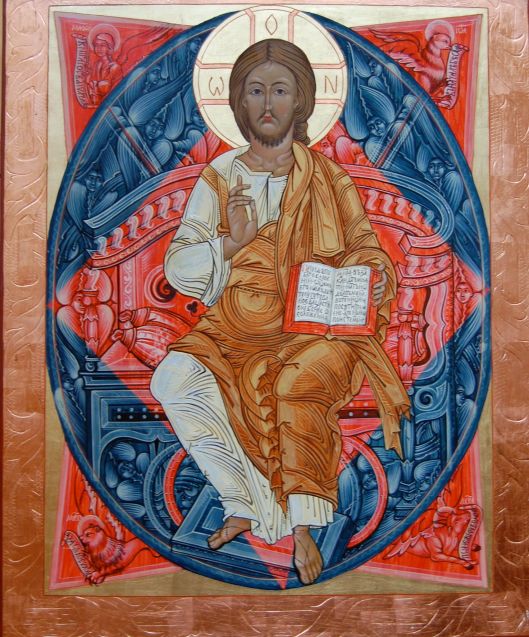
Pantocrator HTC

The Pantocrator, Christ blessing his people with New Testament in left hand. Holy Trinity Chapel.

original Old Trinity

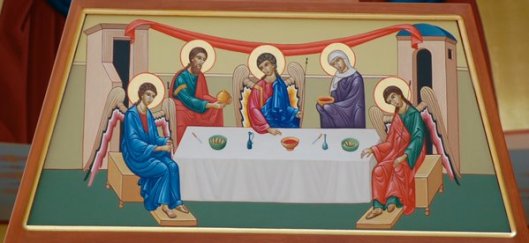
The original Holy Trinity icon written by Russian iconographer Andrei Rublev (b.1360), also called The Hospitality of Abraham and Sarah. One of the most recognizable icons in the world.

The three angels portrayed are sharing together at the table. When a circle is superimposed over the icon, Rublev portrays each figure as equal, no one is more important than the other.

rublev Holy Trinity immaculate conception

“The Holy Trinity” mosaic icon.  Ukrainian Catholic Cathedral of Immaculate Conception in Philadelphia PA. Photo credit: Cathedral of Immaculate Conception

The persons of the Holy Trinity: the Holy Spirit is on the right, the Son in the middle, and the Father on the left.

MACRINA BASILS SISTER htc
Macrina the Younger sister of St. Basil. Holy Trinity Chapel.

In the Life of Macrina, by  St. Gregory of Nyssa, Macrina says “Lord, from your sacrifice, true life begins when present life finishes.” – #MacrinatheYounger

The icon, then, is not only an aesthetical entity. It is the result of the faith and prayer of the Church. It is the life of the Church lived in Christ.

A saving truth is not communicated by the word alone but by the fact of awakening vital forces of life, through the presentation of beauty. Because God loved us, He turned to us a visible face, a human face, in Christ. He turned to us the face of the absolute beauty which is not different from the fullness of God and the fullness of being. The icon carries with it the love of this beauty, and the beauty of this love.

– from Byzantine Daily Worship by Archbishop Joseph Raya & Baron José de Vinck, Alleluia Press, Allendale, NJ. Adapted for use by Father J. Michael Venditti. Eparchy of Passaic NJ.

pantocrator 1

Pantocrator, “Ruler of All” Christ blessing his people located on ceiling of the Holy Trinity Chapel in Jenkintown, Pennsylvania.

“Christ,” says St. Paul, “is the icon of the invisible God” (Col. 2:7).

The icon, therefore, is not a picture. The icon is not a painted representation meant to teach. The icon is a grace and a life. It is a life that penetrates and purifies and elevates. From the icon emanates a virtue that inspires the faithful with hope and gives him consolation.

St. John of Damascus calls it a “channel of divine grace”. In another sense, one can say the icon’s relationship to the faithful is similar, though certainly not equal to, that of Holy Scripture. It may be for this reason that, in the vocabulary of the Byzantine Tradition, an icon is not “painted” but “written.”

– Eparchy of Passaic (NJ)

“Old Testament Trinity” Three angels with Abraham and Sarah. Holy Trinity Chapel.

“Old Testament Trinity” icon is based on Genesis 18:1-15. The story is commonly known as the hospitality of Abraham. When Abraham talks to them, they respond as one (“they said”), the one God in three persons: Father, Son and Holy Spirit.

cappadocian-fathers


Cappadocian Fathers: Basil “the man of action”, Gregory of Nazianzus “the orator” and Gregory of Nyssa “the thinker”.

top of dome pantocrator

The Pantocrator icon written on ceiling of the Cathedral of Immaculate Conception.

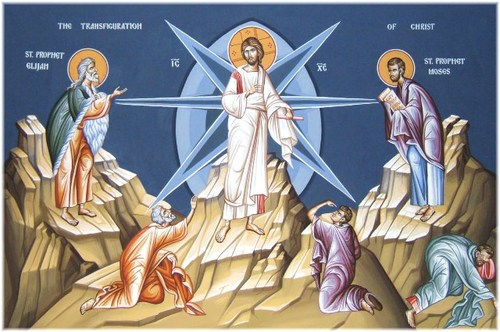
The Transfiguration of our Lord, celebrated August 6

Transfiguration Icon. Here You were transfigured in glory on Mount Tabor, O Christ; You showed Your disciples Your glory.

Icons are “channel of divine grace,”as  St. John of Damascus calls it, next to the scripture, an almost sacramental character.


Architecture of Eastern Christianity

20 Friday Jan 2017

Posted by Brian in Saints

≈ 4 Comments

The Look of an Eastern Christian Church

st. michael 4
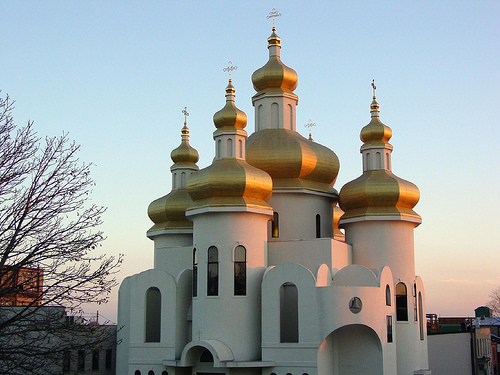
Eastern architecture at St. Michael the Archangel Ukrainian Catholic Church in Baltimore Maryland is easily recognizable with its multiple onion domes.

outside cathedral

Ukrainian Catholic Cathedral of Immaculate Conception in Philadelphia PA with its massive golden dome and new bell tower (on right). The exterior of the cathedral was modeled after the Hagia Sophia in Istanbul, and a stone from the tomb of St. Peter the Apostle was incorporated into the cornerstone. St. John Paul II visited this Cathedral on October 4th, 1979. Photo credit: Cathedral of Immaculate Conception

haggue sopia ?

Hagia Sophia, Istanbul, Turkey

bell tower

Bell Tower outside the Ukrainian Catholic Cathedral of Immaculate Conception.  Photo credit: Cathedral of Immaculate Conception

Orthodox-Church-interior

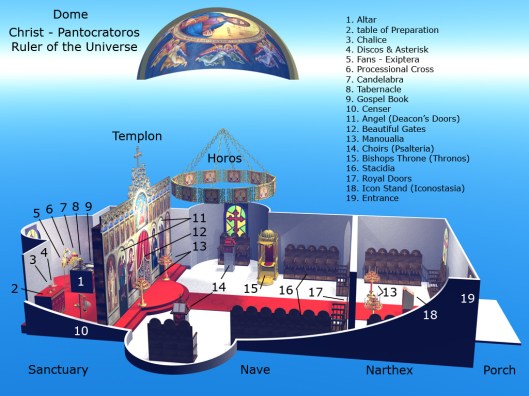
Details of an Eastern Orthodox Church. Note the Templon is also called the Iconostasis.

The Narthex or entrance to the church symbolizes this world, the nave or pews represents the Church. Across the front of the church is the Iconostasis wall that separates the nave or pews from the sanctuary or altar, which symbolizes the Kingdom of God on Earth. No layman is permitted inside the Sanctuary.

overview of immaculate conception cathedralNarthex. Ukrainian Catholic Cathedral of Immaculate Conception, Philadelphia PA. 11/15 Eastern Catholic Church in the Ukrainian Byzantine rite.

On the Holy Table in the Sanctuary are placed the Book of Gospels and the Holy Gifts during the Divine Liturgy, and in the center of the table stands the tabernacle (artopohorion) containing the reserved Eucharist.

dome of cathedral overview photo
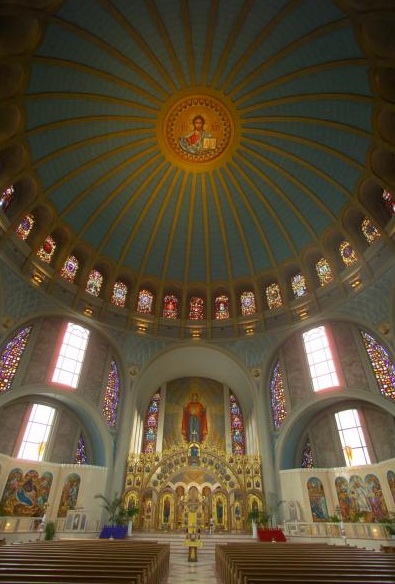
The cupola or inside the dome symbolizes the sky and in an Orthodox tradition, at the top, inside the dome, is Christ the Pantocrator, the Ruler of All. Depicted below him, around the dome, are the central act of worship, the Divine Liturgy; the Twelve Apostles; and major prophets and other figures of the Old Testament.

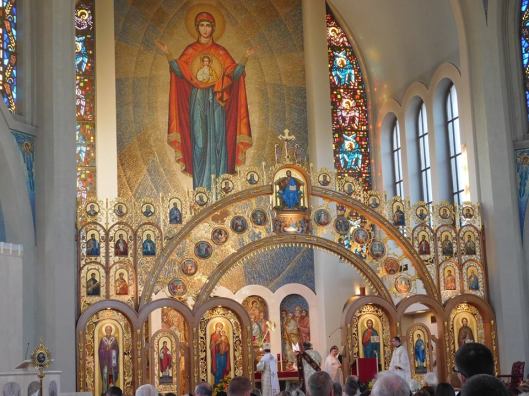
iconostansis cathedralIconostatis at Ukrainian Catholic Cathedral of Immaculate Conception, Philadelphia PA.
The central doors or Royal Doors of the iconostatis are shown open.  The Iconostatis represents the natural boundary between God and man; earth and Heaven.

main door of Iconostasis

The closed Royal Doors of the Cathedral of Immaculate Conception showing the gospel writers flanked by Jesus on the right and Mary with the child Jesus on the left. Only religious walk through these doors.

iconstansis immaculate conceptionPhoto credit: Cathedral of Immaculate Conception
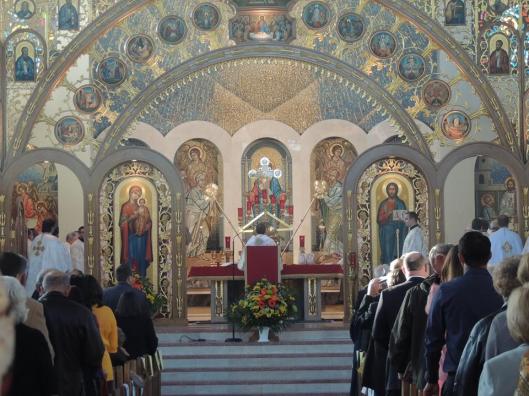
More on the Iconostasis: Next to Mary, the shorter icon is Archangel Michael one one of the side doors or deacon doors. On the far left is St. Nicholas.  Next to the Jesus icon, is also a deacon door shown as St. Stephen and on the far right is St. John the Baptist.

Above are the Great feasts of the Church and the round icons atop the iconostasis are the Old Testament Prophets. The apostles are the rectangular icons. At the center top are the icons of Last Supper and Christ Enthroned.

liturgy behind the iconastastis
Divine liturgy in the sanctuary, behind the Iconostatis as viewed from the narthex. Photo credit: Cathedral of Immaculate Conception

The Divine Liturgy of St. John Chrysostom is the one most commonly celebrated liturgies throughout the year. The longer Liturgy of St. Basil the Great is celebrated ten times a year.
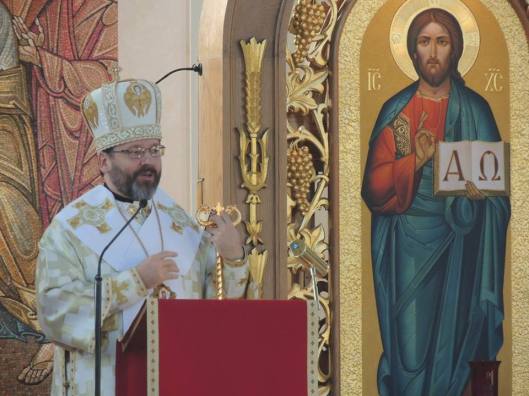
note altar positionHis Beatitude Sviatoslav Shevchuk at the Ukrainian Catholic Cathedral of the Immaculate Conception, Philadelphia, PA celebrating Divine Liturgy on November 15, 2015. He is the Major Archbishop of the Ukrainian Greek Catholic Church. Photo: Cathedral of Immaculate Conception.
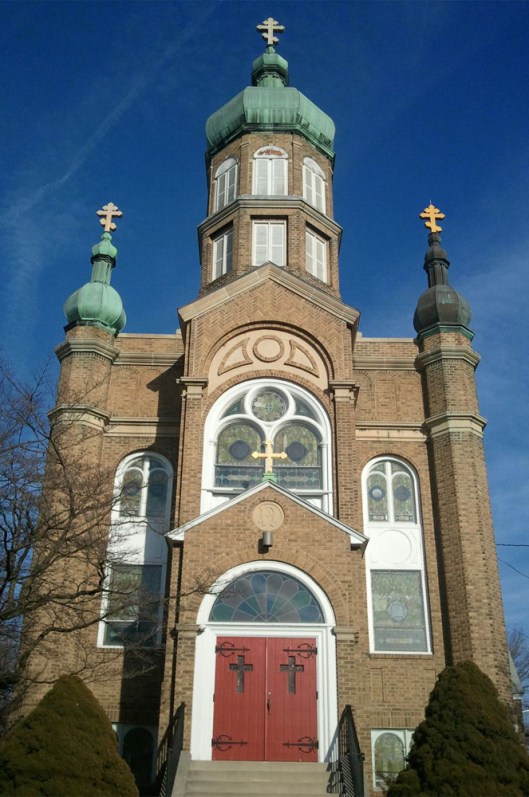
Inside the sanctuary located behind an icon screen, represents Heaven, the dwelling place of God. As shown, the Royal Doors are open showing the altar and tabernacle inside the sanctuary. Note His Beatitude is talking outside the sanctuary, closest to the congregation (representing earth).

Holy Archangel Michael Byzantine Catholic ChurchHoly Archangel Michael Byzantine Catholic Church, Mount Claire PA. In communion with the Bishop of Rome (the Pope). Byzantine Catholic Eparchy of Passaic, NJ. Photo credit: Holy Archangel Michael Byzantine Church.
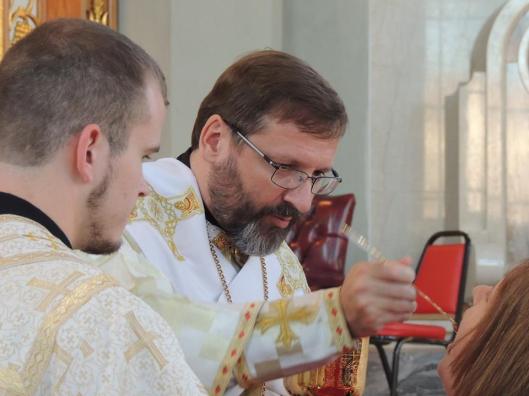
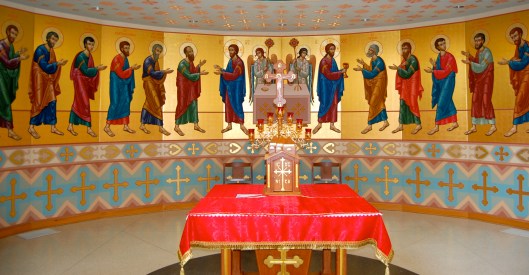
Most of the Eastern Catholic parishes on the east coast of the United States are small parishes with 400-500 parishioners, yet closely knit, vibrant and conveniently located in towns of all sizes. Holy Archangel Michael Byzantine Catholic Church is one of these churches. There are roughly 37 parishes in the Pennsylvania area of the Ruthenian Byzantine Catholic Church and close to 40 parishes in Pennsylvania and New Jersey within the Ukrainian Catholic Archeparchy of Philadelphia.

Catholic priests with bi-ritual faculties, can celebrate the Holy Eucharist in two different traditions: the Divine Liturgy in the Eastern Catholic Byzantine tradition and the Holy Mass in the Roman Catholic Latin tradition. Fr. Mitch Pacwa of EWTN is bi-ritual and Fr. James Badeaux former pastor of Holy Archangel Michael Byzantine Church in Pennsylvania above also has bi-ritual faculties.

Traditions of Eastern Byzantine Catholics

02 Friday Dec 2016

Posted by Brian in Saints

≈ Leave a comment

Receiving the Eucharist in Divine Liturgy

communion 3
Communion served in Eastern Catholic tradition. When receiving the Eucharist in an Eastern Catholic Ruthenian Church, the priest will say your name, and if he doesn’t know it, he will ask your name. The Eucharist is served on a communion spoon. Photo credit: Cathedral of Immaculate Conception.

“I think what people find is a very rich liturgy that’s very focused on the mystical dimension of the Eucharist.” – Father Kevin Kennedy, pastor of Our Lady of Fatima Russian Catholic Church, San Francisco CA.
altar surrounded by apostles
“Truly, I say to you, unless you eat the flesh of the Son of Man and drink his blood, you have no life in you” – Jesus (John 6:53). Altar in sanctuary at Holy Trinity Chapel, Jenkintown, Pennsylvania; surrounded by Jesus, two Archangels and the Apostles.

Pascha Feast Day

resurrection beating death on teh crossThe Resurrection Icon.  Pascha or Easter is the most important feast in the Byzantine liturgical year. It celebrates the resurrection of our Lord and his victory over the power of death. Note: Behind Christ is written: IC XC (Jesus Christ). Holy Trinity Chapel, Jenkintown PA.

More Prominent Eastern Saints

st. andrew
cyril and method

St. Andrew (left) was the first called of the Apostles and brother of Peter and plays an important part in the Byzantine Catholic Church. Saint Andrew is the patron saint of Russia, Ukraine and Scotland. St. Andrew evangelized the region known as Byzantium.

Brothers Saints Cyril and Methodius (rt), “Apostles to the Slavs” (Ukrainian) are the Patron Saints of Europe and play an important part in the founding of the Eastern Byzantine Church. The followers of these Byzantine Greek missionaries converted the Ruthenian people, creating the modern day Ruthenian Byzantine Catholic Church.

There are many eastern saints, some with their feast days are shown in calendar here.

Sign of the Cross

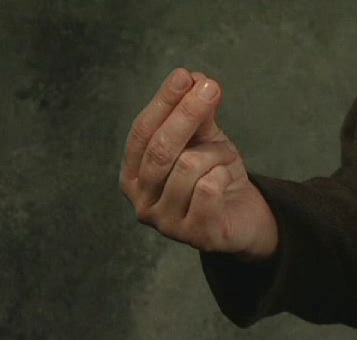
sign of the cross eastern rite

Eastern Orthodox and Eastern Catholics place great emphasis on the sign of the Cross. The Eastern Catholics make the sign of the Cross in the same way as the Orthodox, forehead to chest, then from right to left, with the thumb, index and middle fingers joined in honor of the Trinity. The other two fingers are pressed to the palm, in honor of Christ’s two natures, divine and human, in one Person.

In most parishes, no one will kneel during the sanctification of the gifts. There are other parishes where some will kneel and some will stand. Some parishes have no kneelers in the pews at all. This could be based on the first Christians who stood in the great churches of the time and would read the icons since many did not read or write.

Christmas

NICHOLAS OF MYRA
BIRTH OF CHRIST htc

St. Nicholas of Myra (left) or Holy Father Nicholas plays a prominent role in Eastern Christianity from the Latin Rites.

The famous Icon of the Nativity (right) showing Christ born into a stone coffin, a sarcophagus, a symbol of His death. His mother is lying next to him, dressed in red.

In some Eastern Churches, Christmas is celebrated on January 7th instead of December 25th. This is because Byzantine Catholic churches follow the Julian calendar in which Christmas falls 13 days after that of the Gregorian calendar.

Prophets

The Old Testament prophets play a special role in Eastern Christianity. Their books are read and icons viewed as a critical voice to listeners. Icons share a mystical look into the soul of a prophet. Here are several prophets of distinction:

PROPHETESS ANNA

Prophetess Anna, a seer, speaking with foreknowledge on God’s behalf. “She joyfully told of the child” – Luke. She was very old and spent all her time worshiping God by fasting and praying at the temple. Holy Trinity Chapel.

“Upon seeing the baby Jesus, Anna praised God; in the community seeking deliverance for Jerusalem.”

king david
“Kings of distant lands will come” Psalms 72. King David prophesied foreign kings bringing gifts to the Messiah. #prophet Holy Trinity Chapel.

prophet moses
“A Star Will Come out of Bethlehem” – Numbers 24:17 #ProphetMoses predicts where the Messiah will be born. Holy Trinity Chapel.

prophet Isaiah_(Michelangelo)
Prophet Isaiah (Michaelangelo). Prophet Isaiah foretold: “A virgin shall conceive and bear a son, and they shall call his name Emmanuel.” Isaiah 7:14

st-john-the-baptist-monks-of-tabor

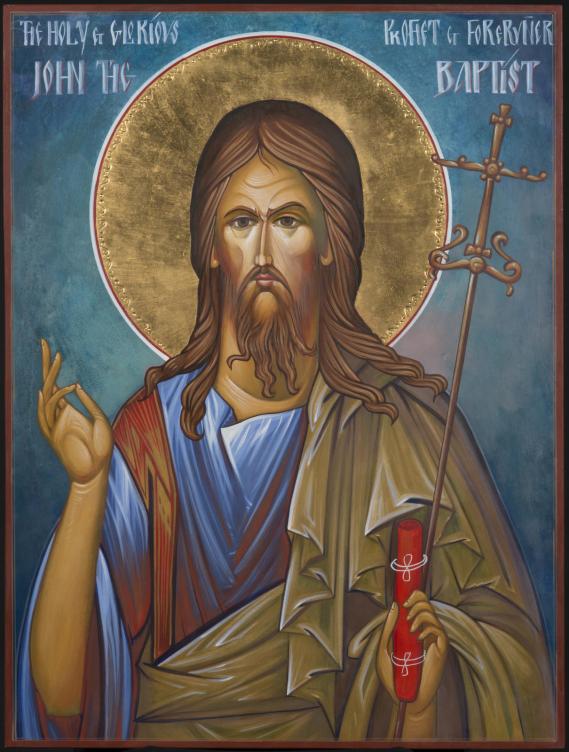
St. John the Baptist icon created by The Monks of Tabor, California.

He laid his hands upon Him as the prophets foretold, showing himself to be the forerunner of the Word of God. Eastern Catholics hold St. John the Baptist in high regard, with multiple feast days throughout the year.

Weekly Cycle of Dedications

From the Weekly Cycle one can see the emphasis on prayer and dedication of Eastern Catholics:
– Sunday dedicated to Christ’s Resurrection
– Monday to Angels and Archangels
– Tuesday to the Prophets
– Wednesday to St. John the Forerunner (Baptist)
– Thursday honors Holy Apostles and Hierarchs
– Friday is The Cross and Crucification
– Saturday to All Saints and Theotokos (Mother of God) and all faithful departed

Angels and Archangels

michael the archangel

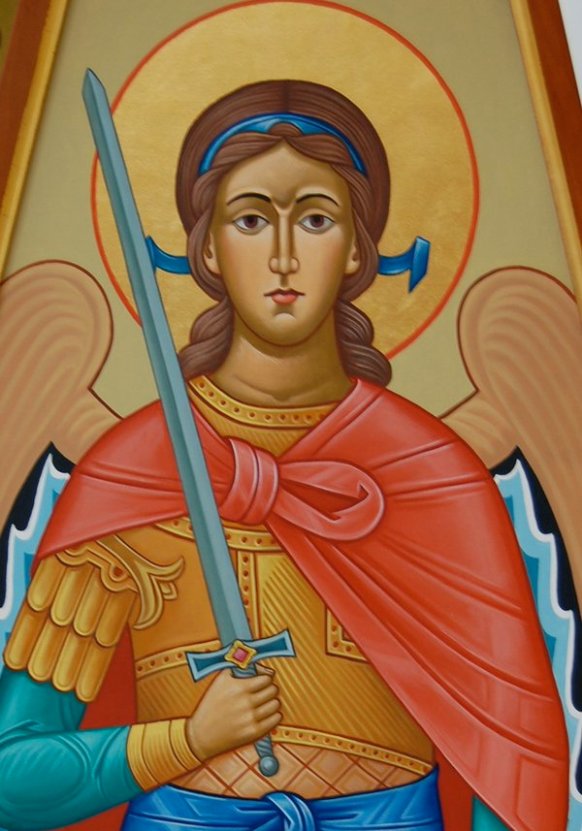
Typically, Mondays dedicated to Angels and Archangels. Icon: Archangel Michael, Holy Trinity Chapel, The Sisters of Saint Basil the Great, Jenkintown, PA. The Sisters who established Manor College in 1947, were founded in the 4th century by Saint Basil the Great and his sister Saint Macrina.

Prayer: Archangel Michael, O leader of the heavenly armies, we beseech you to encircle us with your protection.

“At that time there shall arise Michael, the great prince, guardian of your people.” Daniel 12:1

archangel 2

Icon: Archangel Gabriel at Holy Trinity Chapel.

Archangel Gabriel, watch over us as we bow low, deliver us from trouble, O Prince of the Heavenly Armies.

Gabriel was rapt in amazement, the splendor of her purity, O Mother of God, I am lost – “Hail O Woman full of grace!”

Eastern Catholics and the Pope in Rome

Pope Francis in Philadelphia 2015.
St. Peters Dome designed by Michaelangelo.

Pope Francis in Philadelphia 2015 (lft). St. Peters Dome designed by Michelangelo. (rt)

Eastern Catholics are in union with the Pope in Rome. They share with Roman Catholics the same basic faith and the same mysteries (sacraments) and adhere to the Creed, although the Divine Liturgy follows many of the traditions of the Orthodox churches.

His Beatitude Sviatoslav ShevchukArchbishop Sviatoslav Shevchuk, Patriarch of the Ukrainian Greek Catholic Church.

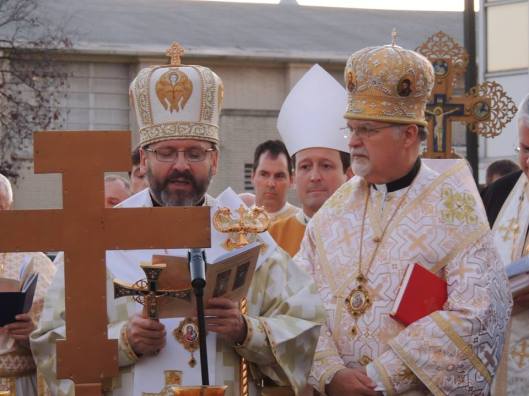
mitresHis Beatitude Sviatoslav Shevchuk on left with the mitre of Eastern Byzantine bishop flanked on left by Archbishop Stefan Soroka of the Ukrainian Catholic Archeparchy of Philadelphia.  Auxiliary Bishop Most Reverend John J. McIntyre (Roman Catholic Church) is in background with the white mitre of the Roman Catholic Auxiliary Bishop. New Church Bell Tower blessing, November 2015. Photo credit: Cathedral of Immaculate Conception.

The Eastern Catholic Church is open to all Roman Catholics as a means to get closer to God. The Divine Liturgy in the Eastern Catholic rite is accepted by Rome and Pope Francis for satisfying Sunday obligation for Roman Catholics.

ukrainian cathedral doors wide open

The Byzantine Catholic door is open to all Catholics, both Byzantine and Roman Catholic rites.  Photo credit: Cathedral of Immaculate Conception in Philadelphia, Pennsylvania.

Music

Incense and music are used throughout an Eastern Christian liturgy service. The epistle reading are sung usually by a cantor from the congregation. The priest can sing the gospel and many parts of the Divine Liturgy.

Byzantine Chant from St. Andrew, Kontakion the Great Canon (in English) by Fr. Apostolos Hill.

Fasting

Fasting is an important discipline in the Christian East. Major portions of the Liturgical cycle are taken up by periods of fasting. In the Byzantine tradition observed by Greek Catholics or Byzantine Catholics (and Orthodox Christians) the Great Lent also known as the Great Fast is a major fast lasting for 40 days.

Attempts at Reunion: Eastern Orthodox with the West

pope and Archbishop of Constantinople

Pope Francis hopes to reunite the Roman Catholic Church with the Eastern Orthodox Church and is seen here with Archbishop of Constantinople,  Patriarch Bartholomew in Rome.

There is a separate dialogue between Pope Francis and the six Oriental Orthodox Churches of the Coptic, Armenian, Syriac, Indian, Ethiopian, and Eritrean tradition. These churches did not accept the council of Chalcedon in 5th century that professed Jesus was one person with two natures, a human and divine.

A meeting in Cuba in February 2016 between Patriarch Kirill of the Russian Orthodox Church and Pope Francis  is the first of its kind in a 1,000 years. In November 2014, Pope Francis told Kirill: “I’ll go wherever you want. You call me and I’ll go.”

popepatriar

Pope Francis and Russian Orthodox Patriarch Kirill exchanged a joint declaration on religious unity at the Jose Marti International airport in Havana Feb. 12, 2016. (Gregorio Borgia / AP)

There have been tensions between the two religions due to the Eastern Catholic resurgence in Russian states. John L Allen perspective:

 Russian Orthodox leaders still routinely exude hostility.

They insist that Eastern Catholic churches, which follow Orthodox traditions but are in communion with the pope, are a Trojan horse to siphon off their faithful. They complain about Catholic encroachment on their “canonical territory” in Ukraine, Belarus, and Russia, although they show no inhibitions about opening up shop in Western Europe and Latin America.

…Roughly half the members of the Russian Orthodox Church are in Ukraine, and if they break away, it would be a major political and financial blow for Moscow.

Many Ukrainians recall the way criticism of the Soviets was stifled in Rome for decades as part of a policy of Ostpolitik, and, to be frank, some see Friday’s joint declaration as cut from the same cloth.

coptic church fromnileCoptic Orthodox Church in Egypt
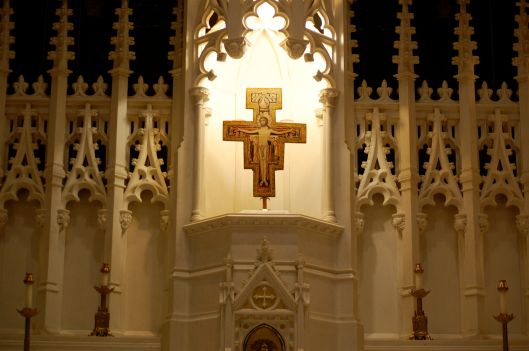
“Christians of the East and West must give common witness so that, strengthened by the Spirit of the risen Christ, they may disseminate the message of salvation to the entire world.” – Pope Francis

Likewise, Saint Pope John Paul II urged that the Catholic Church “breathe with two lungs” — East and West alike — rather than with only one Western, or Latin, lung. He underscored his point in 1985 by naming Saints Cyril and Methodius, whose feast day is celebrated Feb. 14, as co-patrons of Europe alongside St. Benedict of Nursia.

“The goal would be that we could all be celebrating the same Eucharist together and commemorating the pope in Rome and all of the Orthodox vanguards and Catholic bishops together and that we could be what we were for the first thousand years in the history of Christianity, an undivided faith. Different, but in communion with each other” – Fr Kennedy Our Lady of Fatima Russian Catholic Church, San Francisco CA.

When Pope John Paul II met the Catholic Bishops of Ukraine in the year 2001, he used the analogy of two lungs in the human body to represent the Western and Eastern elements of Christianity. Using Pope John Paul II’s analogy, the left lung represents the Latin Rite, and the right lung represents the Eastern Churches. (Note: The Eastern Churches include all of the Eastern Rites in union with Rome, and the separated Orthodox Churches.) Since the Great Schism of 1054, the separation of the Orthodox Churches from Rome has made the Mystical Body of Christ (the Church) breath with one lung for many centuries, instead of two. –  Nicholas Kovacs, O.F.S.

Politics of Unrest

ukrainian martyrs

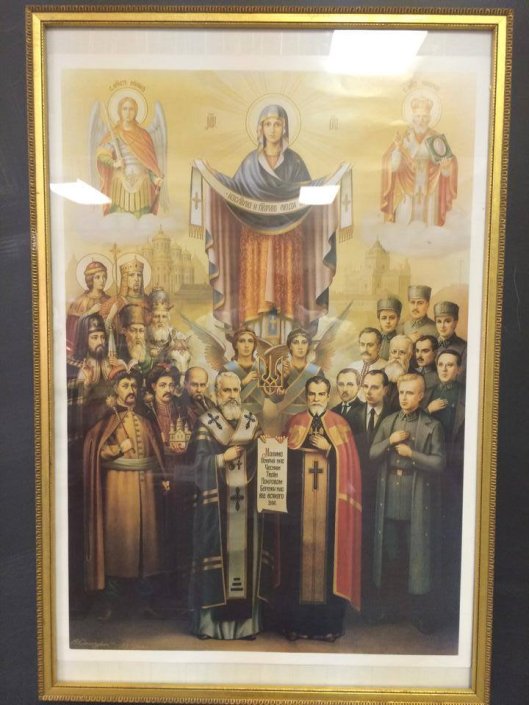
Ukrainian Martyrs: thousands of Eastern Catholics perished under communist rule 1918-1980 from The Treasury of Faith Museum, Philadelphia PA.

Russian rebel occupation in 2014 of Eastern Ukraine and hostilities resulting in 9,500 deaths and 20,000 injuries, as of this writing. It affects Ukraine’s roughly 6 million Ukrainian Greek Catholics and also those in Orthodox Church. We pray that this conflict may come to an end.

St. John Neumann: From Manhattan to Buffalo NY to Philadelphia PA

05 Tuesday Jan 2016

Posted by Brian in Saints, Shrines of Philadelphia, St. John Neumann

≈ 5 Comments

Tags

Buffalo NY, John the Evangelist Church, National Shrine of Saint John Neumann, Philadelphia, Saint, St. John Neumann, St. Peter the Apostle Church, Williamsville NY

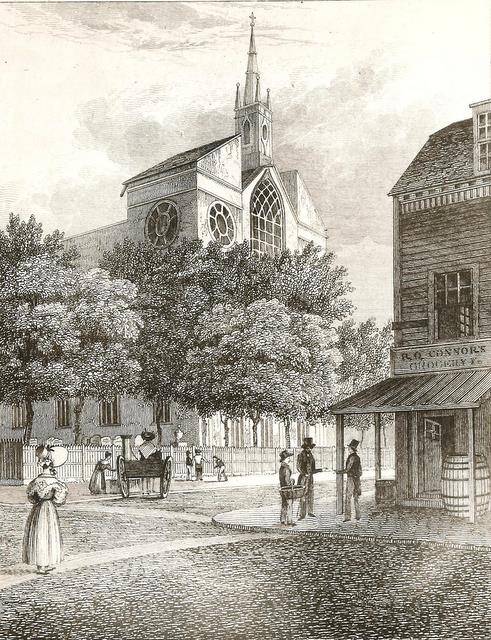
Old_St.Patrick's_Cathedral,_New_York_1815
Old St. Patrick’s Cathedral 1811, Manhattan, NYC

St. John Neumann was ordained in June 1836 at Old St. Patrick’s Cathedral in NYC.

Father Neumann celebrated his First Mass on Sunday, June 26. He wrote home, “Now, my dearest Jesus, I have obtained that for which my soul yearned. What I have always believed so far away, You have now given me.”

Neumann chapel 1833The Neumann Chapel, Buffalo NY.

Just 16 days after his arrival in Manhattan, John was ordained a priest and sent to rural Buffalo.

Father John established himself in a small log parish house. He hardly ever lit a fire and often lived on only bread and water.

st peter and paul williamsville ny
Sts. Peter and Paul Roman Catholic Church, Williamsville NY. (today)

While in Williamsville New York, Father Neumann started the parish of Sts. Peter and Paul, which is in existence today (above). He also taught school four hours a day and used his knowledge of botany to make medicines from local herbs.

Williamsville_Village_sign
Village of Williamsville NY (Buffalo) today, where John Neumann was a priest.

He was assigned to the Buffalo, New York region which was a boomtown in the mid and late 1830s with commerce on the Erie Canal and stagecoach routes.

creek ny_williamsville
Creek in Williamsville NY that John Neumann would have surely saw.

The Sisters of Mercy were instrumental in working with Father Neumann while in the Williamsville New York region.

glen-falls-williamsville-ny-michael-frank-jr
Glenn Falls Creek today, by Michael Frank Jr.

Father Neumann made rounds to attend to the sacramental life of about 400 families. A journal entry shows John’s concern for the German immigrants: “They have not received any schooling. They speak German poorly, and English just as poorly. The will soon have to work, and there will be no thought of religious instruction.” This thinking was the start of the Catholic Parochial school system.

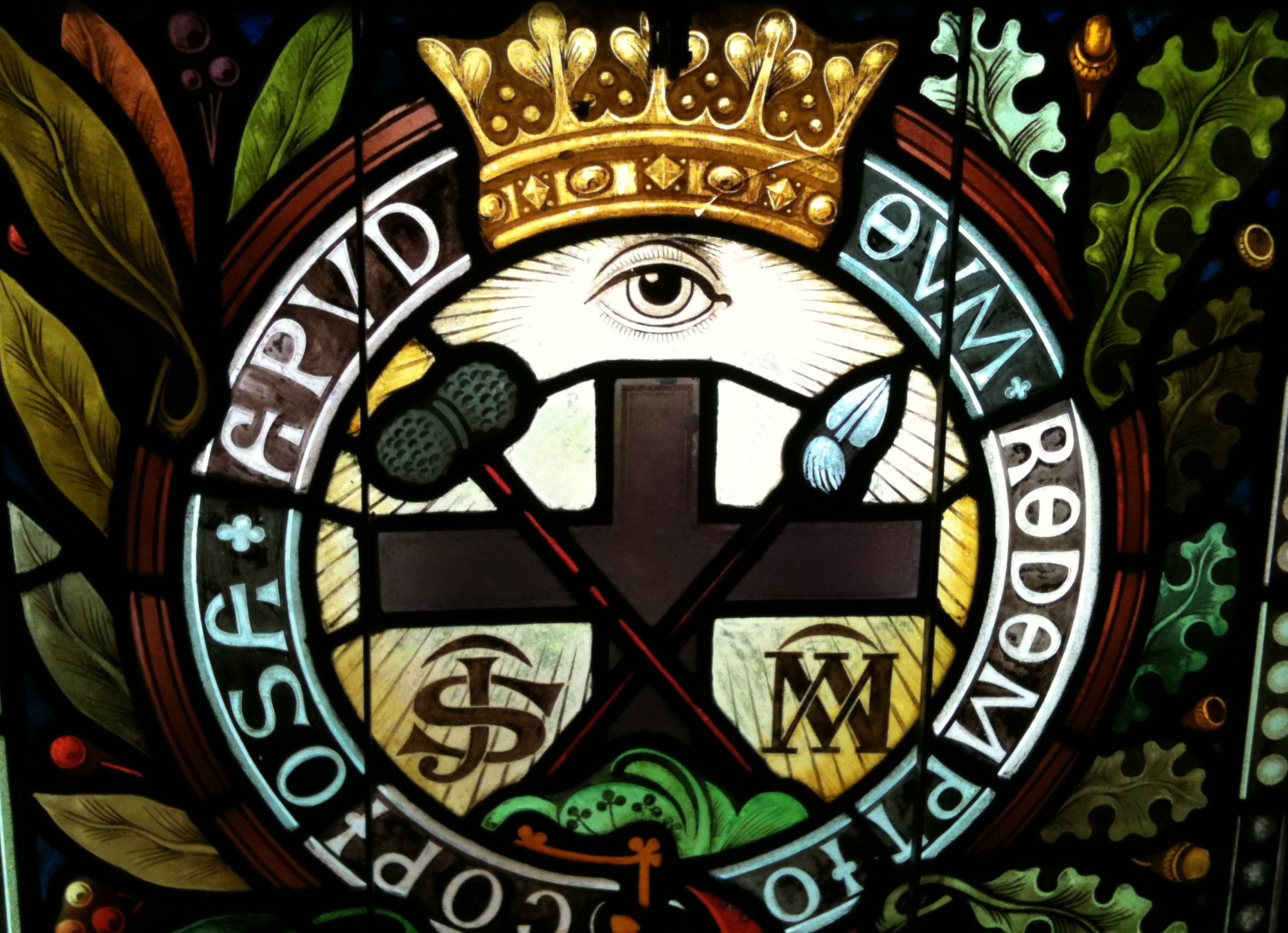
IMG_2305Redemptorist seal at The National Shrine of St. John Neumann, located at St. Peter the Apostle Church in Philadelphia, Pennsylvania.

Father John joined the Redemptorist order and continued his missionary work until he was elected bishop of Philadelphia in 1852. Bishop Neumann was in attendance for Pope Pius IX’s proclamation of the Dogma of the Immaculate Conception.

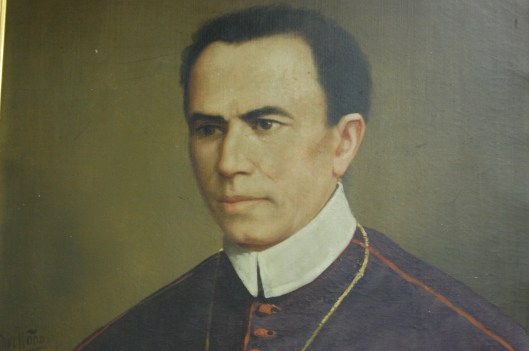
DSC_0183Saint John Nepomucene Neumann.

cross at st john the evangelist at st johns church phila
Cross at St. John the Evangelist Church, Philadelphia,

Bishop Neumann took up residence at St. John the Evangelist parish in downtown Philadelphia.

Also in the 1850’s a young Katharine Drexel received First Holy Communion at St. Johns the Evangelist Church. She later became founder of the Congregation of the Sisters of the Blessed Sacrament, and a saint, St. Katharine Drexel!

DSC_0212Parish of St. Peter the Apostle in Philadelphia. The upper church is where St. John worshiped in Philadelphia.

pulpit used by JN
Pulpit where St. John Neumann preached. Parish of St. Peter the Apostle in Philadelphia.

DSC_0142Lower church is the National Shrine of Saint John Neumann.

Under the altar are the remains of St. John Neumann in a glass reliquary.

DSC_0158St. John Neumann body incorrupt, (face with mask).

Bishop Neumann passed away in Philadelphia while doing errands on January 5, 1860. St. John collapsed and died due to a stroke, a few blocks from Logan Street, where he was building the Basilica of St. Peter and Paul, the regional Church that stands today. He is a patron of immigrants and of sick children.

Memorial of St. John Neumann, Bishop is January 5.

A man must always be ready, for death comes when and where God wills it.

– Saint John Neumann

The Word Became Flesh – God’s Message in the Gospel of John

31 Thursday Dec 2015

Posted by Brian in Saints

≈ 2 Comments

Tags

Bible, God, Gospel of John, religious movies

jesus climbing mountain
Jesus climbing mountain.

“In the beginning was the Word, and the Word was with God, and the Word was God. He was in the beginning with God.” –  John 1:1-4

the word became fleshJesus on mountain from Gospel of John, Lumo Project.
“All things came to be through Him, and without Him, nothing came to be.”

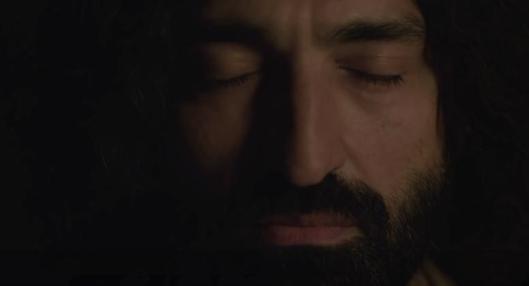
jesus face eyes closedJesus eyes closed from Gospel of John, Lumo Project.
“What came to be through Him was life, and this life was the the light of the human race.”

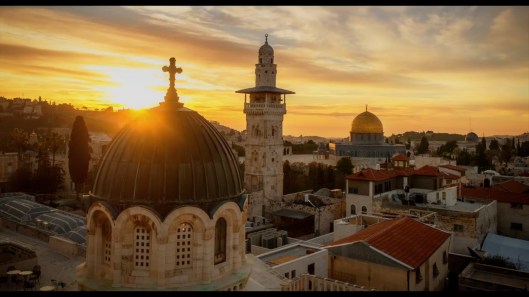
Jerusalem Skyline Photo
Jeruselem.

“The light shines in the darkness, and the darkness has not overcome it.”


In the Beginning was the Word, excerpt from Gospel of John movie, Lumo Project.

Credits:
Above verse: John 1:1-18
Verse in Lumo video: John 1:1-18@lumoproject

John the Baptist with Jesus at the Jordan River, from The Lumo Project

30 Wednesday Dec 2015

Posted by Brian in Saints

≈ 2 Comments

Tags

Baptism, Gospel of John, John the Baptist, religious movies

john the baptist in waterJohn the Baptist in river Jordan, near Bethany.

“A man named John was sent from God. He came for testimony, to testify to the light, so that all might believe through him. He was not the light, but came to testify to the light. The true light, which enlightens everyone, was coming into the world.” – Gospel of John

john the baptist  and JesusJohn the Baptist baptizing Jesus.

The video below with bible verse narrative brings to life the baptism of Jesus by John in a creative interpretive way. This video is an excerpt from the movie Gospel of John by the Lumo Project, not to be confused with another Gospel of John movie widely available on the internet, but not as good.  The entire Lumo version of the movie is available on Netflix and iTunes.

Excerpt from Gospel of John by the Lumo Project.

Looking forward to the next movie in this series, which is the Gospel of Luke, being released in 2016 (Easter).

Video credit – @TheLumoProject

Video Bible verse –  John 1:6-34

← Older posts
Newer posts →
Follow @shrinetower

Enter your email address to follow this blog and receive notifications of new posts by email.

Most Recent Posts

  • Theosis: Becoming Like God — “Be Attentive” to Divine Energy
  • St. Basil the Great, the Jesus Prayer, and the Wisdom of the Three Holy Hierarchs
  • From Elijah to Today: The Legacy of Mount Carmel
  • Celebrating St. Basil: Paths to Divine Union and the Essence of Eastern Christianity
  • J.S. Bach – Christmas Oratorio BWV 248
  • Merry Christmas to all!

Previous Posts

Tags

Eastern Christianity Gregory of Nyssa music Pope Francis Saint saints Shrine St. Basil St. Ignatius of Loyola St. Vincent de Paul

The Cover Art

Jan Van Eyck, “The Adoration of the Lamb” 1432 from the Ghent Alterpiece. Detail: The red altar where the lamb stands reads, “Behold the Lamb of God, which taketh away the sins of the world” and “Jesus the way, the truth, and the life”, both quotes from Gospel of John. In this image and in the book of Revelation the Lamb is Jesus. Directly around the Lamb on the altar are angels who are carrying the instruments in the Passion scenes, like the cross and crown of thorns.

gichontree

Unknown's avatarThere's beauty in sacred spaces; from the stories they tell in architecture, stained glass windows and icons; to the rituals and liturgy that arises our soul. Inside a shrine, the angels and saints praise God with us. I hope to relay the message for the kingdom, power and glory of God, now and forever.

Create a free website or blog at WordPress.com.

Privacy & Cookies: This site uses cookies. By continuing to use this website, you agree to their use.
To find out more, including how to control cookies, see here: Cookie Policy
  • Subscribe Subscribed
    • Shrine Tower
    • Join 76 other subscribers
    • Already have a WordPress.com account? Log in now.
    • Shrine Tower
    • Subscribe Subscribed
    • Sign up
    • Log in
    • Report this content
    • View site in Reader
    • Manage subscriptions
    • Collapse this bar
 

Loading Comments...