• Shrines of Philadelphia
    • St. Katharine Drexel
    • Miraculous Medal
    • St. John Neumann
    • St. Rita of Cascia
    • Our Lady of Czestochowa
    • St. Gianna Molla
  • Sacred Places
  • Art, Film, Poetry
  • Saints
  • Music
  • Services

Shrine Tower

~ Saints, Shrines and Sacred Places

Shrine Tower

Tag Archives: St. Teresa of Avila

Searching for Mt. Carmel

24 Friday Feb 2023

Posted by Brian in Saints

≈ Leave a comment

Tags

Mt. Carmel, St. John of the Cross, St. Teresa of Avila, Teresa of Jesus

The Philadelphia Carmelite Nuns may have left, but the Saints live on. I followed John of the Cross and Teresa of Jesus throughout the Carmelite Monastery asking for directions to reach the summit of Mt. Carmel. Here’s what I found…
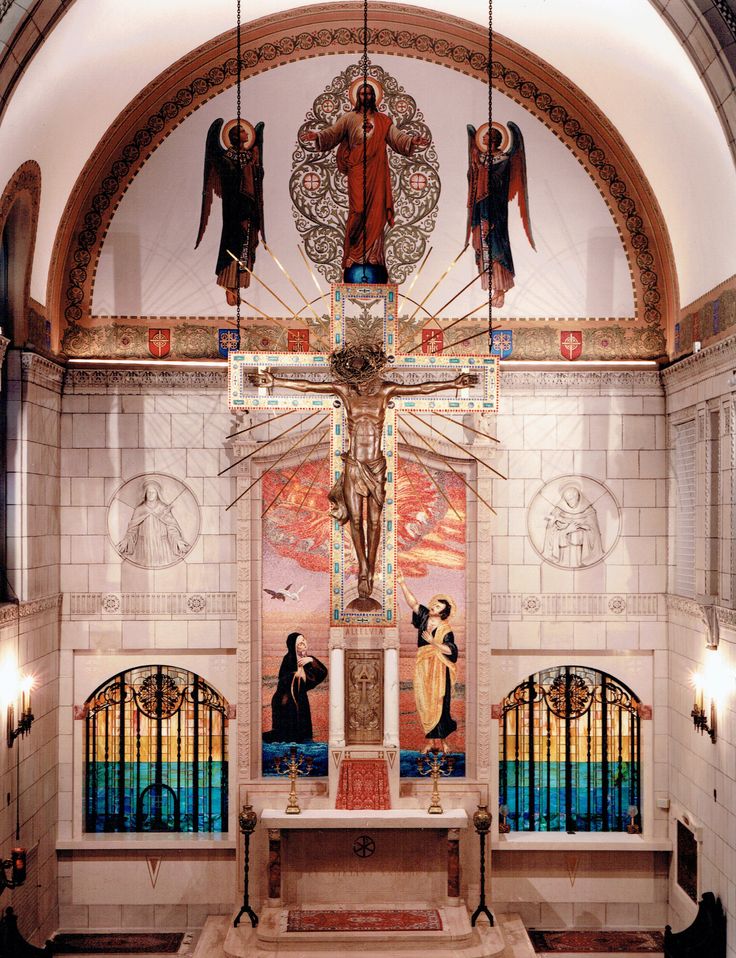
sanctuary Philadelphia CarmelThe Triumphal arch, with crucifix suspended, inspired by the crucifix of Fra Innocenzo de Palerno (1637) in the Church of San Damiano, Assisi. – Philadelphia Carmel

The origins of Triumphal arch comes from the Roman era when captives were led under an arch to symbolize their submission to the authority of Rome. Later centuries the liturgical procession through the triumphal arch symbolizes Christians as captives of Christ are lead to the Kingdom of Heaven. The sacred space of the sanctuary represents the Kingdom of Heaven.
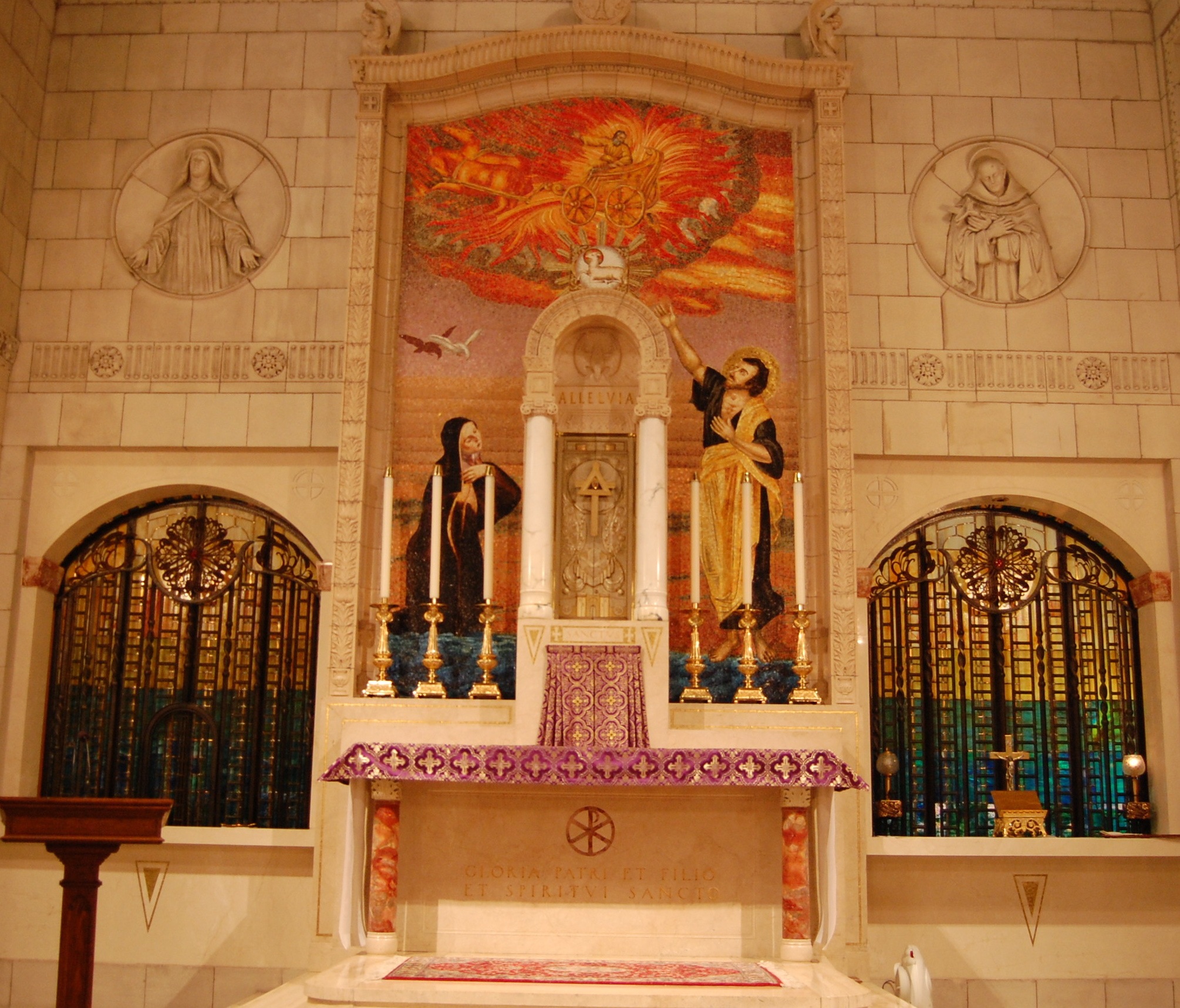
altar best ofThe sanctuary of the Holy Spirit Chapel, Mount Carmel.

The two round medallions are Teresa of Jesus on the left and John of the Cross on the right.

altar mosaic 2The Sanctuary of the Holy Spirit Chapel, Mount Carmel – Detail

From left to right, Teresa of Jesus, the sanctuary doors with Cross, St. Elisha with hand raised to the Lamb of God. At top is the chariot with Elijah. The Holy Spirit is above Teresa in the form of a dove.

The Mosaic (Sanctuary)
The images of the mosaic express the reality of divine love in the charism of Carmel. It is love revealed by God in the Old Testament and fulfilled in the New, a love that en-kindles our hearts and transforms them. Ultimately this transformation enables one to enter, body and soul into full union with God. Horizontal and spatial concepts of the mosaic echo passages of time in the Old and New Testament history of the Carmelite order.

Images and symbols include the following:

Fire and Water
Fire increased its own virtue in the water – Wisdom 19:20

These lamps of fire are living waters of the spirit…although it is fire, it is also water. – St. John of the Cross, The Living Flame of Love Stanza 3, #8

Oh, God help me, what marvels there are in this greater en-kindling of fire by water. The water does not impede the fire though it’s the fire’s contrary, but rather makes its fire increase! St. Teresa of Jesus, The Way of Perfection 19:3

Water
Water symbolizes cleansing as in the river Jordan; baptism, blessing, grace, prayer and contemplation. – St. Teresa of Jesus, Life 11:7

Fire
Fire symbolizes divine love. – St John of the Cross, Spiritual Canticle 39:14, St. Teresa of Jesus Life 30:20

Chariot of Fire

in Christian art, St. Elijah carried into heaven in a chariot of fire is a symbol of Christ’s Ascension. In the Dialogue of St. Catherine of Siena, Christ himself is referred to by the Father as a fiery chariot.Prophet Elijah in chariot
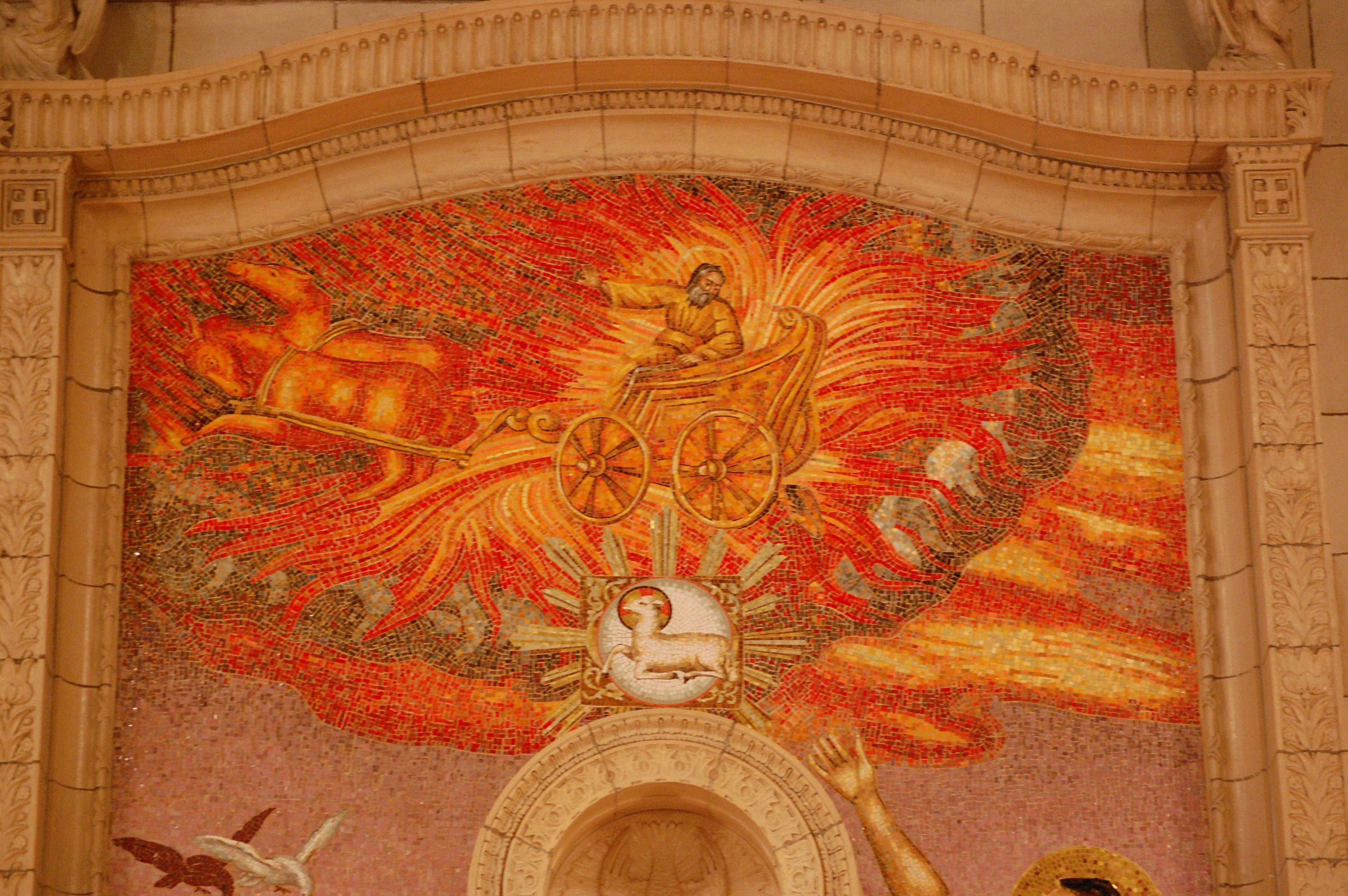
St. Elijah (c 870 BC) (in chariot)

Elijah the Prophet is called the founder of the Carmelite ideal. There are two accounts of him being taken up to heaven in a fiery chariot 2 Kings 2:1-12 and Sirach 48:9. His feast is celebrated by the Carmelite Order on July 20.

The Holy Spirit (Dove)
The Holy Spirit is the third Person of the Blessed Trinity, the Sanctifier, the living Flame of Love. – Romans 5:5

St. Teresa of Jesus
St.Teresa of Jesus (1515-1582), the foundress of the reformed Carmel (Discalced Carmelites) is portrayed in Eucharistic Adoration. In her spiritual writings one finds frequent images of fire and water.

The Lamb of God and the Eucharist
Fulfillment is found in Christ, the Alpha and Omega, the sacrificial lamb of god, who gave himself for the life of the world. His sacrifice is perpetuated in the Eucharist. From this divine reality the graces symbolized by the fire and the water are sought and obtained. Mt. 26;26-29; 1 John 5:6-8; Rev:5:6-14

Elisha and Teresa reaching
St. Elisha (hand raised)

St. Elisha (c. 840 BC) was the first disciple of St. Elijah. He was the leader of the prophets on Mt. Carmel.  The Carmelite order celebrates his memory on June 14.

Between Elisha and Teresa of Jesus, with the arrow pointing up, are the sanctuary doors. A schematic of the Sanctuary Doors is below.

repository doors sketch
The symbols that are employed on these bronze doors show St. Teresa’s image of the Interior Castle. They are:

Door
“The door of entry to this castle is prayer and reflection.” – St. Teresa of Jesus, Interior Castle I:i,#7

Castle
The castle is the image of the soul: We consider our soul to be like a castle made entirely out of a diamond or of a very clear crystal in which there are many rooms, just as in heaven there are many dwelling places. – St. Teresa of Jesus, Interior Castle

The soul of the just person is nothing else than a paradise where the Lord says He finds His delight. I do not find anything comparable to the magnificent beauty of a soul and its marvelous capacity. – St. Teresa of Jesus, Interior Castle I:i, #1

Triangle
The triangle is the symbol of the Most Holy Trinity dwelling in the center of the soul.

Cross
The Cross is the symbol of the Paschal Mystery of Christ’s passion, Death and Resurrection.

Blood and Water
Blood and water flowed out of our Redeemer on the Cross. The Fathers and Doctors of the Church interpret this to mean that from the pierced Heart of the Son, God the Father pours out through the Holy Spirit, the saving graces of the Church’s Sacraments.

“One of the soldiers pierced His side with a lance and immediately there came out blood and water. – John 19:37

Jesus Christ who came by water and blood, not with water only, but with water and blood. – 1 John 5:6

He loves us and has washed away his own sins in His own Blood… Rev1:5

Then the angel showed me the river of life, rising from the throne of God and of the Lamb and flowing crystal clear down the middle of the city street. Rev 22:1-2

Center Room of the Castle
The castle has many dwelling places. Located at the center, is the abode of the most Blessed Trinity: the Father, the Son, and the Holy Spirit. It is here, in intimacy, that sweet exchanges of love occur between God and the soul. Mysteries of the Holy Trinity are made manifest and the soul comes to understand the Gospel passage:

If anyone loves me he will keep my word,
and my Father will love him,
and we shall come to him
and make out home with him. – John 14:23

Shell
The shell is a symbol of Baptism, the sacrament of initiation to the divine life.

our lady w spirit 14
Blessed Virgin Mary, dwelling with the Holy Trinity in the most profound union, supreme above all creatures, beloved Daughter of the Father, mother of the Son, Spouse of the Holy Spirit Mediatrix of all Graces.
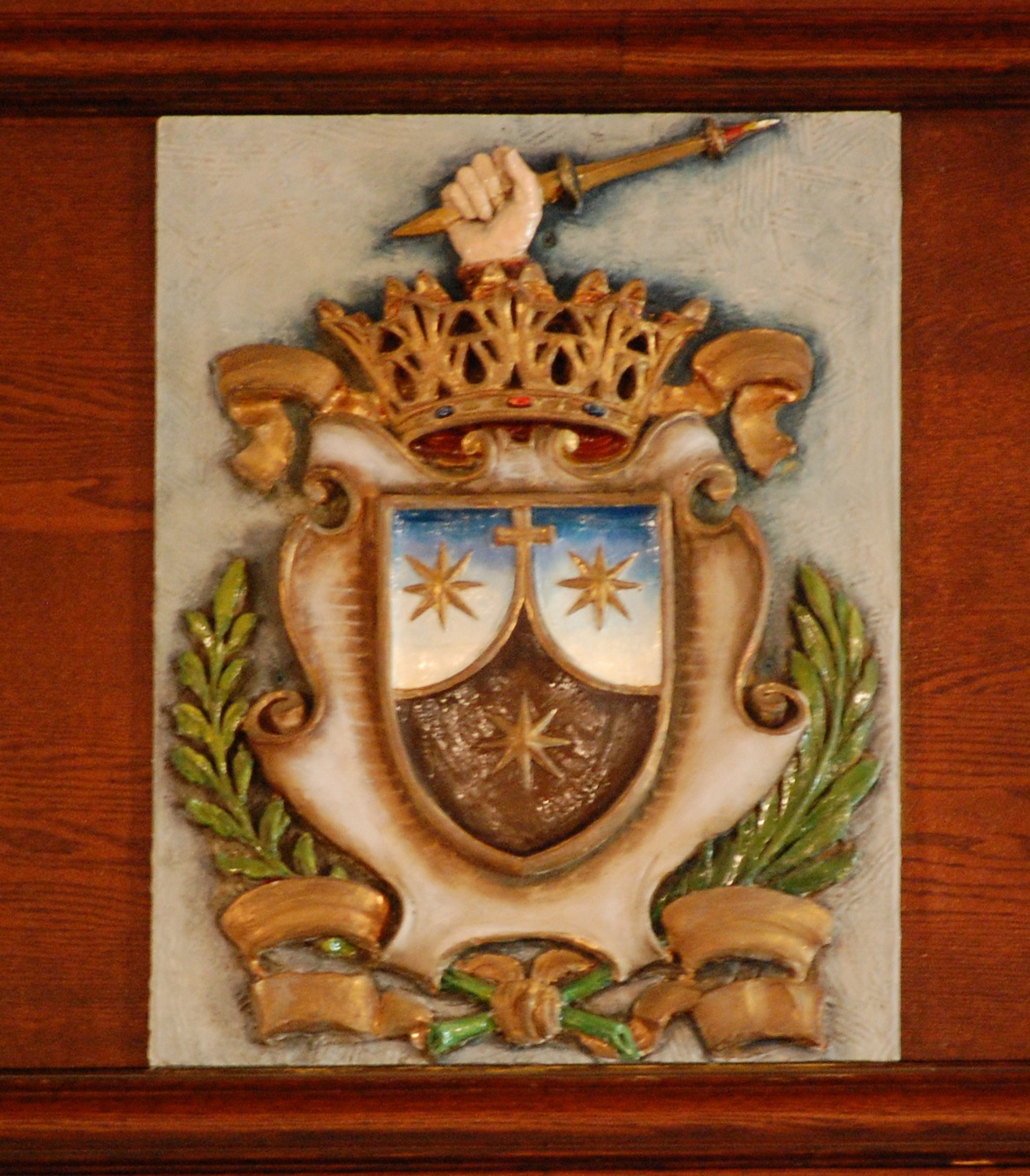
Carmelite coat of arms

Discalced Carmelite Order (OCD) Coat of Arms plaque.

Located on balcony front, near organ of the Holy Spirit Chapel, Philadelphia Carmel.

Seal of Mount Carmel

In the center of the seal is Mount Carmel, cradle of the Carmelite Order, and the star in the mountain refers to the Our Lady of Mount Carmel. The two stars above are the prophets Elijah and Elisha.

Mount Carmel is the Carmelite’s place of origin located in modern day Haifa, Israel. In the 9th century BC the prophet Elijah lived there and had a profound experience of God. In that same place in the early 12th century some hermits, inspired by the memory of Elijah, gathered there, with a desire “to live a life of allegiance to Jesus Christ” (Rule of St. Albert).

Revealing the Mystical; St. Teresa of Avila’s Interior Castle

15 Saturday Oct 2022

Posted by Brian in eBooks, Saints

≈ 4 Comments

Tags

Interior Castle, mysticism, St. Teresa of Avila

A Mystical Saint Talks

One tends to reminisce about our own spiritual experiences while reading the Interior Castle and which of the seven mansions described by St. Teresa we may have visited. The book, Interior Castle, is ranked among the top 25 of all time Catholic books. It’s an eerie read. Like any good writer, the Saint appears to talk directly to us, giving little indication of the life or working atmosphere of 16th century Europe from which it was created. It appears relevant today in 2022 as it did in 1577 when the book was released.

an-interior-castle-from-my-viewpointAn impression of a convent or castle in St. Teresa’s time. October 15, 2022 is St. Teresa of Avila feast day.

Several insights on The Interior Castle:

We are within Him.

St. Teresa says that “God is a very large and beautiful mansion” and since we reside in the mansion any sins we commit are “done in the palace itself, inside God”.

We are inside God’s mansion. This requires meditation to fully understand. Perhaps this is why the book is at times difficult to read, requiring re-reads to fully grasp the message.

God suffers from our misdeeds since we are “his creatures within Himself” (6th mansion.)  A simple eye opening concept.

scene-dark-night

A mystic writes to us in the future.

More favours hurts.

God gives us “favours” and the more favors we receive, the pain of receiving a favour increases, since we learn more about His greatness, yet we are “being so far and unable to enjoy Him”. This painful desire within the soul, who wants more favours. Yet receiving the favours is not up to us. The soul enjoys the “great delight” at being near to God, but its God who chooses the soul.

teresa_lazzarini

St. Teresa of Avila by Lazzarni.

St. Teresa compares the soul as blind and dumb like St. Peter at his conversion (Acts 9:8), preventing him from having any sense of where or how the favour came.

the-original-autograph-of-the-interior-castle-preserved-in-the-carmelite-monastery-at-seville

Original manuscript, Interior Castle by St. Teresa of Avila. (Avila, Spain)

Seeing the Trinity.

“God removes the scales from the eyes of the soul” and reveals the Holy Trinity in all three persons. She saw these three persons and suggests we can too;  one of Substance and one of Power and one of Knowledge; all God alone.

“So what we hold by faith the soul grasps by sight, but nothing seen by the eyes; it’s felt by the body or the soul.”

The Trinity, one of the biggest mysteries of the faith, is explained in the book. This is mind boggling!

cell-of-teresa-of-avila-1

Monestary cell of Saint Teresa.

Understanding the Trinity.

The Saint says, “All three Persons communicate Themselves to the soul and speaking to the soul and explaining to it those words which the Gospel attributes to the Lord, namely, that He and the Father and the Holy Spirit will come to dwell in a soul which loves Him and keeps His commandments.”

She references  the Gospel as a means to understand the Trinity, which is probably a good tip.

the-interior-castle

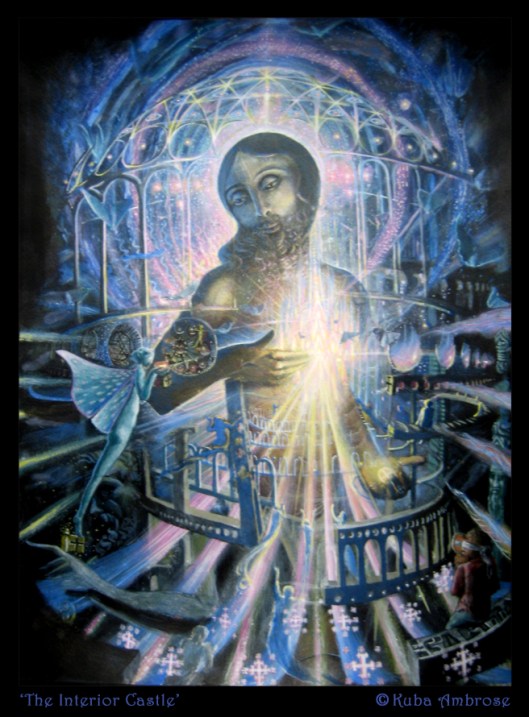
Artist Kuba Ambrose’s The Interior Castle was inspired by the Saint’s book. Used by permission.

Heaven observation.

“Our Lord brings the soul into this Mansion (7th) of His, which is the center of the soul itself, for they say the empyrean heaven, where Our Lord is, does not move like the other heavens.” Praise his name and “make every effort to serve a Lord who will give us a reward in Heaven.”

I’ve read about these multiple Heavens before, possibly it was in the Gospel, the Book of Revelations. This needs more investigation.

What if we, individually, captured all the questions that puzzle us in our life; in this world; in nature; and document it, to be answered in Heaven, as our reward for getting there. Like, what causes cancer, what miracles weren’t recorded, how close were we to death. More later…

teresa-of-avila-stature
St. Teresa of Avila also know as St. Teresa de Jesus. She wrote the Interior Castles under God’s direction and her superiors when she was 62 years old.

A Mystic Poet as well

Poetry is another way to explain mysticism. Here is St. Teresa’s most famous poem written after coming out of the ecstasy at Salamanca. There are several translations, this one by Megan Don.

I Live Without Living In Me

by Teresa of Avila

English version by Megan Don
Original Language Spanish

I live without living in me,
and I expect a life so high,
that I die because I do not die.

I live already beside myself
since I am dying of love;
because I live in Him,
who wanted me for Himself:
when I gave my heart to Him
He placed this sign in it,
that I die because I do not die.

This divine prison,
the love in which I’m living,
has made God my captive,
and my heart free;
causing in me such passion,
to see God, my prisoner,
That I die because I do not die.

Oh, how long is this life!
How hard this exile,
this prison, these chains
which my soul has entered!
Just waiting to get free
causes me so much fierce pain,
that I die because I do not die.

Ah! so much bitterness in this life
without God as my lover!
Because if to be in love is sweet,
to wait so long is not:
take this burden God,
heavier than steel,
that I die because I do not die.

Trusting in You alone, I only live
because I know I’ll die
because in death I know
that I will live;
death, where I’ll find life
do not be slow, it is you I wait for,
that I die because I do not die.

You see how strong love is;
life, do not hinder me,
you see, all I need do to gain you
is to lose you.
Come on already sweet death
come quickly death
that I die because I do not die.

That life above,
that is the true life,
until this life dies
nothing can be enjoyed in living
death, don’t be coy;
let me live by dying first,
that I die because I do not die.

Life, what can I give
to my God who lives in me?
In losing you,
then I am worthy of gaining Him.
I want to reach Him by dying,
Since I love my lover so,
that I die because I do not die.

avila-castles
Avila, Spain. Home of St. Teresa of Avila

References:

The blog, Teresa of Avila Turns 500 discusses the topic We are within Him in the post “God’s Presence: Part Two”. This blog, several years in the making, is a structured study of the book, helpful for anyone interested in gaining insights and understanding the depth at which St. Teresa describes her experiences, influenced directly from God.

The audio book of The Interior Castle is here.

The ebook of The Interior Castle is here.

Follow @shrinetower

Enter your email address to follow this blog and receive notifications of new posts by email.

Most Recent Posts

  • St. Basil the Great, the Jesus Prayer, and the Wisdom of the Three Holy Hierarchs
  • From Elijah to Today: The Legacy of Mount Carmel
  • Celebrating St. Basil: Paths to Divine Union and the Essence of Eastern Christianity
  • J.S. Bach – Christmas Oratorio BWV 248
  • Merry Christmas to all!
  • Feast of The Exaltation of the Holy Cross

Previous Posts

Tags

Eastern Christianity Gregory of Nyssa music Pope Francis Saint saints Shrine St. Basil St. Ignatius of Loyola St. Vincent de Paul

The Cover Art

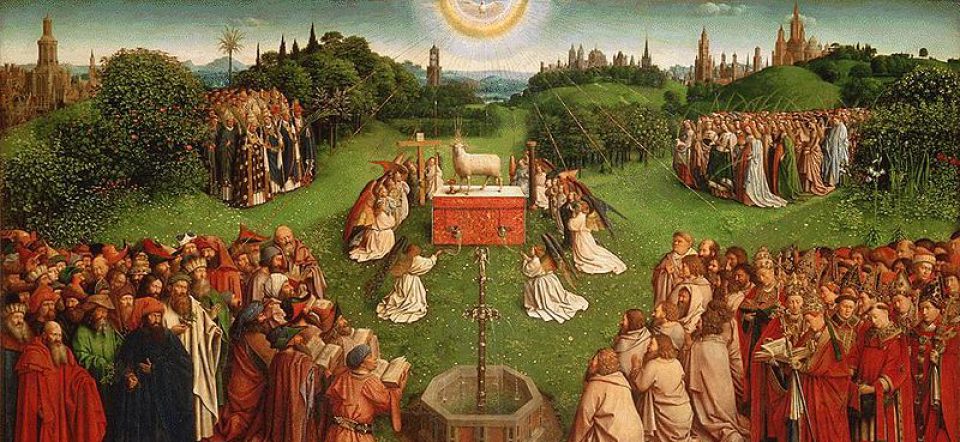
Jan Van Eyck, “The Adoration of the Lamb” 1432 from the Ghent Alterpiece. Detail: The red altar where the lamb stands reads, “Behold the Lamb of God, which taketh away the sins of the world” and “Jesus the way, the truth, and the life”, both quotes from Gospel of John. In this image and in the book of Revelation the Lamb is Jesus. Directly around the Lamb on the altar are angels who are carrying the instruments in the Passion scenes, like the cross and crown of thorns.

gichontree

Unknown's avatarThere's beauty in sacred spaces; from the stories they tell in architecture, stained glass windows and icons; to the rituals and liturgy that arises our soul. Inside a shrine, the angels and saints praise God with us. I hope to relay the message for the kingdom, power and glory of God, now and forever.

Blog at WordPress.com.

Privacy & Cookies: This site uses cookies. By continuing to use this website, you agree to their use.
To find out more, including how to control cookies, see here: Cookie Policy
  • Subscribe Subscribed
    • Shrine Tower
    • Join 76 other subscribers
    • Already have a WordPress.com account? Log in now.
    • Shrine Tower
    • Subscribe Subscribed
    • Sign up
    • Log in
    • Report this content
    • View site in Reader
    • Manage subscriptions
    • Collapse this bar
 

Loading Comments...