• Shrines of Philadelphia
    • St. Katharine Drexel
    • Miraculous Medal
    • St. John Neumann
    • St. Rita of Cascia
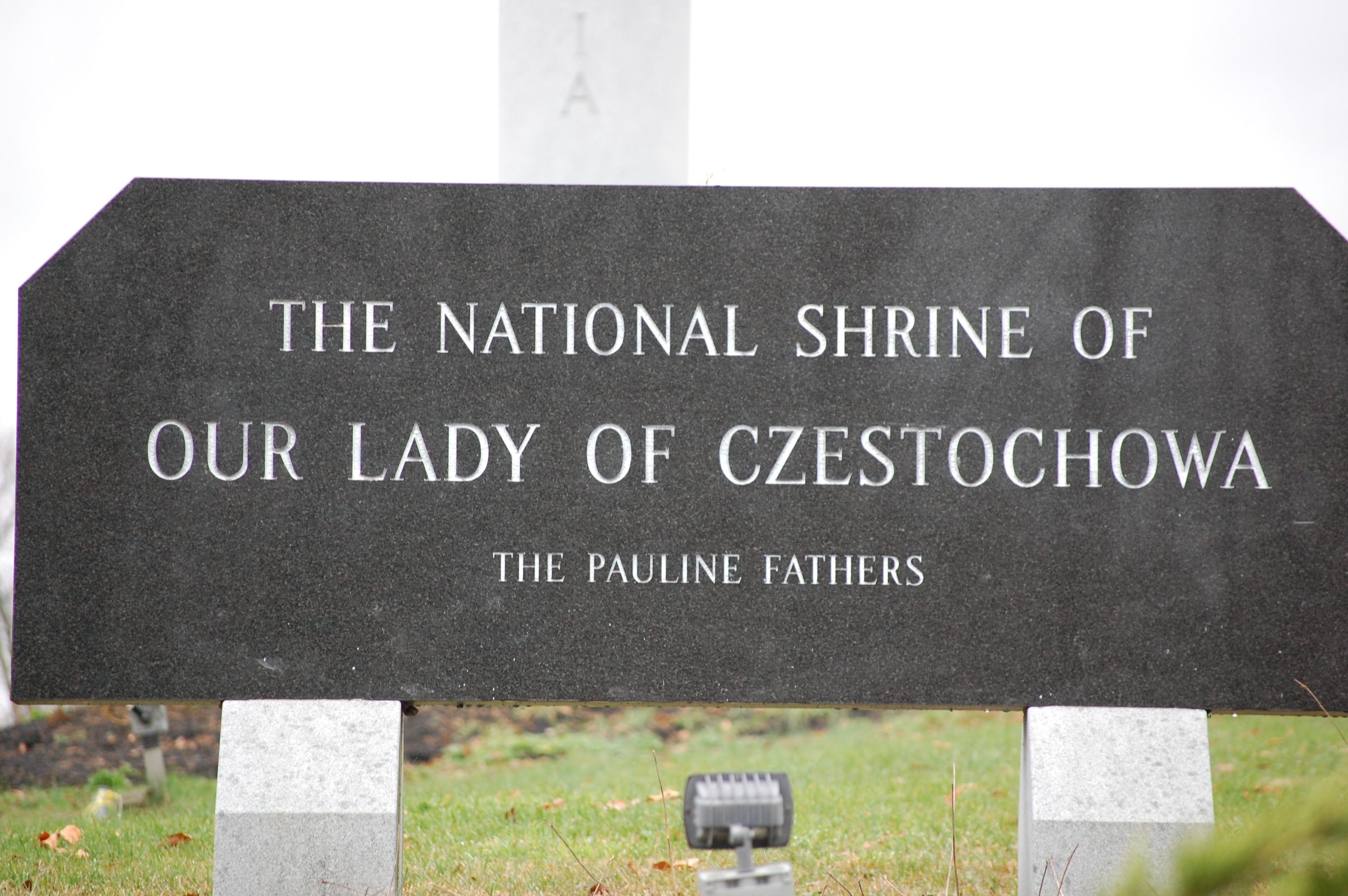
    • Our Lady of Czestochowa
    • St. Gianna Molla
  • Sacred Places
  • Art, Film, Poetry
  • Saints
  • Music
  • Services

Shrine Tower

~ Saints, Shrines and Sacred Places

Shrine Tower

Category Archives: Saints

St. Thérèse of Lisieux’s Connection with Pope Francis

01 Thursday Oct 2015

Posted by Brian in Saints

≈ 4 Comments

Tags

Bishop Robert Barron, Blessed Louis Martin, Blessed Marie Zelie Guerin Martin, Carmelite Monastary, Discalced Carmelite Nun, Philadelphia Carmel, St. John Paul II, St. Therese of the Child Jesus of the Holy Face

Age24 thereseSt. Thérèse of Lisieux (Jan 2, 1873 – Sept 30, 1897) Feast day is October 1, 2015.

Saint Thérèse said that she would spend her time in heaven doing good on earth. Also known as St. Therese of the Child Jesus of the Holy Face and the “Little Flower”. She lived to be 24 years old. Pope John Paul II proclaimed Thérèse of Lisieux a Doctor of the Church in October 1997, the year of the 100th anniversary of her death, making her the youngest and most contemporary of all Doctors of the Church. 

St. Thérèse on flowers:
“Great deeds are forbidden me. I cannot preach the Gospel nor shed my blood – but what does it matter? Others toil instead of me, and I, a little child, keep close by the throne of God and I love for those who fight. Love proves itself in deeds. I will scatter flowers, perfuming the Divine Throne, and I will sweetly sing my hymn of love. These flowers are every little sacrifice, every glance and word, and the doing of the least of actions for love.”

therese before deathThérèse of Lisieux, a Professed Discalced Carmelite Nun at the Monastery of Lisieux.

St. Thérèse on being a saint:
“I always wanted to become a saint…Instead of being discouraged, I told myself that God would not make me wish for something impossible…I will look for some means of going to heaven by a little way which is very short and very straight. It is your arms, Jesus, which are the elevator to carry me to heaven. So there is no need for me to grow up. In fact, just the opposite: I must become less and less.”
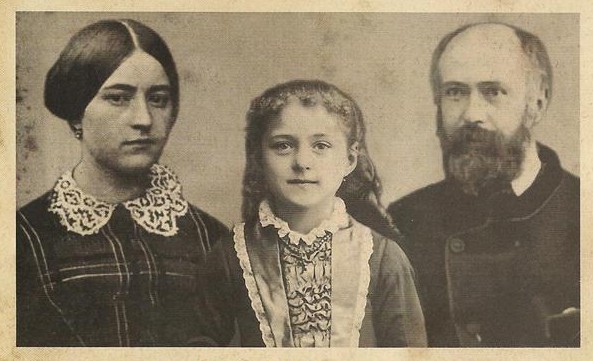
Martin familyLois Martin, a watchmaker, Zelie Martin a lacemaker and St. Therese in middle.

The canonization of Louis and Zelie Martin, parents of St. Thérèse of Lisieux will take place on Mission Sunday, October 18, 2015, during the Synod of Bishops on the Family.

theresa parents reliquaryThe Martin Family Reliquary at The Chapel of the Holy Spirit, Carmelite Monastery in Philadelphia. Photo credit: Fluer Nabert.

St. Thérèse, Louis and Zellie relics:

Shown above are the three individual reliquaries, housing the relics of Therese, Louis and Zellie. This is the first family reliquary for veneration and procession. The reliquary of St. Thérèse, Doctor of the Church is placed highest. Louis and Zellie reliquary are united by wedding rings. The two white lilies are for the parents and the rose is for St. Thérèse.

The Archdiocese of Philadelphia has entrusted the relics of Blessed Louis and Zélie Martin and St. Thérèse to the Philadelphia Carmelite Monastery. The latest news from the Carmelite Monastery in Philadelphia: “Pilgrims are welcome to venerate the reliquary in the chapel Monday – Friday 9:00 am to 12 noon and Sunday 8:00 am to 3:00 pm. You may confide your intentions to these soon-to-be-saints.”

IMG_8498
Pope Francis in Philadelphia, September 26, 2015. Photo by Will Yurman.

The Papal Connection:

Pope Francis has a strong devotion to St. Thérèse of Lisieux while as a Cardinal and now as Pope. Using a quote from St. Thérèse, Pope Francis calls us to “not miss out on a kind word, a smile, or any small gesture which sows peace and friendship.”

Pope Francis has said he received signs from St. Therese while asking for her intercession, in 2010, while still a Cardinal. He told reporters he received a white rose from a man while greeting pilgrims, who said, “you don’t understand anything: this is the sign that you are waiting for.”  The man was never seen again.

Pope Francis has carried forward the devotion to St. Thérèse. From October 4 through 25, the XIV Ordinary General Assembly of the Synod of Bishops on the Family will be held at the Vatican. This synod will mark the 50th anniversary of the Synod of Bishops. The theme of this 2015 synod is “The vocation and mission of the family in the Church and in the contemporary world.”

The parents of St. Thérèse of Lisieux will be canonized by Pope Francis on October 18, 2015 at the Vatican during the synod. Louis Martin (1823-1894) and Marie Zelie Guerin Martin (1831-1877) are the first married couple with children to be canonized in the same ceremony.

Pope Francis has also said, while reflecting on St. Therese’s words, “he (Jesus) does not care if you’re big, or you’re small.” What interests him is “if you are filled with the love of Jesus.”

St. Therese on nature:
“Nature seemed to share in my bitter sadness, for during these days, the sun did not shine and the rain poured down in torrents.  I have noticed in all the serious circumstances of my life that nature always reflected the image of my soul.  On days filled with tears the heavens cried along with me; on days of joy the sun sent forth its joyful rays in profusion, and the blue skies were not obscured by a single cloud.”

monstary wall
The walled Philadelphia Carmel Monastery with the Chapel of the Holy Spirit in the background. St. Thérèse lived in a similar Carmelite Monastery in Lisieux France.

The Discalced Carmelite Monastery of Philadelphia were the originators of devotion to St. Thérèse of Lisieux in the United States. It was founded in 1902, less than five years after St. Thérèse died

St. Thérèse on Blessed Virgin Mary:
“How I love the Blessed Virgin! She is represented as unapproachable, rather ought she to be shown as imitable. She is more Mother than Queen! I have heard it said that all the Saints are eclipsed by her radiant brightness as the Sun at rising makes the stars disappear. How strange that seems! A Mother eclipsing the glory of her children! I think quite the contrary, I believe that she will immensely increase the splendor of the elect. The Virgin Mary! How simple does her life appear to me!”

mary with Jesus and scapular final
Blessed Virgin Mary with the Child Jesus.
Carmelite Monastery, Philadelphia Carmel in Pennsylvania.

Bishop Robert Barron on St. Thérèse of Lisieux and Martin Family

“I am not dying; I am entering into life,” wrote Thérèse of Lisieux a few weeks before her death in Carmel on September 30, 1897, at the age of 24.

st-therese-sick-bed1
At the time of her death, Therese knew no more than 50 people, having lived in a cloistered, contemplative convent. As she studied and prayed the science of love from her own experiences, her wisdom blossomed.

I wanted Carmel as soon as I learned of it; I find that all the aspirations of my heart are fulfilled in this Order. – Saint Thérèse of Lisieux

best view of chapel
Chapel of the Holy Spirit after Our Lady of Mount Carmel Feast Day Mass in 2014.

St. Thérèse of Lisieux on the Science of Love:

“I desire only this science of love…I understand so well that it is only love which makes us acceptable to God that this love is the only good ambition. Jesus deigned to show me the road that leads to Divine Furnace [of God’s love] and this road is the surrender of the little child who sleeps without fear in it’s Father’s arms.”

partitionShe is with us still.

St. John Paul II on St. Therese:

Therese of the Child Jesus and the Holy Face is the youngest of all the “Doctors of the Church”, but her ardent spiritual journey shows such maturity, and the insights of faith expressed in her writings are so vast and profound that they deserve a place among the great spiritual masters.
St. Thomas of Villanova: Augustinian, Educator and Carer of the Poor

11 Friday Sep 2015

Posted by Brian in Parish Shrines, Saints

≈ 2 Comments

Tags

Augustinian, saints, Thomas of Villanova, Villanova University

DSC_0120

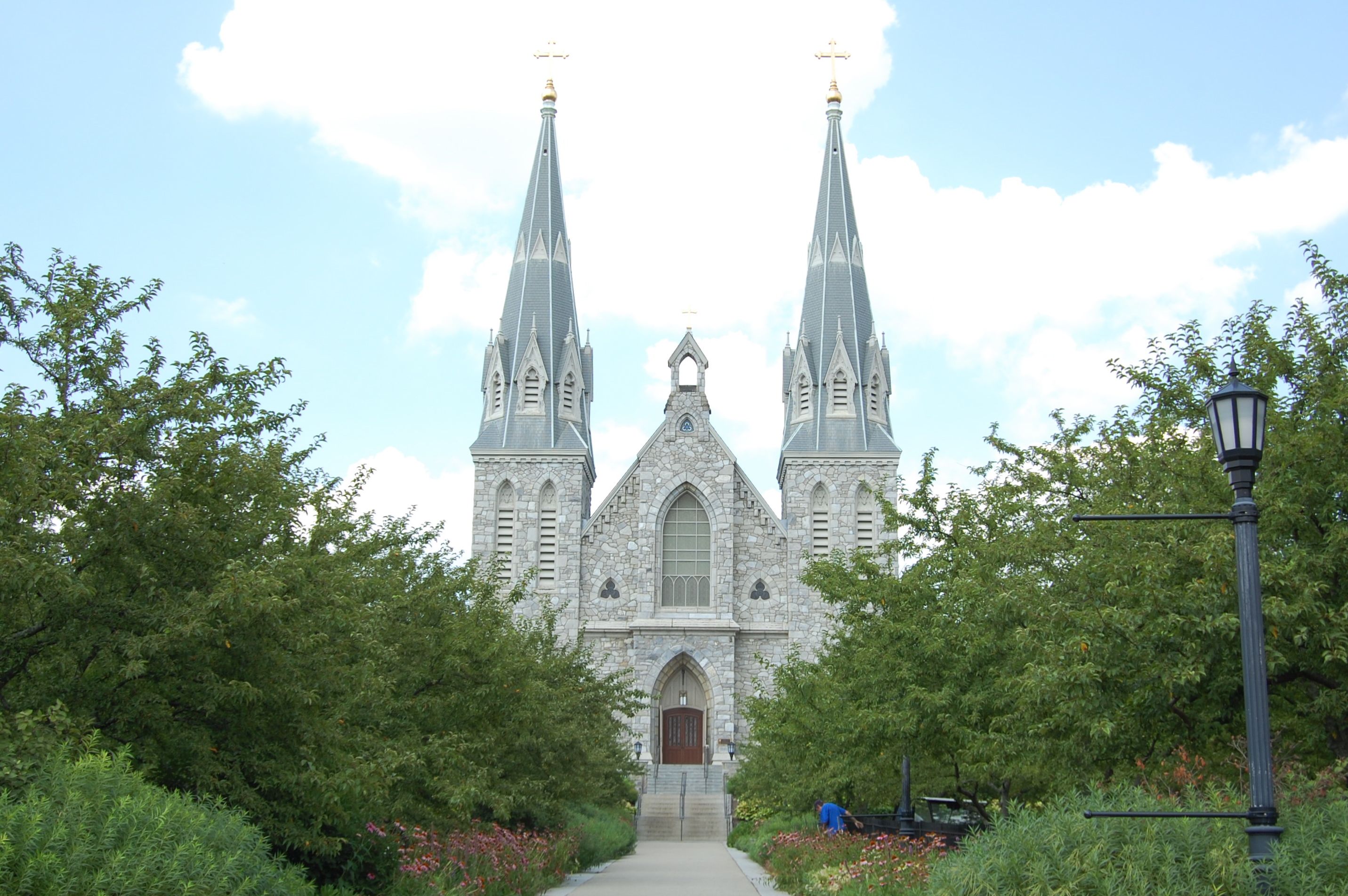
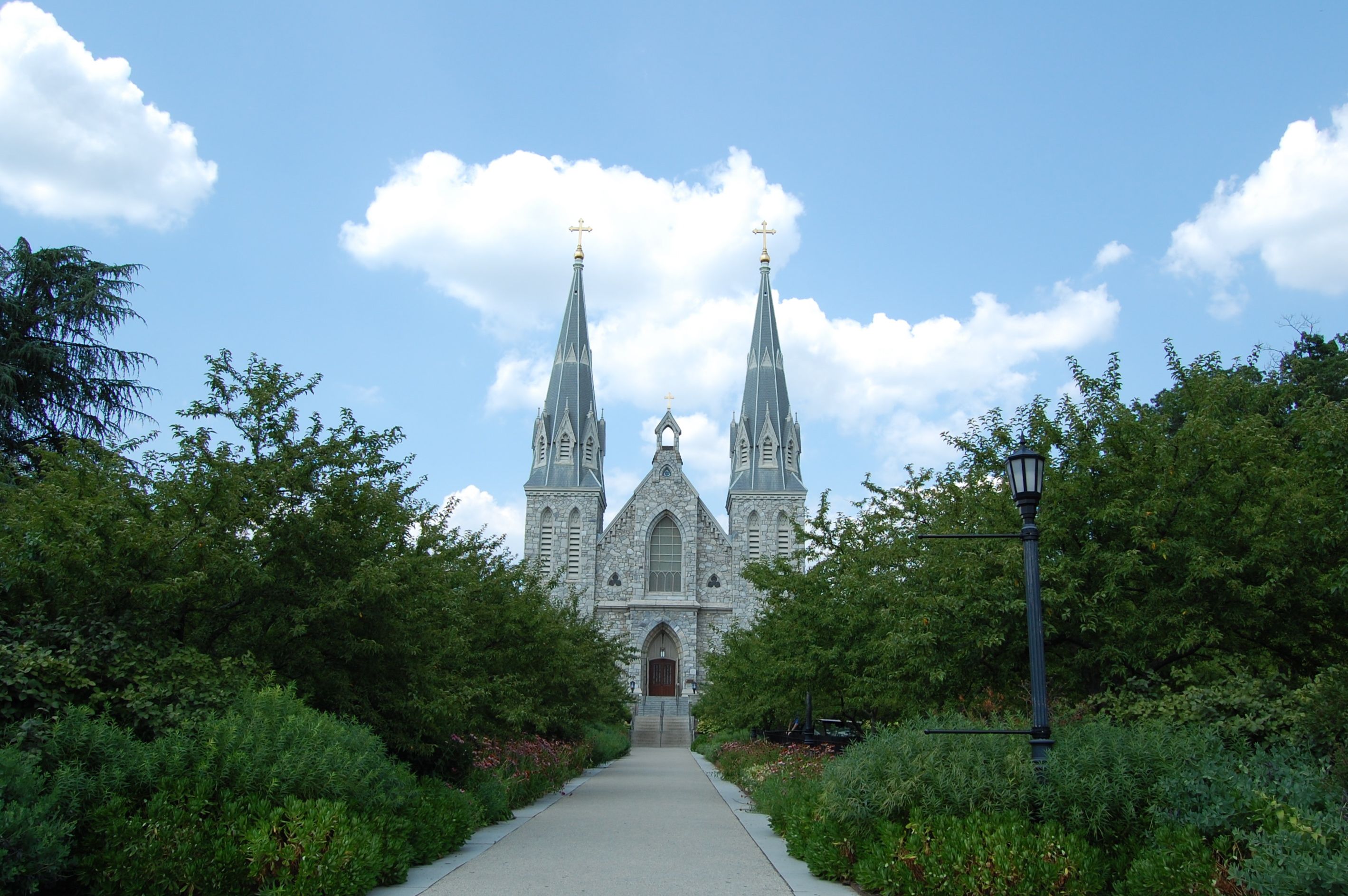
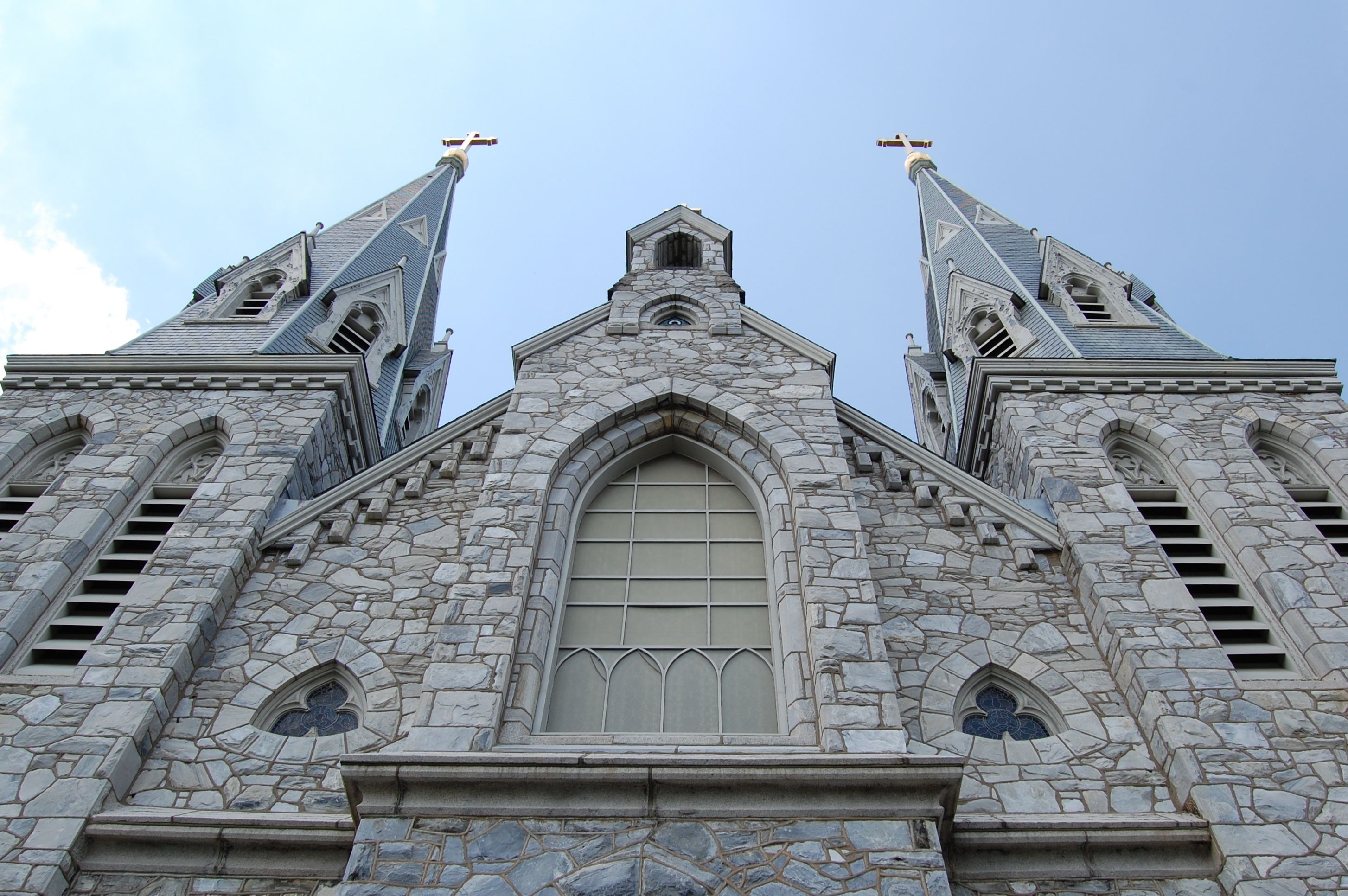
St. Thomas of Villanova Church on the campus of Villanova University, Philadelphia, Pennsylvania.

DSC_0018 copy

St. Thomas of Villanova:

Charity is not just giving, rather removing the need of those who receive charity and liberating them from it when possible.

thomas in front of bild 2

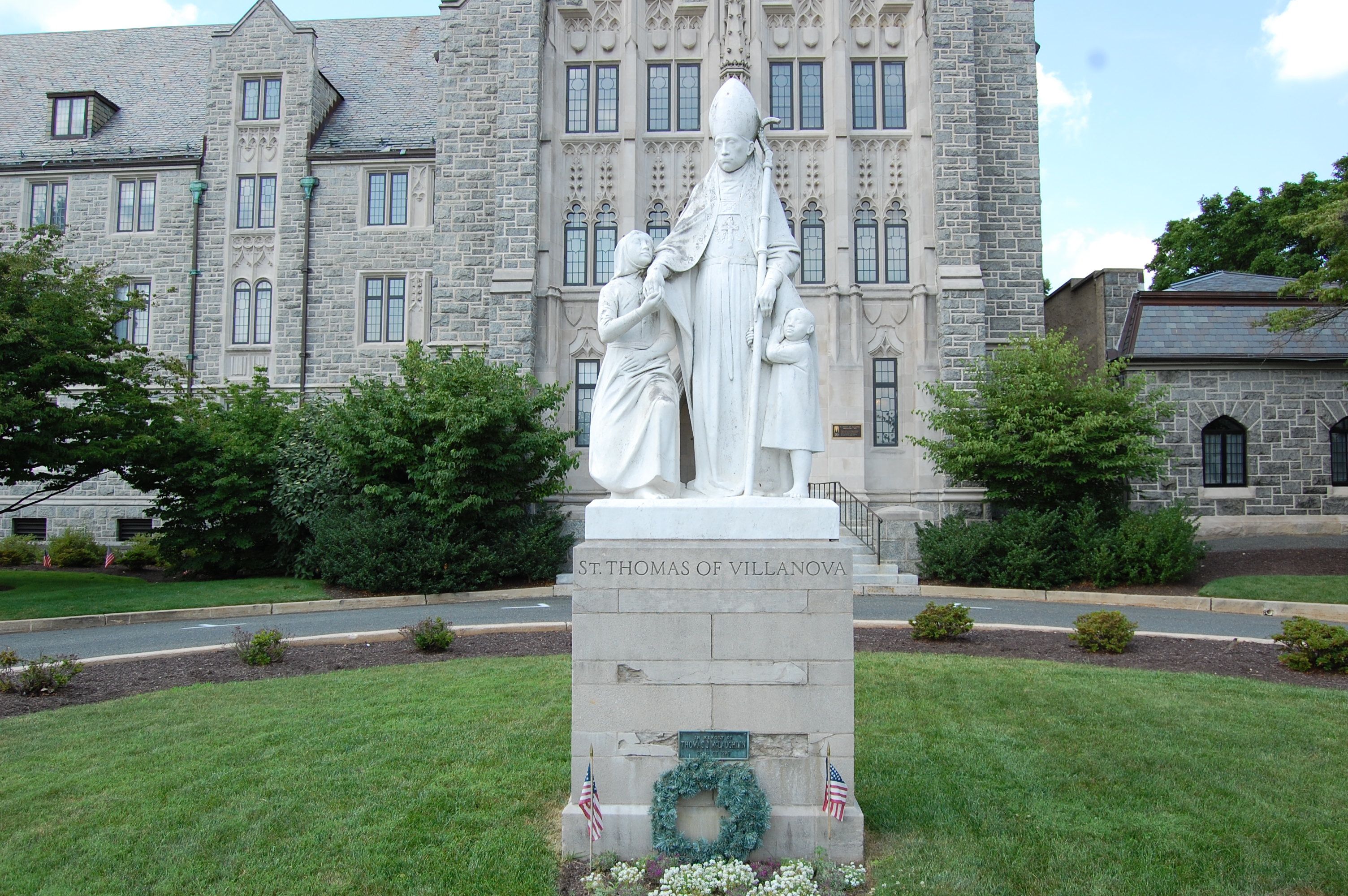
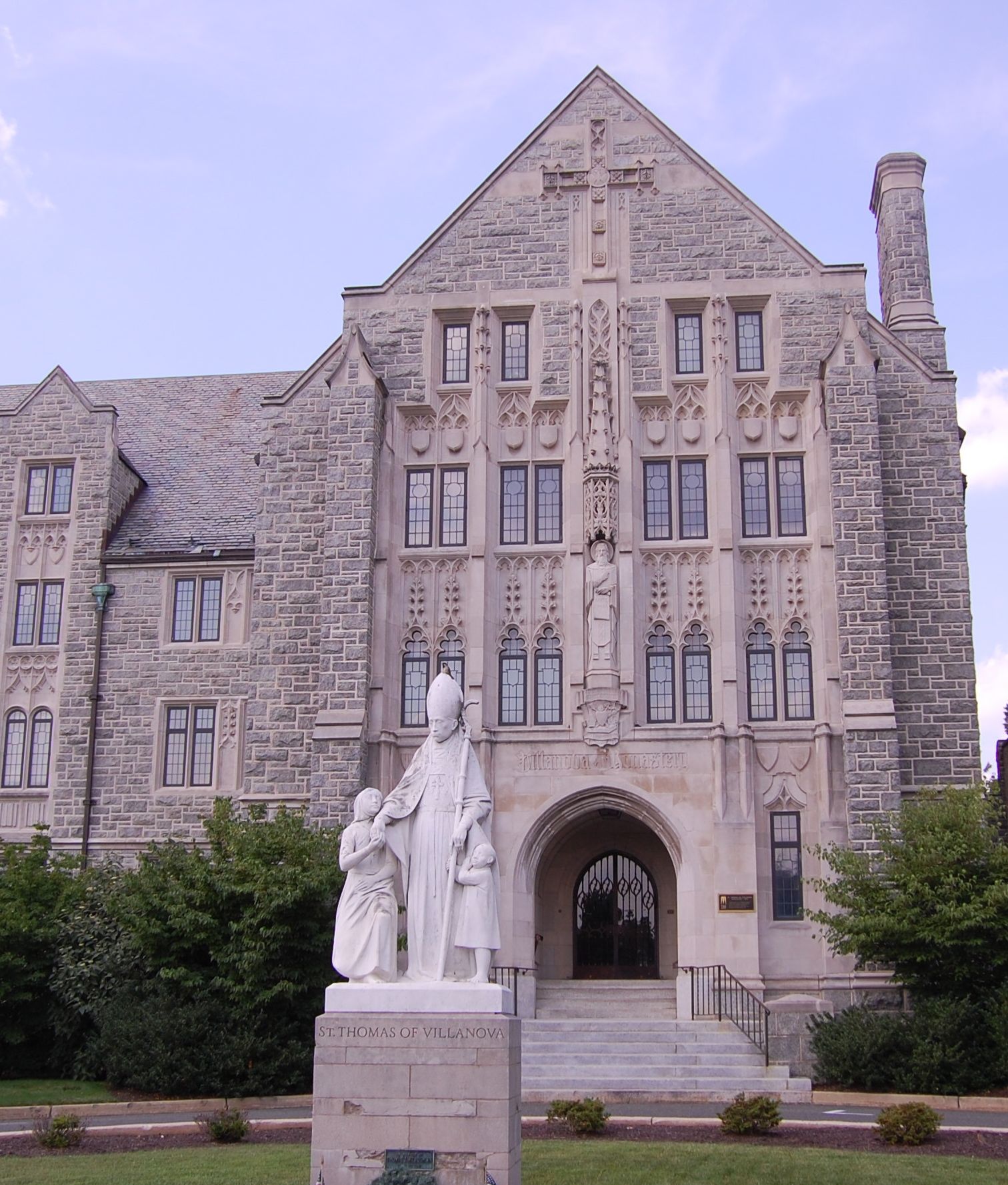
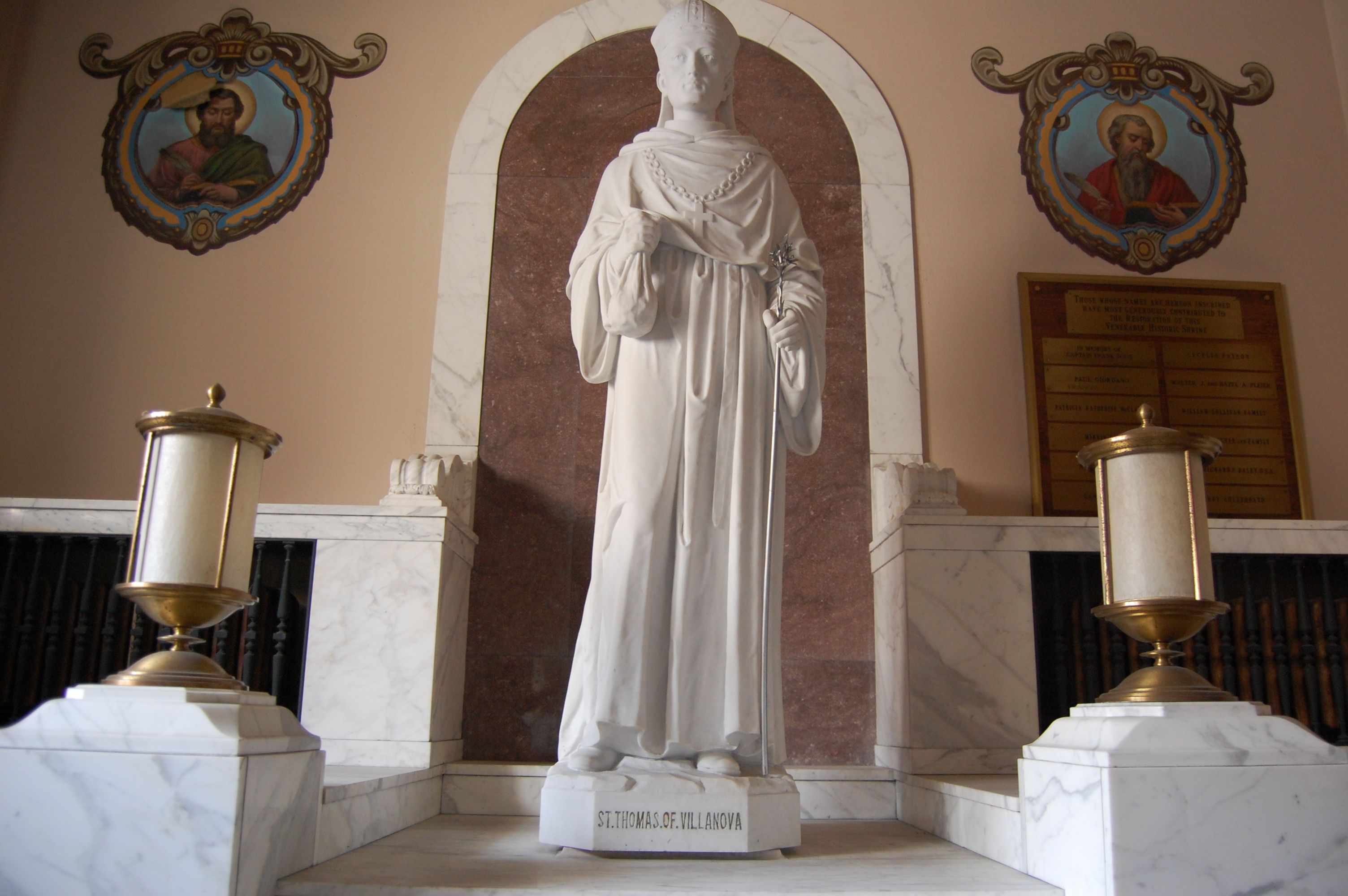
St. Thomas of Villanova, an Archbishop, educator and carer of the poor. The patron saint of Villanova University, shown in the plaza in front of St. Thomas of Villanova Monastary. He lived from 1488-1555. His feast day is September 22nd.

st. thomas of villa statue detail

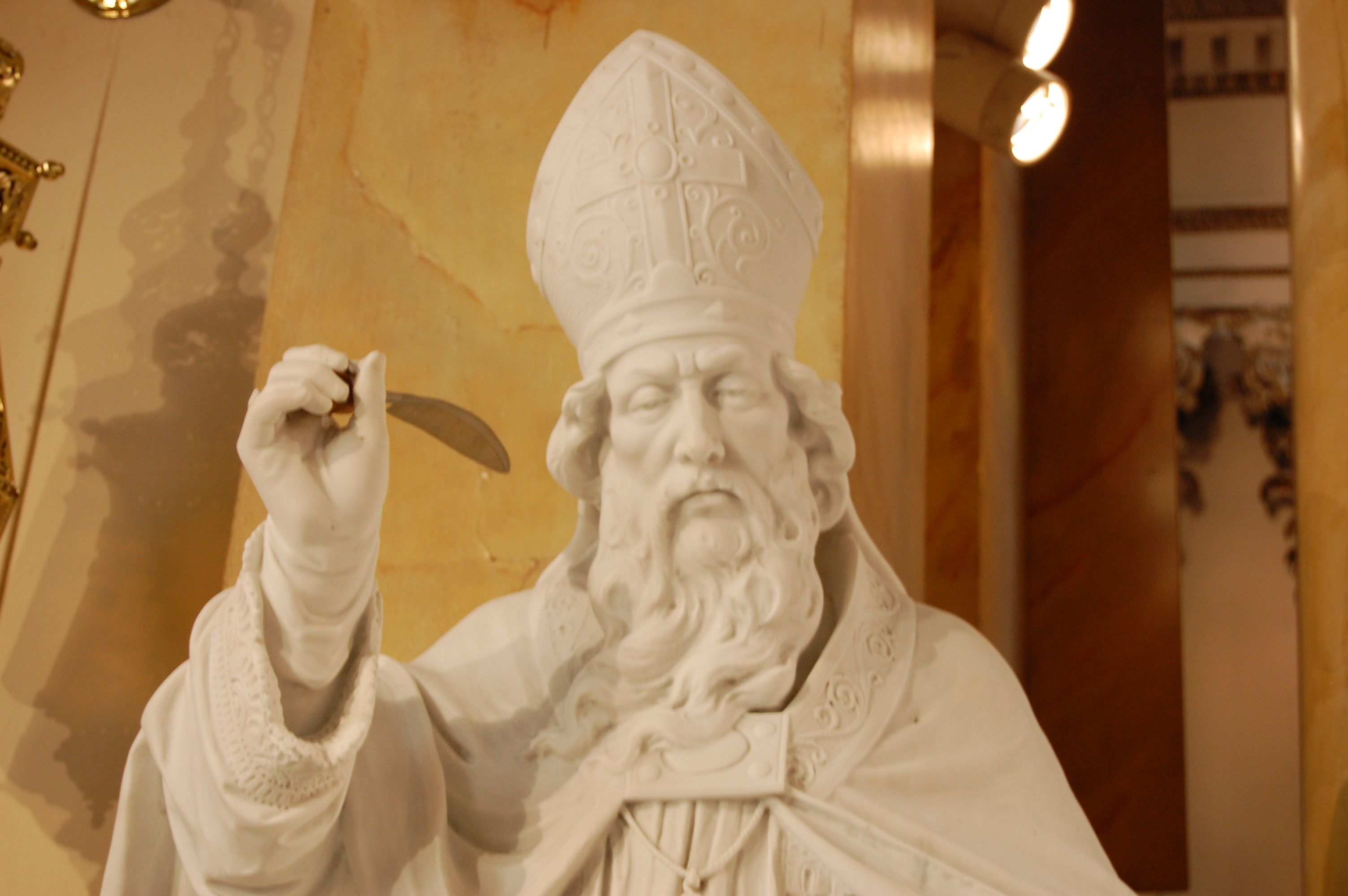
Details depicts Thomas dressed as a bishop with crozier and mitre, giving alms to poor children.

If you want God to hear your prayers, hear the voice of the poor. If you wish God to anticipate your wants, provide those of the needy without waiting for them to ask you. Especially anticipate the needs of those who are ashamed to beg. To make them ask for alms is to make them buy it.”   – St. Thomas of Villanova

nova 3
St. Thomas attended Arts and Theology at the University of Alcala de Henares and eventually became a university professor. He decided to leave the university setting and entered an Augustinian monastery.

DSC_0036

Later in life St. Thomas received mystical encounters with God, having ecstatic visions during Mass. He sucumbed a heart condition in 1555 at the end of Mass. He is said to have died on the floor rather than in his bed, which he insisted on offering to a poor man who had come to his house.

DSC_0032 copy
He was a great preacher and Emperor Charles V, upon hearing him preach, exclaimed, “This monsignor can move even the stones!”

altar

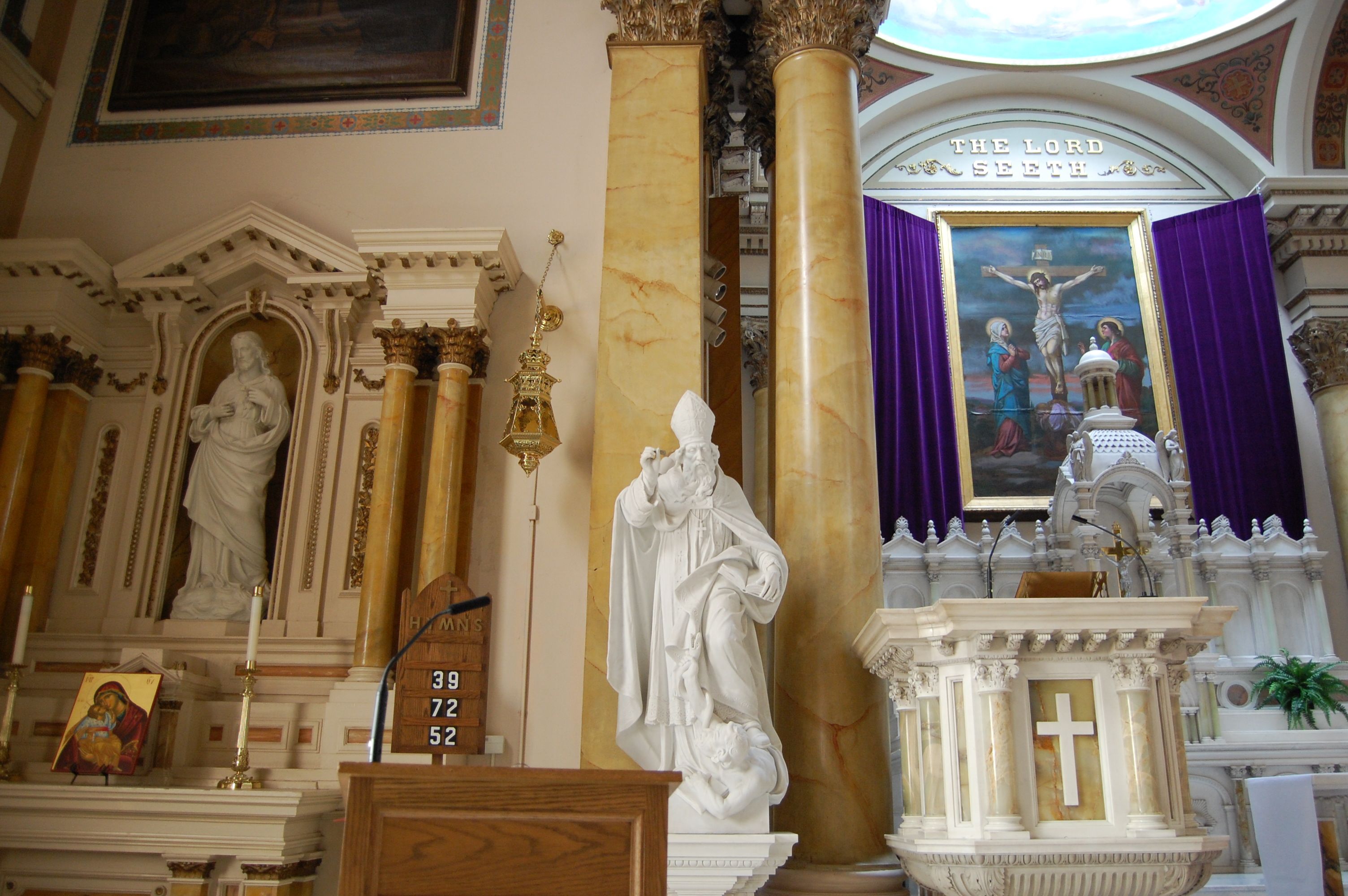
He also had a great devotion to the Virgin Mary, whose heart he compared to the burning bush that is never consumed. He was canonized by Pope Alexander VII on November 1, 1658.

DSC_0101 copy
Villanova University’s crest reflects the school’s Catholic roots and symbolically commemorates the seal of St. Augustine, whose order founded Villanova in 1842.

Seven key elements are represented:

1. Motto: Villanova’s motto, “Veritas (truth), Unitas (unity), Caritas (charity)” is highlighted on the crest, with each term enclosed in a rectangular box.

2. Book: A large book in the center of the crest represents St. Augustine’s commitment to learning as well as his study of Scripture when making his famous conversion to Christianity.

3. Cincture: On top of the book, a cincture or cord with tassels depicts part of the clothing worn by friars in the Order of St. Augustine.

4. Flaming Heart: St. Augustine’s quest to know God meant that he needed to pursue his goal with all his heart. The flaming heart also characterizes Augustine’s commitment to love one’s neighbor.

5. Crosier: The crosier, or staff, on the Villanova crest marks St. Augustine’s role in the church as the Bishop of Hippo.

6. Crosses and Laurel Wreath: Crosses, a symbol of Christ’s death and resurrection, show the importance of St. Augustine’s conversion. The laurel wreath marks his victory through learning and knowledge.

Villanova_University_Seal.svg

7. Fide of the University: On the official university seal, the outer rim states in Latin “Villanova University in the State of Pennsylvania.”

nova

The Bible tells us that the poor, the downtrodden, the oppressed, the needy, and the hungry and thirsty were the Lord’s favorites.Why, then, should they not be our favorites as well?” – St. Thomas of Villanova

DSC_0078

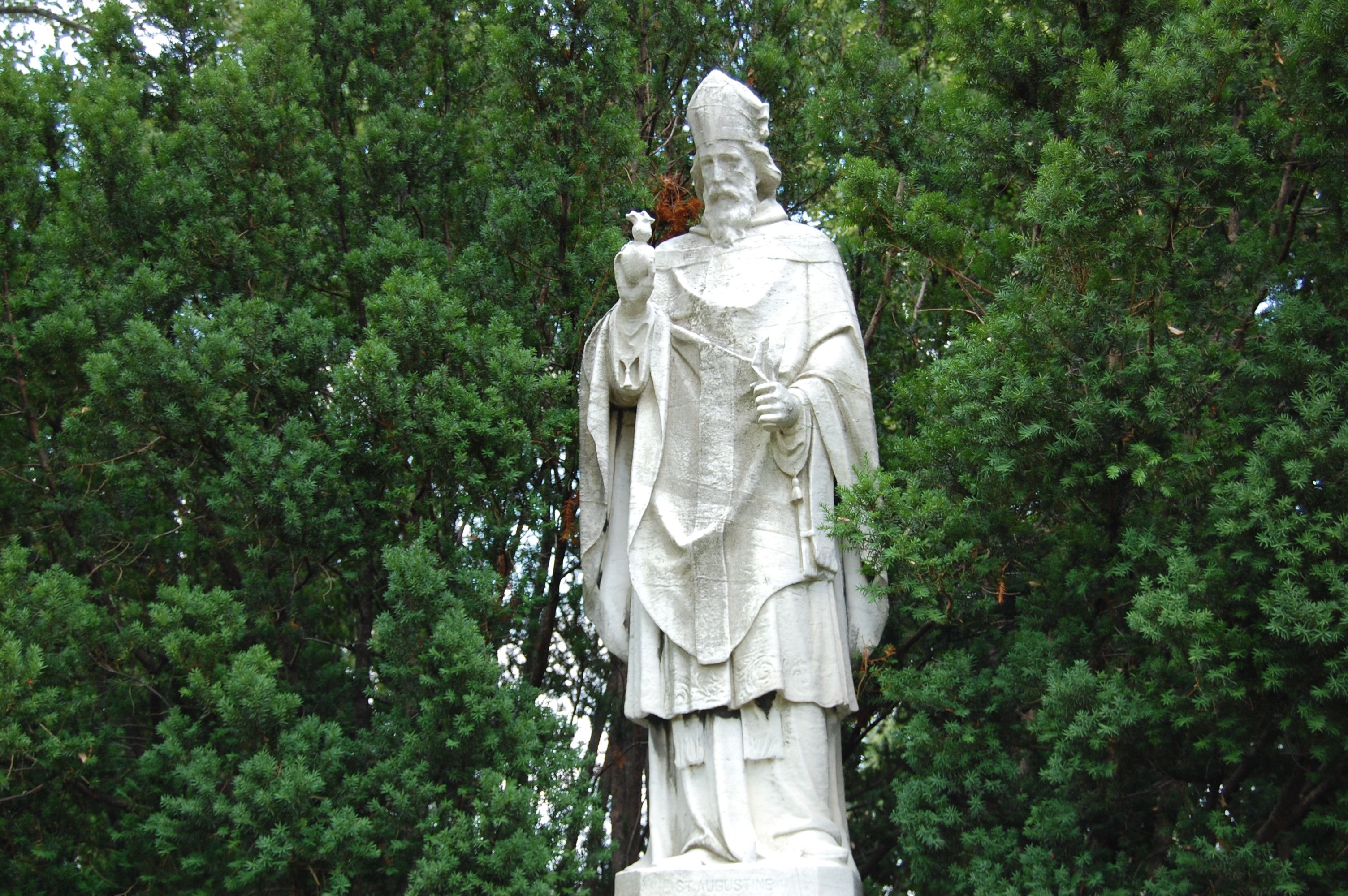
St. Augustine statue with his own heart set on fire with the love for Christ. The friars of his religious order founded Villanova University, where they administer today.
rita at villa
Another Augustinian, St. Rita of Cascia, shown here at one of the courtyards in the St. Augustine Center for Liberal Arts at Villanova University.

entrance

This door is always open as St. Thomas of Villanova would want it.

Basil’s Family at the Basilian Spirituality Center

16 Monday Jun 2014

Posted by Brian in Parish Shrines, Saints

≈ Leave a comment

Tags

Basilian Spirituality Center, Holy Trinity Chapel, Sisters of the Order of St. Basil the Great, St. Basil

outside view of chapel
Basilian Spirituality Center.

Located in Fox Chase Manor, Pennsylvania, a suburb of Philadelphia, the Basilian Spirituality Center is part of the Eastern Byzantine Ukrainian Catholic Church, under the umbrella of the Ukrainian Greek Catholic Archeparchy of Philadelphia.

basil mary macrina mother gregory
The Basilian Family at the Basilian Spirituality Center.

Icons play a significant role in the Eastern Byzantine rite.

The “Basilian Family” icon, located on a wall within the retreat center is especially core to the Sisters of the Order of St. Basil the Great. Central in the Basilian Family is Mary, her arms outstretched and the name of her Son, “IXC”, radiating from her body. In Eastern Byzantine rite this is called The Theotokos, Mary Mother of God. Macrina The Elder is to the right of Mary, to whom St. Basil attributed much of his spiritual formation. She is dressed in green, the symbol of the Holy Spirit, a woman of spiritual gifts and the wisdom of God. To the right of Macrina the Elder is St. Gregory of Nyssa, brother of St. Basil, holding the gospels as a symbol of his preaching abilities and is dressed in the ecclesiastical garb of a Bishop. To the left of The Theotokos is Macrina the Younger, Basil’s sister, in monastic garb as a foundress of the community of Neocaesarea and next to her is St. Basil also dressed as a Bishop carrying the gospel.

song of songs
Song of Songs poem.

Inscribed above the wall of the Basilan Family, is the love poem from Song of Songs v8:6-7
“Set me as a seal on your heart, for love is as strong as death, its flames are flames of fire, many waters cannot quench love.”

overall holy trinity chapel
Holy Trinity Chapel. The Solemnity of the Holy Trinity was celebrated here on June 15th.

The Byzantine rite is one of several Eastern rites recognized in full communion with the Bishop of Rome; Pope Francis. Its origin can be traced to the ancient city of Byzantium (modern-day Istanbul), renamed Constantinople when the emperor Constantine relocated his capital city there from Rome in A.D. 330.

mother and childe 2
The Theotokos.

On the rear wall of the Holy Trinity Chapel, the Chapel of the Sisters of the Order of Saint Basil the Great, is the “Theotokos” icon, meaning “God Bearer” or ‘Mother of God’. Mary is the Theotokos, the one who gave birth to God. This was the Council of Ephesus (in 431) and the Council of Nicea’s definition of Mary since Jesus was true God and true Man, so Mary could be called “Mother of God”. It appeared in the Archbasilicas of Rome, built by Constantine in one of the first churches ever built.

jesus icon
Jesus at the Garden of Gethsemane

The Eastern Ukrainian Byzantine Church has 5.5 million followers. Typically the sanctuary is separated from the congregation by an iconostasis, a screen covered with icons. Leavened bread is used for the consecration of the body of Christ in the liturgy (not called the “Mass” in Eastern rites), which is either the liturgy of St. John Chrysostom or that of St. Basil the Great. Communion is received under both kinds and administered by the priest using a spoon to the faithful.
icon looking up in HTC
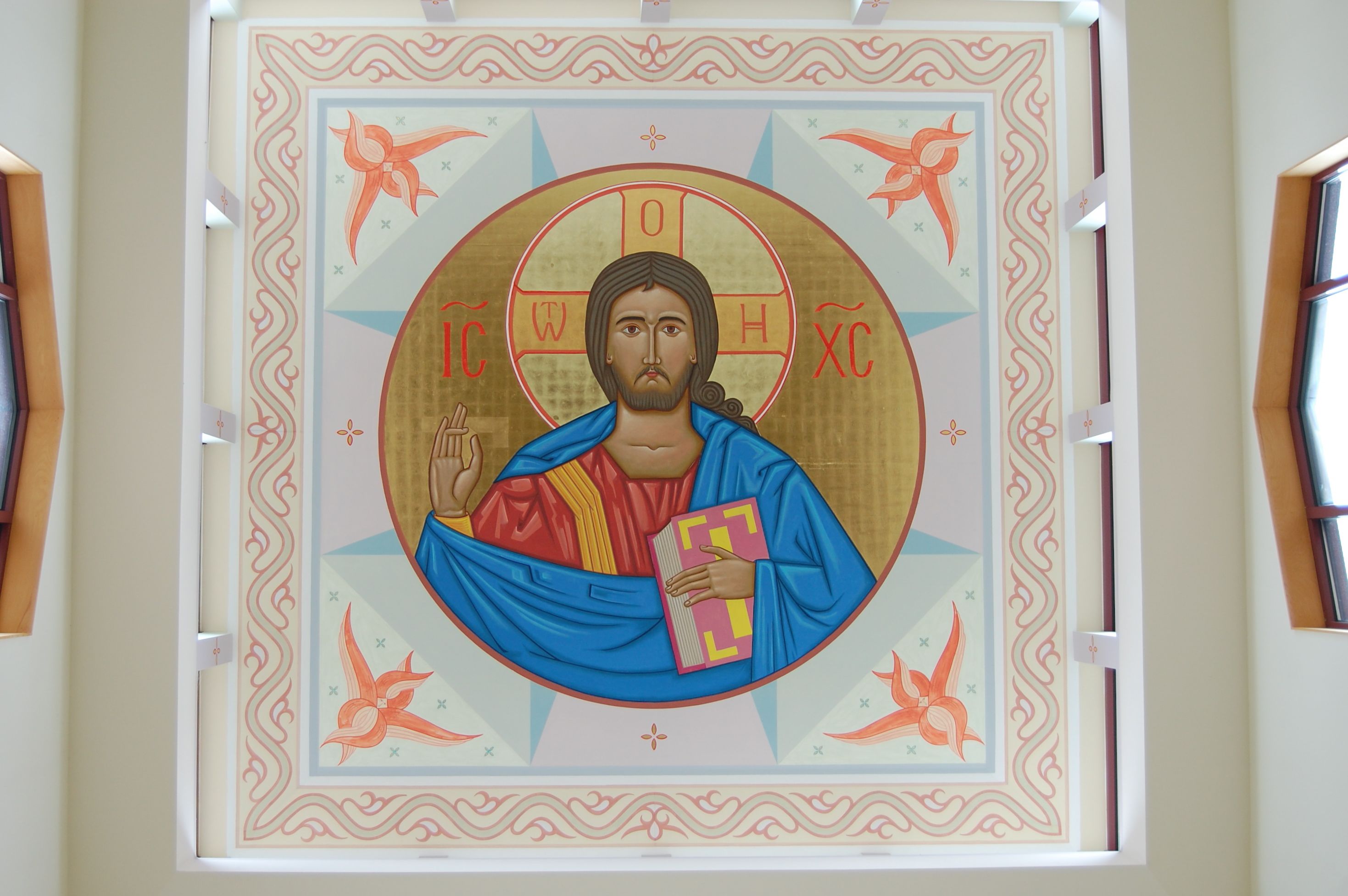
The Pantocrator.

Located on the ceiling in the nave of the Chapel is the Pantocrator Icon, “Ruler of All”, Christ blessing his people. The Pantocrator is present in most Eastern Byzantine churches along with the Theotokos described earlier.

holy trinity chapel

Byzantine Catholics operate under a different code of canon law. They also celebrate a somewhat different liturgical year with some unique feasts and saints. Latin-rite Catholics can attend a Byzantine liturgy to fulfill their obligation to attend Mass.

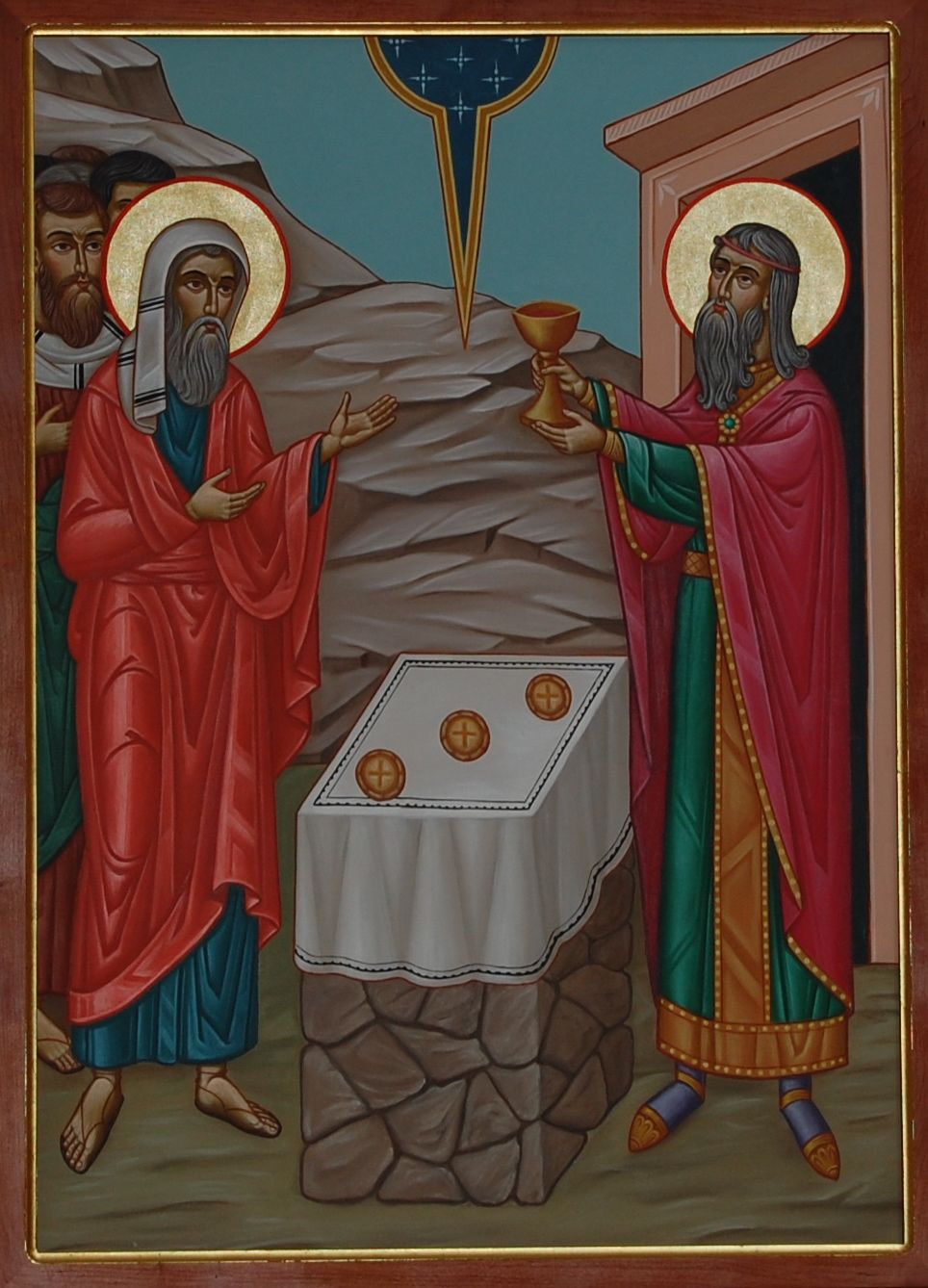
two at tomb
Two at the Tomb icon.

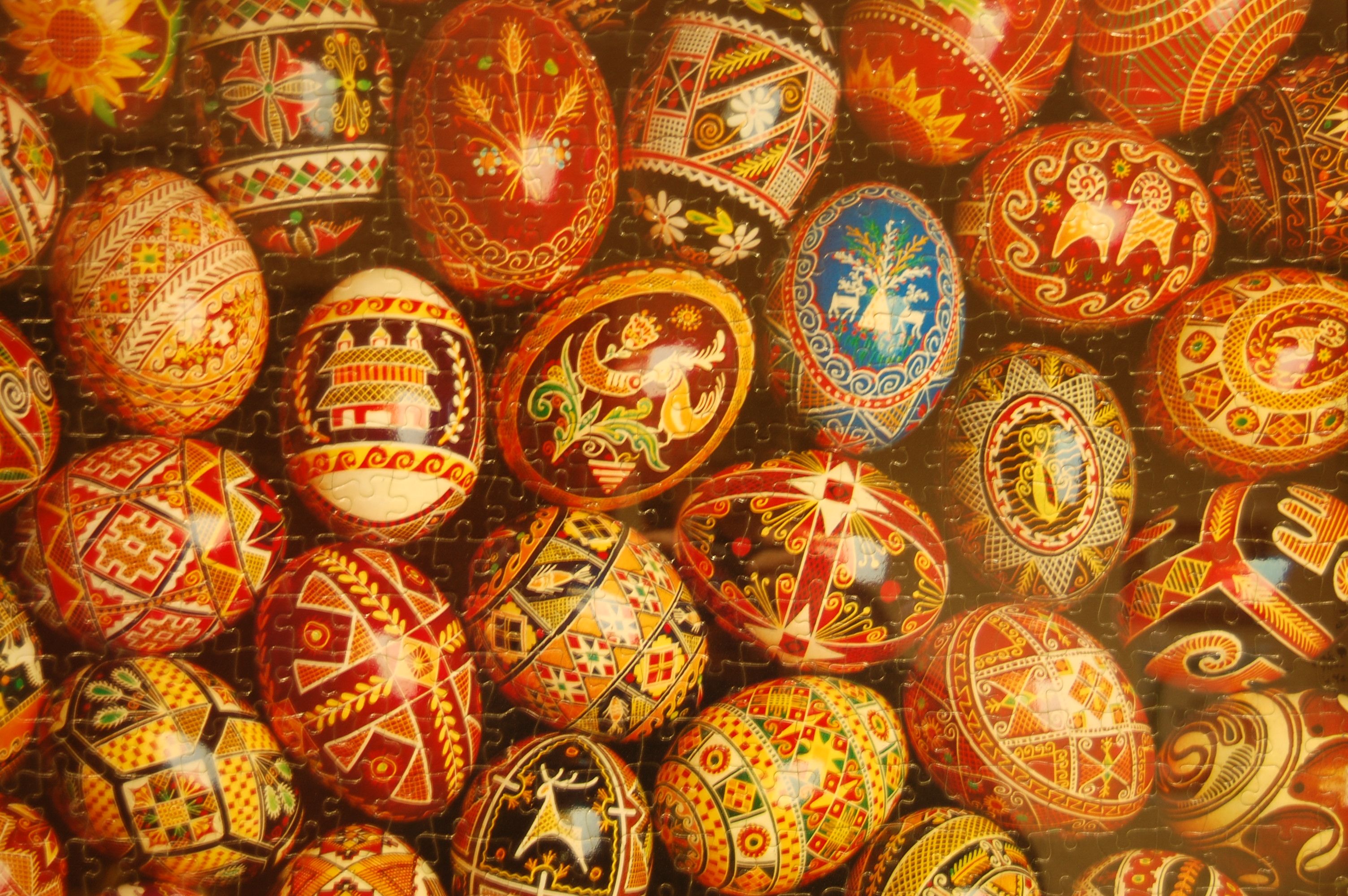
easter eggs
Pysanky eggs photo on display at the Basilian Spirituality Center.

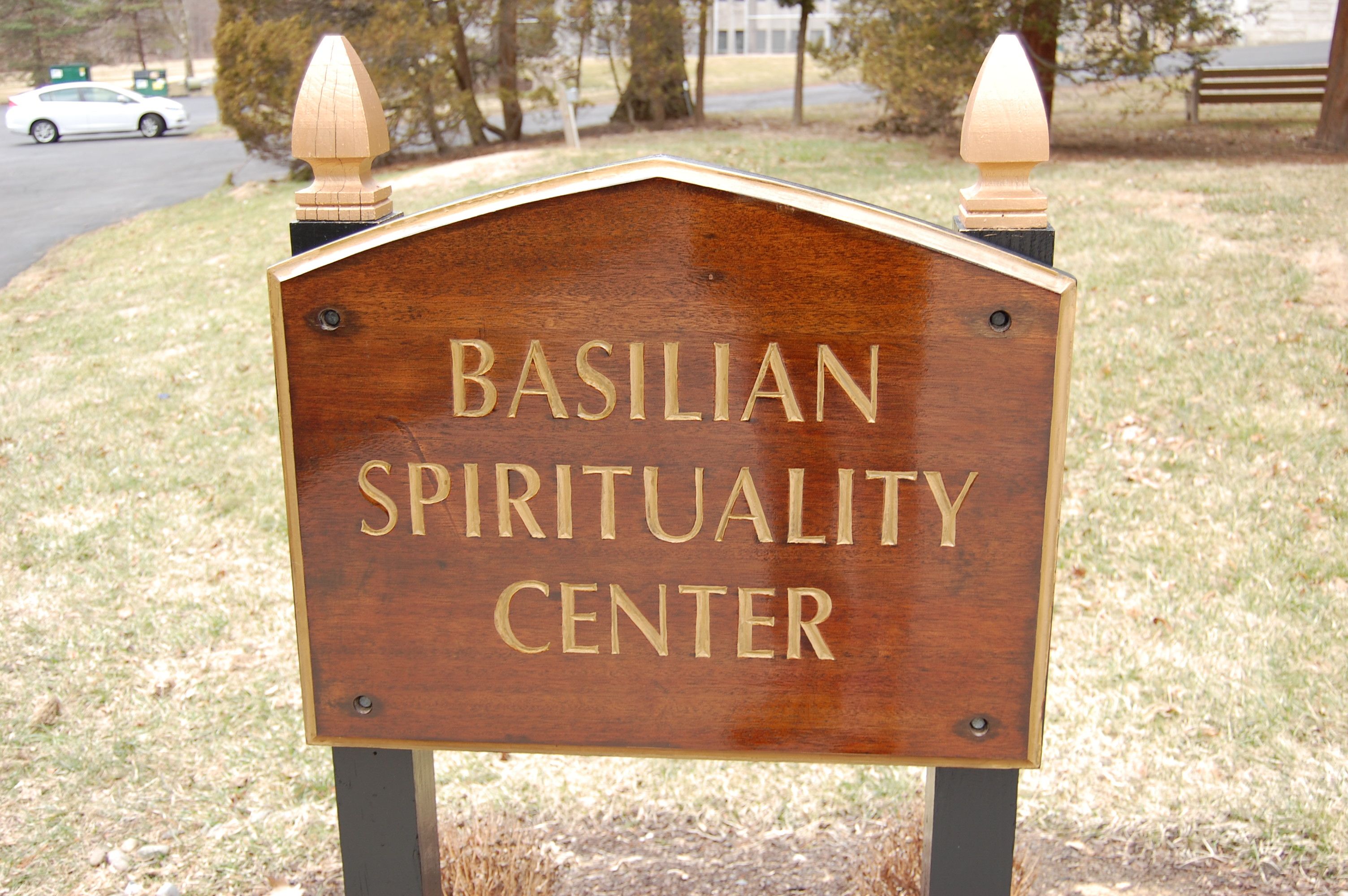
sign Basilian Spirituality Center
Entrance to the Basilian Spirituality Center complex.

IconTracing
Creating an icon.

Each year an icon presentation and icon writing workshops are held at the Basilian Spirituality Center in Philadelphia Pennsylvania. This year (2014), famed iconographer Rev. Damian Higgins conducted the icon workshop. Rev Damien is from the Holy Transfiguration Monastery also known as Mt. Tabor Monastery in Redwood Valley, California.

Andrej Rublev
One of the all time famous icons every created, “The Holy Trinity” by Russian iconographer Andrei Rublev (1360-1370).

three crosses
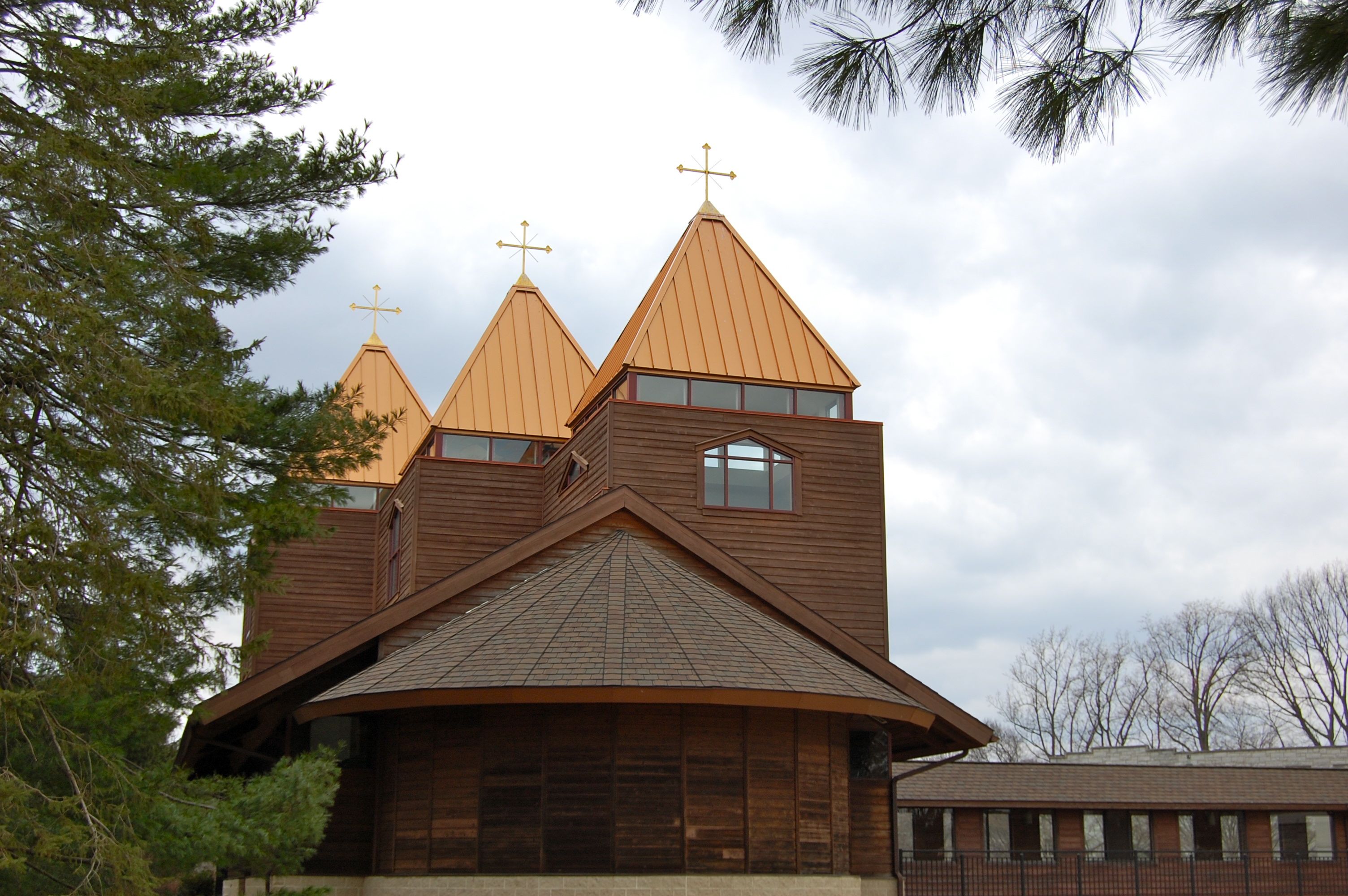
Symbolism in the three spires on Holy Trinity Sunday.

“A tree is known by its fruit; a man by his deeds. A good deed is never lost; he who sows courtesy reaps friendship, and he who plants kindness gathers love.”
St. Basil the Great

Saint John Paul II Embraces The National Shrine of Our Lady of Czestochowa

26 Saturday Apr 2014

Posted by Brian in Our Lady of Czestochowa, Saints

≈ Leave a comment

Tags

canonization, Our Lady of Czestochowa Shrine, Pauline Fathers, Saint, Saint John Paul II, Shrine, St. Faustina, St. John XXIII, St. Paul the Hermit, The National Shrine of Our Lady of Czestochowa

Saint John paul II Saint John Paul II, The National Shrine of Our Lady of Czestochowa, Philadelphia Pennsylvania.

On April 27, 2014, Divine Mercy Sunday, Pope Francis canonized Blessed Pope John Paul II. He attended the Second Vatican Council initiated by Pope John XXIII, who is also being canonized on this day. Born Karl Wojtyla, Pope John Paul was an actor, poet, athlete, playwrite, priest and philosopher. As Charles Chaput, Archbishop of the Archdiocese of Philadelphia stated: He proved by his life the words of St. Irenaeus that “the glory of God is man fully alive.”

outside with JP2

St. John Paul II visited the Shrine of Our Lady of Czestochowa on two occasions while a cardinal. Karol Cardinal Wojtyla first visit was in 1969 and again in 1976 while attending the Eucharistic Congress held in Philadelphia. He became the 264th Pope of the Catholic Church two years later in 1978. John Paul II was the first non Italian pope since Pope Adrian VI who died in 1523.

saint JP II COAT OF ARMS
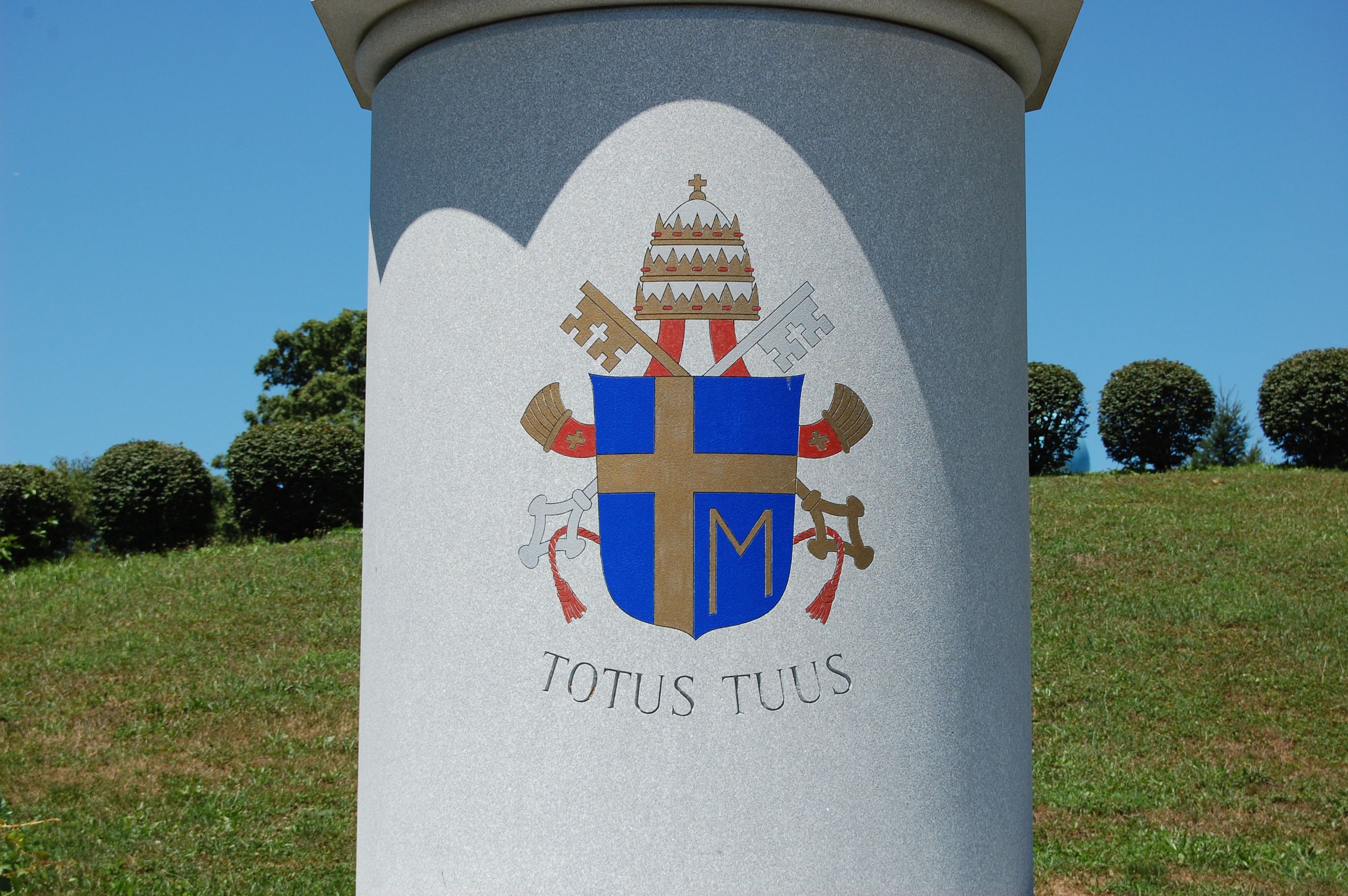
Coat of Arms of Pope John Paul II with the Marian Cross. The Letter M is for Mary, the mother of Jesus, to whom he held strong devotion.

john paul at the door full view

John Paul II created Divine Mercy Sunday which is celebrated on the Sunday after Easter. It is originally based on the devotion to the Divine Mercy that Saint Faustina Kowalska reported as part of her encounter with Jesus. St. Faustina Kowalska, a Polish nun reported visions and visitations from Jesus and conversations with Him. John Paul II beatified Sr. Maria Faustina Kowalska on April 18, 1993 and canonized her on April 30, 2000.

DSC_0314
St. Paul the Hermit, a strong influence at the Shrine of Our Lady of Czestochowa.

The Order of St. Paul the Hermit was founded during the first half of the 13th century in Hungary. The members of the Order were actual hermits who lived in the caves in Hungary. For their patron they chose St. Paul the Hermit, thereby acquiring the name “Pauline Fathers”. John Paul II had an affection for the Pauline Fathers religious order, and helped persevere the order in Poland. The Pauline Fathers, like John Paul II, have a strong devotion to the Blessed Virgin Mary. Their main monastery is in Czestochowa, Poland, where they continue to reside. The Pauline Order received permission from the Holy See to establish a monastery in Doylestown, Pennsylvania, and subsequently built Our Lady of Czestochowa Shrine.

upper church 2

In the main church is the Miraculous Icon of Our Lady of Czestochowa, which was blessed by Pope John XXIII on February 10, 1962, who also became a saint. The Icon of Our Lady hangs behind the altar in the main nave and depicts the Holy Trinity. God the Father, with His arms stretched out like the wings of a large bird, enfolds Jesus Christ and all God’s people. Above them is shown a dove, the symbol of the Holy Spirit. Below them, a choir of angels, with their golden horns, extol the glory of God.

our lady of czs lower church adoration day

The Chapel of Our Lady of Czestochowa, located at The National Shrine of Our Lady of Czestochowa on Adoration Day.

This chapel is a replica of the chapel found at the Jasna Góra Shrine in Poland. At the heart of the chapel is a copy of the Miraculous Icon of Our Lady of Czestochowa, blessed by Pope John Paul II, now a Saint.

Jesus

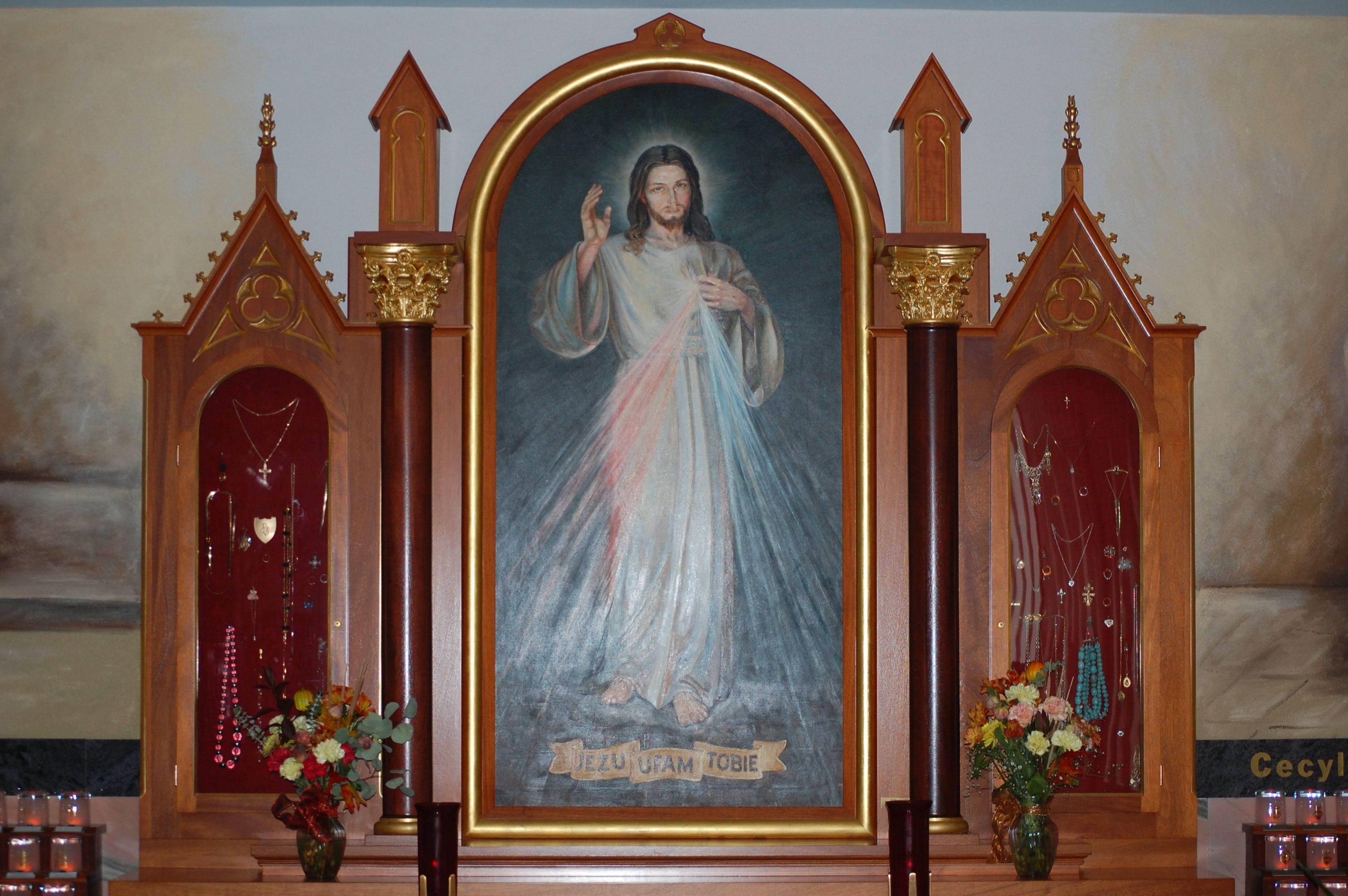
chapel of divine mercy
The Chapel of Divine Mercy, within The National Shrine of Our Lady of Czestochowa, Philadelphia Pennsylvania. John Paul II died on the vigil of Divine Mercy Sunday, April 2, 2005.

sign
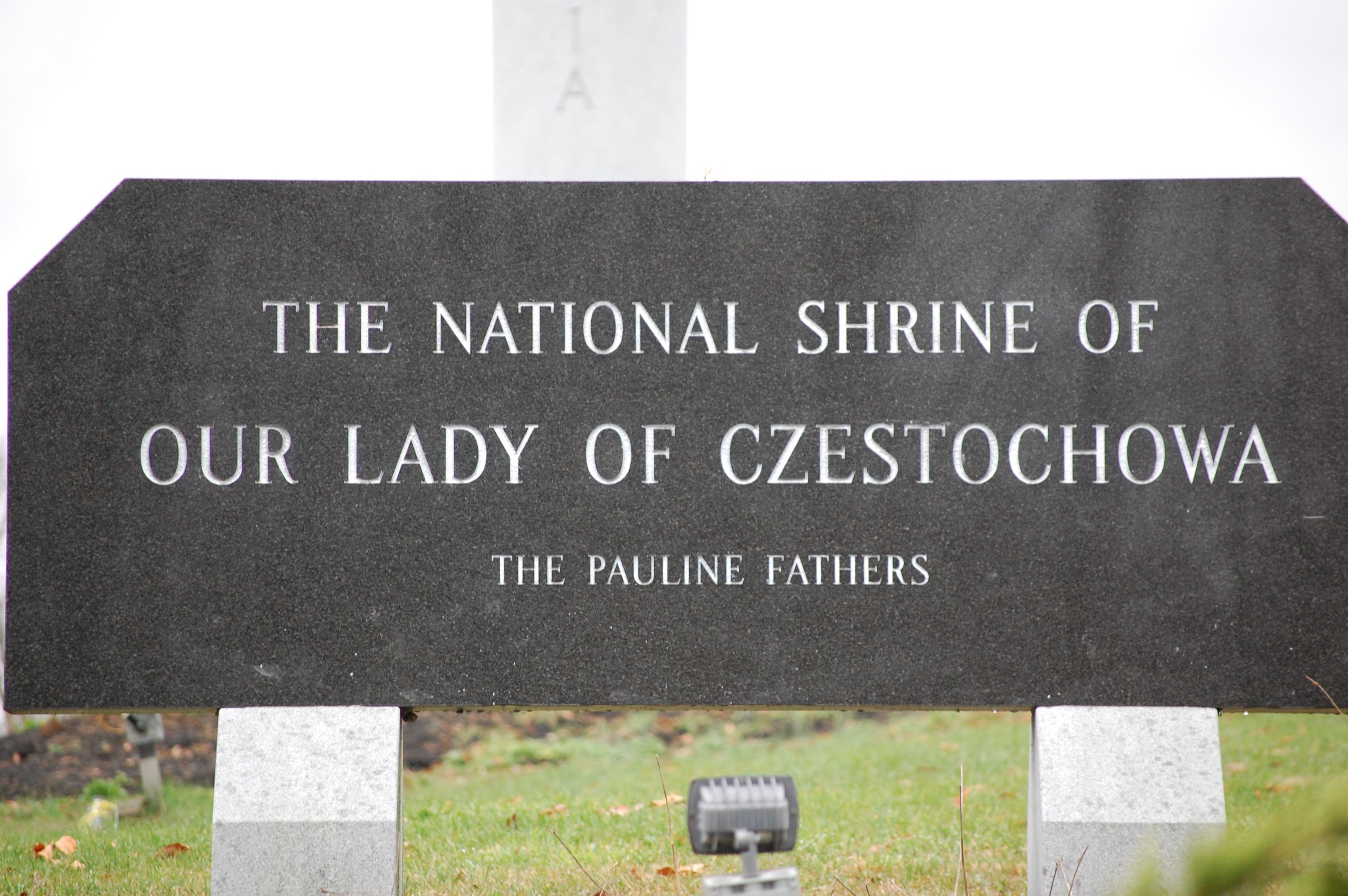
Entrance to the shrine complex.

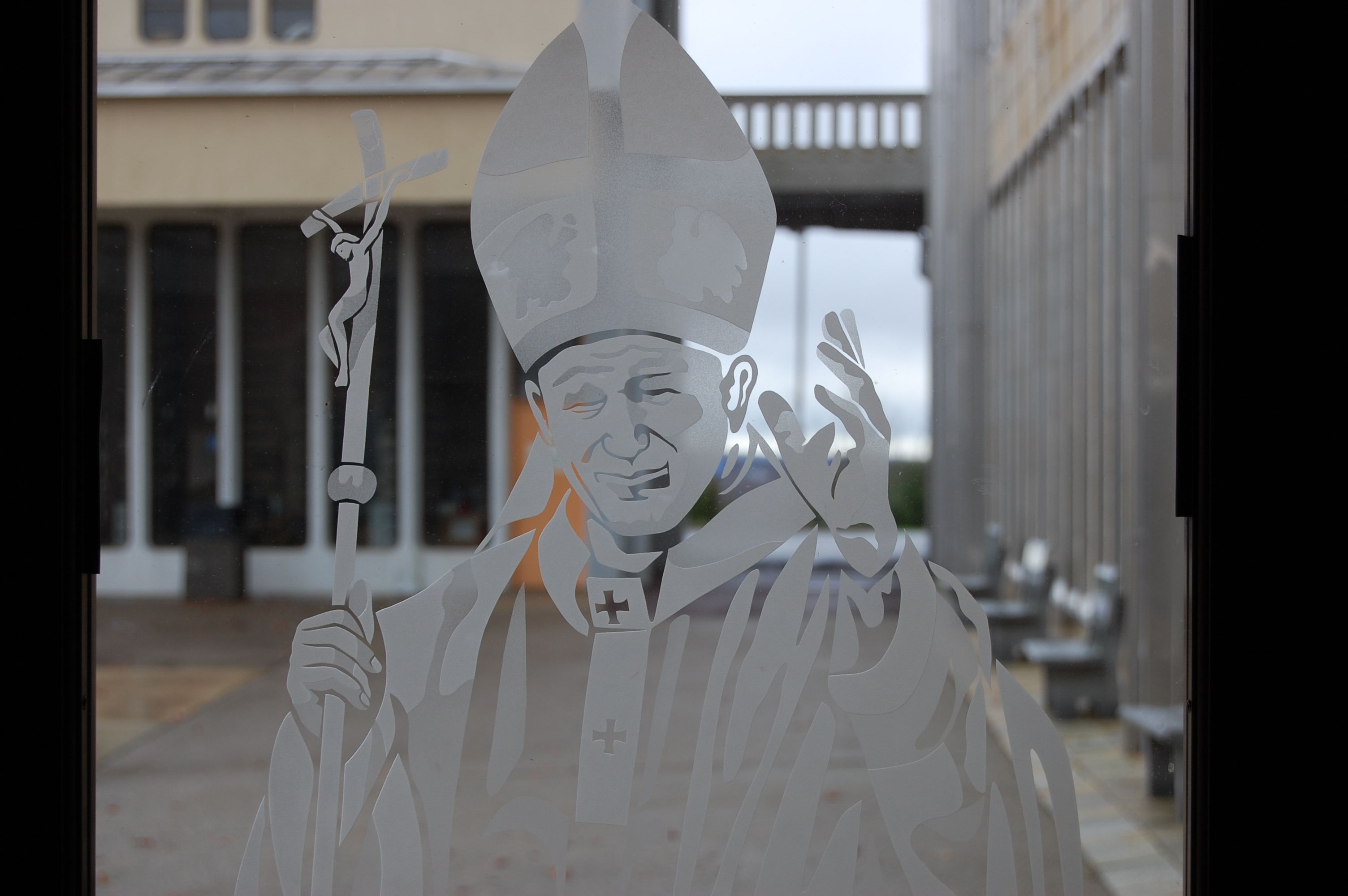
john paul at the door
Saint John Paul II
Feast day is October 22nd, the anniversary of his inauguration to Pope in 1978.

Opening the Doors to St. Patrick

17 Monday Mar 2014

Posted by Brian in Saints

≈ Leave a comment

Tags

bronze doors, Mother Cabrini, Saint Elizabeth Ann Seton, saints, St. Isaac Jogues, St. Joseph, St. Kateri Tekakwitha, St. Patrick, St. Patricks Cathedral

patrick window

St. Patrick was the founding bishop of the Irish church. According to legend the three leaf clover or Shamrock was coined by Saint Patrick for the Holy Trinity. Saint Patrick’s Day is observed on March 17, the date of his death.

In the background of this turn of the century bavarian stained glass window is St. Kevin’s tower (a 5th century monastery) in Glendalough, County Wicklow, Ireland. It is near the village of Laraugh, home of Thomas Kinsella, the poet laureate of Ireleand. From stained glass window at St. Basil the Great Church, Chester County, PA.

NewYorkStPatrick03

Shown above is St. Patrick’s Cathedral on Fifth Avenue in New York City. Photo taken from the Rockefeller Center.

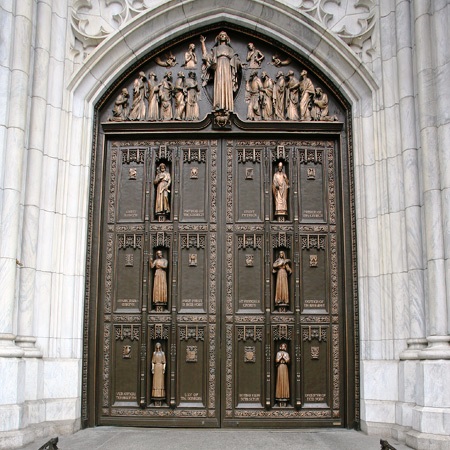
bronze doors3

The bronze doors of St. Patrick’s Cathedral. In the main door are six figures, (including St. Patrick) each playing a significant role in local church history in the State of New York and surrounding area. Just above them is the Figure of Christ the Redeemer surrounded by the twelve apostles, the Virgin Mary, St. John the Baptist and two angels with scrolls.

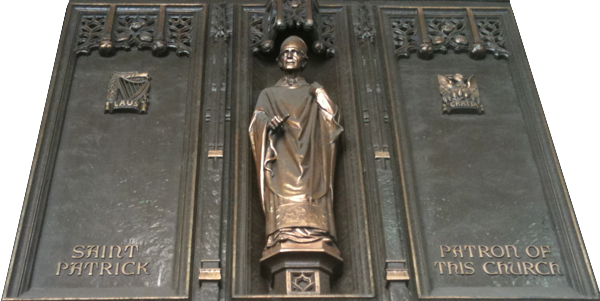
Saint_Patrick on the door

St. Patrick, the patron of the Archdiocese of New York and apostle of Ireland stands in the upper right section. On his left is the mystical phoenix rising to renewed life and the word “gratis” or gratitude. On his right is the Celtic harp and the word “laus” or praise.

St. Joseph, the upper left statue holds a budding staff, token of his espousal to the Virgin Mary and a carpenter’s square, symbolic of the saint as patron of workingmen. The design to his left refers to his position as earthly father of Christ, to his right the design is symbolic of his purity of life and intention.

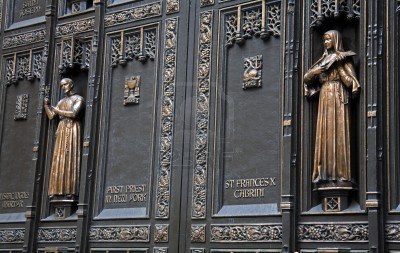
7210952-detail-of-door-at-st-patrick-s-cathedral-midtown-manhattan-new-york-city-new-york-usa

The middle left figure is Issac Jogues, the French Jesuit priest, who was the first Catholic missionary to enter New York state. He holds a crucifix representative of his mission to the Iroquois. The palm branch to his left is a martyrs symbol. The Greek letters ICXC and the word nika mean “Jesus Christ conquers”; the word passio means passion. The other panel has a chalice and the letters AMDG, which is the Latin motto for the Society of Jesus.

The middle right figure is that of Mother Cabrini, wearing the habit of the Missionary Sisters of the Sacred Heart, which she founded. To her left the dolphin and star symbolizes Pope Leo XIII’s direction to extend her apostolic work to the West; the word “spes” means hope. Two hands and a rose represent her heart going out to the immigrant; cor and Jesu means “heart of Jesus.”

In the lower left of the door stands St. Kateri Tekakwitha, an Indian maiden known as the Lily of the Mohawks and the Pocahontas of the Catholic Church. The design to her left shows an American eagle with the word fides meaning faith. To her right is the coat of arms of pope Pius XII, who declared her venerable in 1943. (She was canonized on October 21, 2012, Vatican City by Pope Benedict XVI)

seton-st.-patricks

The statue at the lower right is of St. Elizabeth Ann Seton, canonized the first American-born saint in 1975. The panel to her right shows a rose bush, for the official NY state flower and the word caritas meaning charity. On her left is the motto from Cardinal Spellman, Sequere Deum meaning Follow God. (St. Patricks Cathedral by Leland A. Cook)

450px-Atlasstpatricks

View of the Cathedral from across 5th Avenue with bronze statue of Atlas in foreground at right.

St. Patrick at Charles Borremeo Seminary

Tucked away in the library at St. Charles Borromeo Seminary in Philadelphia can be found St. Patrick.

happy st. patricks day

John Neumann’s World

22 Saturday Feb 2014

Posted by Brian in Saints, St. John Neumann

≈ 2 Comments

Tags

Alphonsus Liguori, Cathedral Basillica of St. Peter and Paul, John Nuemann, National Shrine of John Neumann, Redemptorist, Saint, Shrine of Philadelphia, St. Peter the Apostle Church

outside of church peter and paulSt. Peter the Apostle church, Upper Church of St. John Neumann Shrine in Philadelphia, Pennsylvania, built in 1843.

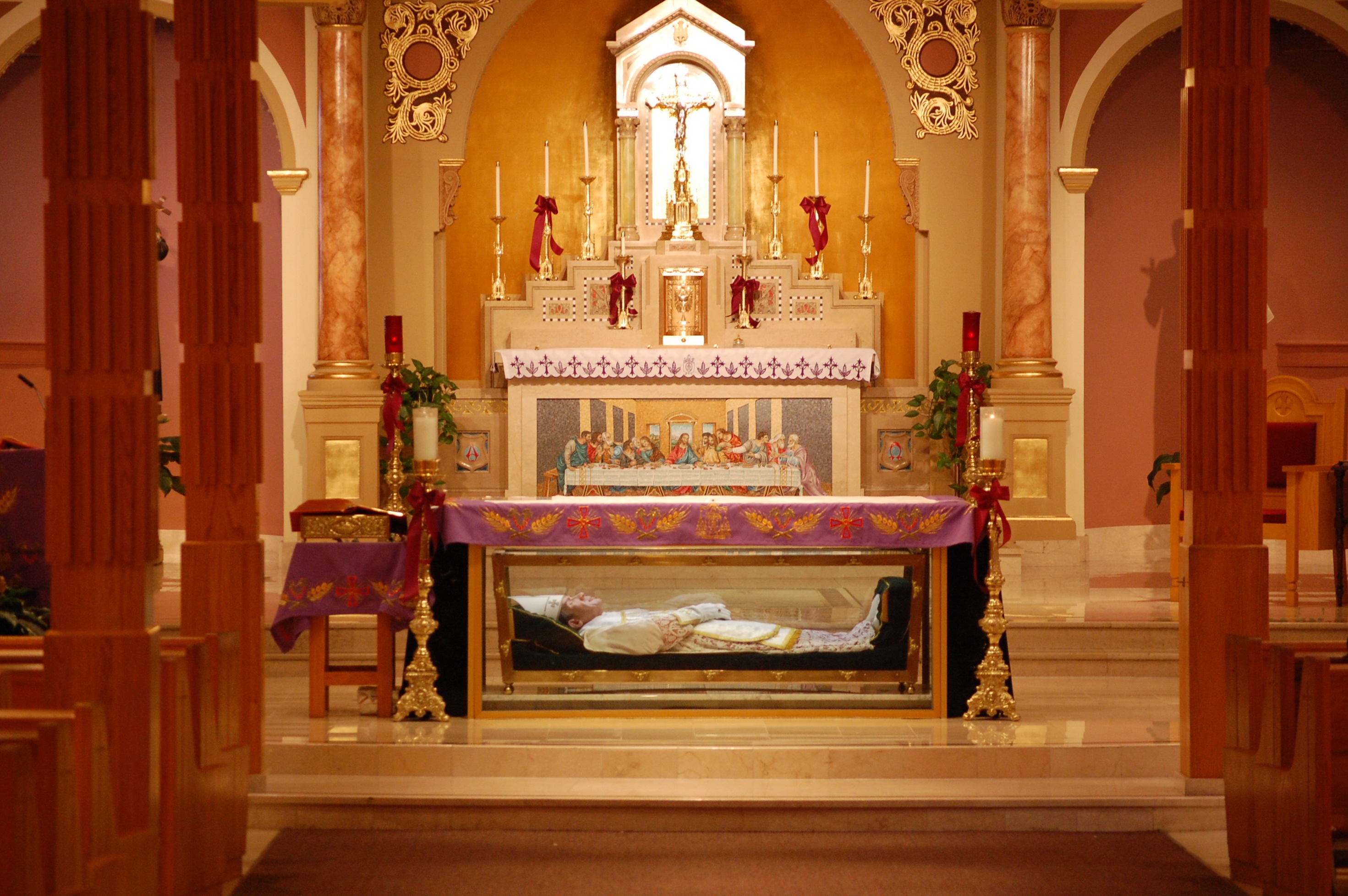
John Neumann (1811-1860) celebrated Midnight Mass (Christmas) in 1859, a few days before his death. After his funeral services he was laid to rest in a grave in the basement of St. Peter the Apostle church. The body now lies in state, enclosed in glass under the altar at what has become the world renowned National Shrine of St. John Neumann. Feast day is January 5.

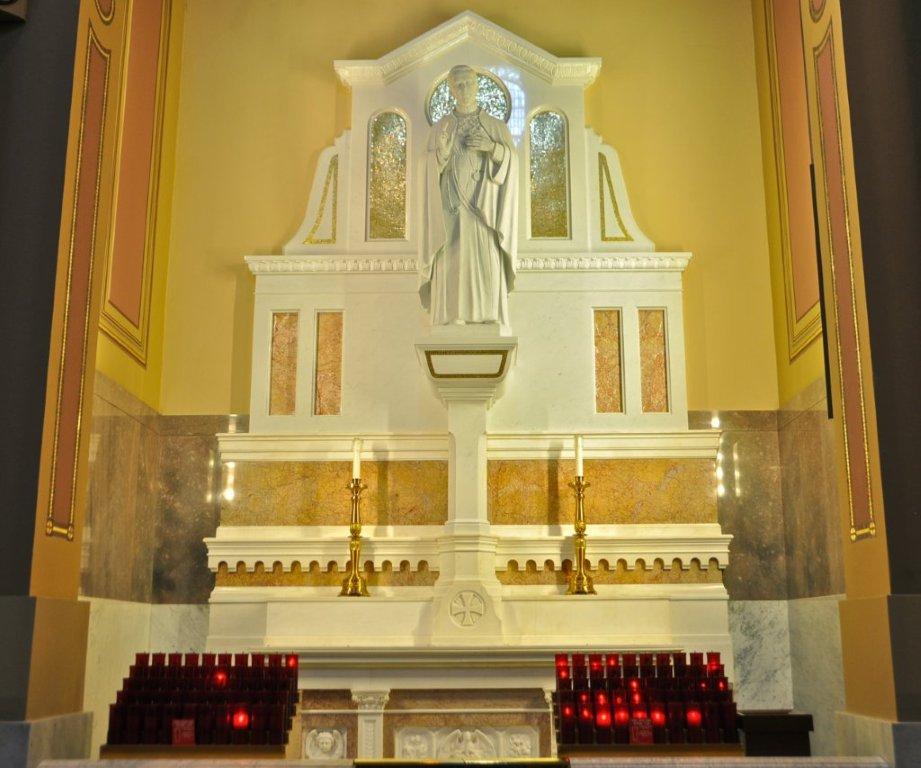
Lower Church Neumann shrine National Shrine of St. John Neumann, in Lower Church.

Prayer requests can be made to John Neumann for intersession by God to make the request realized. Saints themselves do not perform miracles, but recognized in Heaven as Saints, they can request from God to intercede on their behalf. The National Shrine of John Neumann has on record many of these realized prayer requests.

alphonsus liguori founder redemptorists Alphonsus Liguori is the founder of the Redemptorist religious order. (1732)

Saint Alphonsus Liguori is also a Doctor of the Church. Liguori was influenced by St. Teresa of Avila (1515-1582), St. Francis de Sales (1567-1622) and St. Vincent de Paul. (1581-1660). As Neumann became a Redemptorist and eventually its leader, he spread knowledge about these great saints.

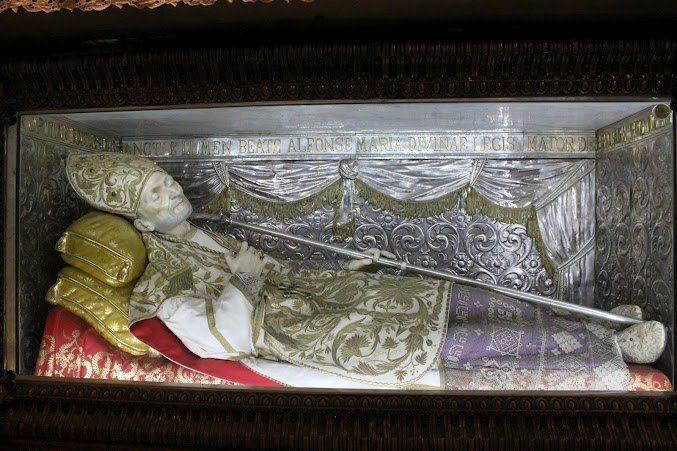
liguori at rest Saint Alphonsus Liguori, in state in Italy.

Pope Pius IX proclaimed Liguori a Doctor of the Church in 1871. In his book Preparation for DeathLiguori says, “While we are in the body, we are absent from the Lord.” (2 Cor. v. 6). While the soul is united to the body, it is at a distance from the vision of God, as if in a strange land, and excluded from its true country. Hence, according to St. Bruno, the departure of the soul from the body should not be called death, but the beginning of life.”

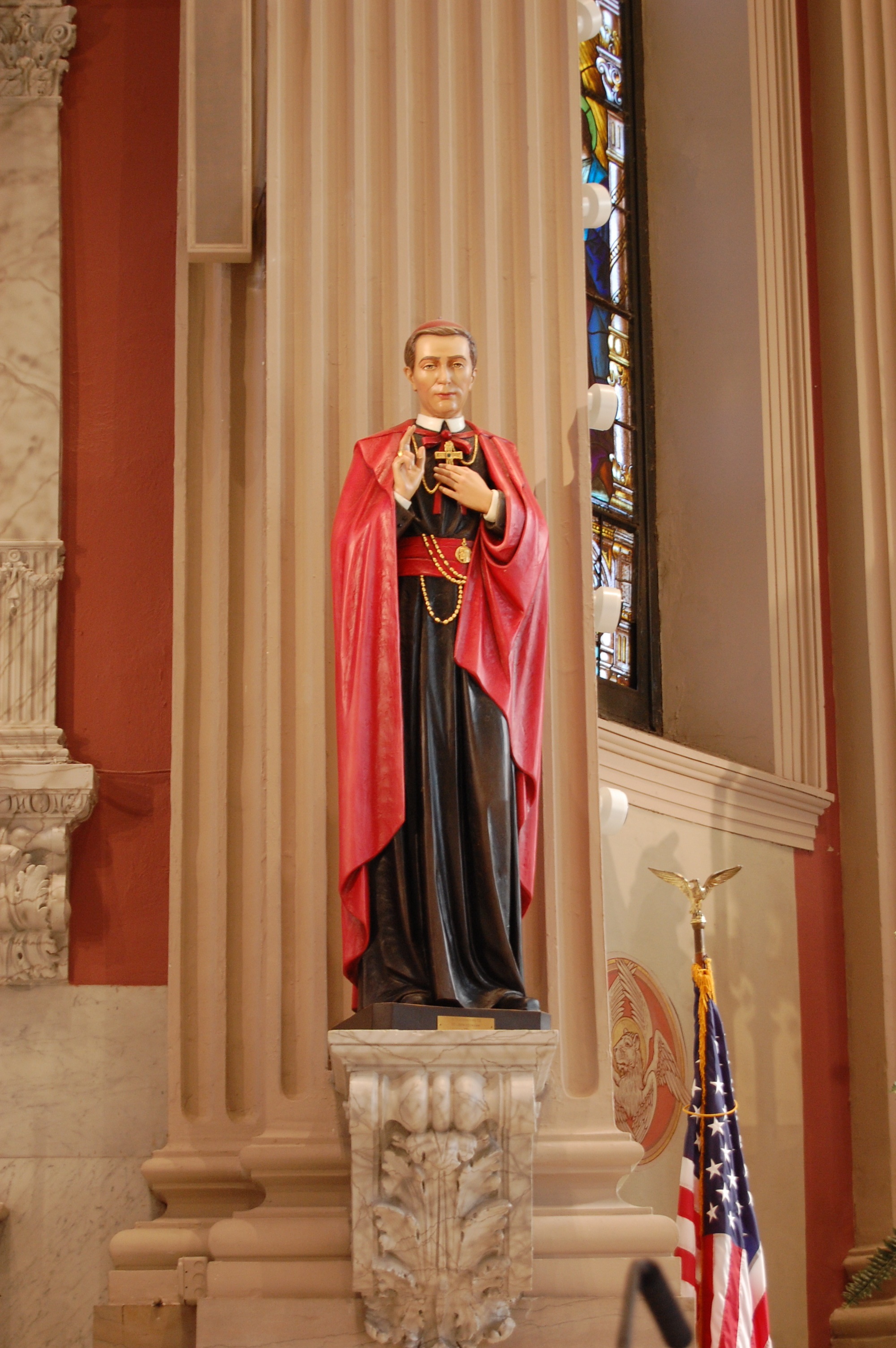
neumann icon in Upper Church Neumann in St. Peter the Apostle church, Upper Church of the Neumann Shrine, Philadelphia, Pennsylvania.

biship nuemann diocese4
A large diocese to manage.

First appointed Superior of the Redemptorist American Mission in 1850, then on March 19, 1852 Nuemann was consecrated bishop of Philadelphia, a role he really didn’t want.

Nuemann at st. peter and paul At Cathedral Basilica of Saint Peter and Paul, St. John Neumann Chapel.

Opened in 1864, the Cathedral is the motherchurch of the Archdiocese of Philadelphia. One of the first tasks when Neumann became Bishop was to complete the Cathedral. Unfortunately due to money constraints, the Cathedral completion was delayed. The cathedral was finally dedicated on November 20, 1864, where it stands today.

Neumann shrine  p and p More of Neumann in the Basilica of St. Peter and Paul.

The interior of the Basilica is in Roman-Corinthian style with a dome at 156 feet high. St. Katherine Drexel, a contemporary of John Nuemann, also has a side chapel, one in which she donated while she was alive! The Basilica is one of the finest east coast examples of architecture expressing our Catholic faith.

neumann shrine entranceThe future planned entrance of the St. John Neumann Shrine.
The Shrine continues to thrive and remains active in the local community, much as Nuemann did while alive.

Jesus rises 2 In St. John Nuemann Shrine, looking up, in all its glory.

Thomas Aquinas – The Angelic Doctor

28 Tuesday Jan 2014

Posted by Brian in Saints

≈ Leave a comment

Tags

Angelic Doctor, Dumb Ox, saints, St. Thomas Aquinas, Summa Theologica, Thomists

St. Thomas Aquinas got his name from the town he was born 8 km north of Aquino, Italy in 1225. He was also called the “Dumb Ox” for his quiet demeanor and being a large framed man. He knew and was inspired by John of St. Julian, a member of the Dominicans, started by St. Dominic around 1216. Thomas would eventually become a Dominican at age 19. The other influential person was Peter of Ireland, an academic who taught Thomas. One other Saint of this time was Albert the Great whom Thomas met in Paris. Albert was the leading academic and expert in science, history, astronomy, music and scripture.

St. Thomas Aquinas Icon

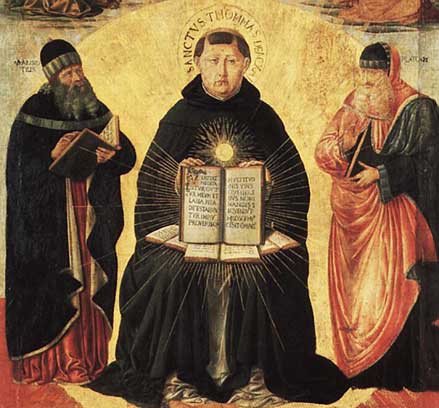
Thomas was a theologian and philosopher and wrote a seminal document called the Summa Theologica which is widely available as an ebook and book today. Thomas is a Doctor of the Catholic Church. Those that study Thomas’s teachings are know as Thomists. Two modern day Thomists are; Ralph McInerny (d2000) who taught philosophy and medieval studies at Notre Dame, and Dr. Taylor Marshall, a theology professor and avid blogger, who created the New Thomas Institute, an on-line series of courses on Thomas in 2013.

Aquinasbeforecommunion

Also known as the Angelic Doctor, Thomas Aquinas felt each angel in heaven was a separate species, not just an angel species. On earth every Human belongs to the human species, in heaven there are numerous different species or forms of angels according to Thomas. Humans rationalize and ponder, angels never think through their forms, they have pure formal knowledge. Thomas takes the angels debate further than the ancient Greeks. He philosophically describes the fallen angels and their wickedness. Thomas expands St. Augustine’s thought on Satan and evil angels. The fallen angels wanted to be called God, to be be worshiped like God. Although originally created as good angels, they inherently choose to become evil.

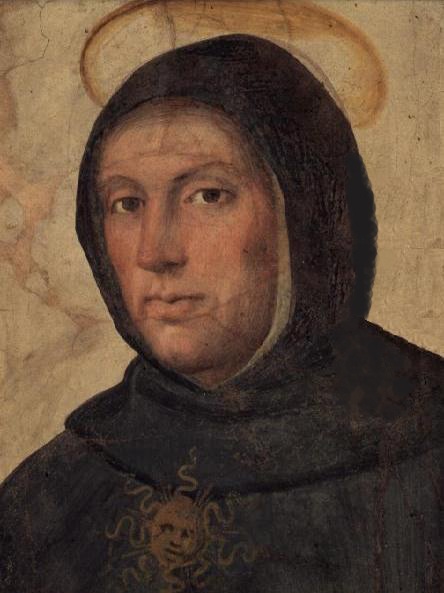
Thomas_Aquinas_by_Fra_Bartolommeo

Thomas stopped writing his Summa Theologica in 1273 after a mystic appearance by Jesus Christ at Mass and kept the vision to himself till death, four months later on March 7, 2074.

Today, Thomas Aquinas teachings continue to flourish in the Catholic Church. And probably will for another 800 years.

Additional insight:
Dr. Taylor Marshall, an avid blogger, wrote Thomas Aquinas in 50 Pages (taylormarshall.com), whith topics like “How to think like Thomas Aquinas” and “the difference between philosophy and theology”. On the later topic, per Dr. Marshall; philosophy pertains to reason alone and the love of wisdom, while theology pertains to divine revelation and the study of God. With email sign up, the ebook is free.

A First Glance at St. Thomas Aquinas, A Handbook for Thomists, by Ralph McInerny has topics like “Aristotle and the Beatific Vision” and “The Meaning of life” and “Does God Exist” according to Thomas.
“There is nothing on this earth more to be prized than true friendship.”
— Thomas Aquinas
(Patron saint of universities and students; Feast Day is January 28th)

St. Paul the Hermit Embraces Our Lady of Czestochowa Shrine in Pennsylvania
15 Wednesday Jan 2014

Posted by Brian in Our Lady of Czestochowa, Saints

≈ 2 Comments

Tags

Our Lady of Czestochowa Shrine, Paul the Hermit, Pauline Fathers

DSC_0174 St. Paul the Hermit

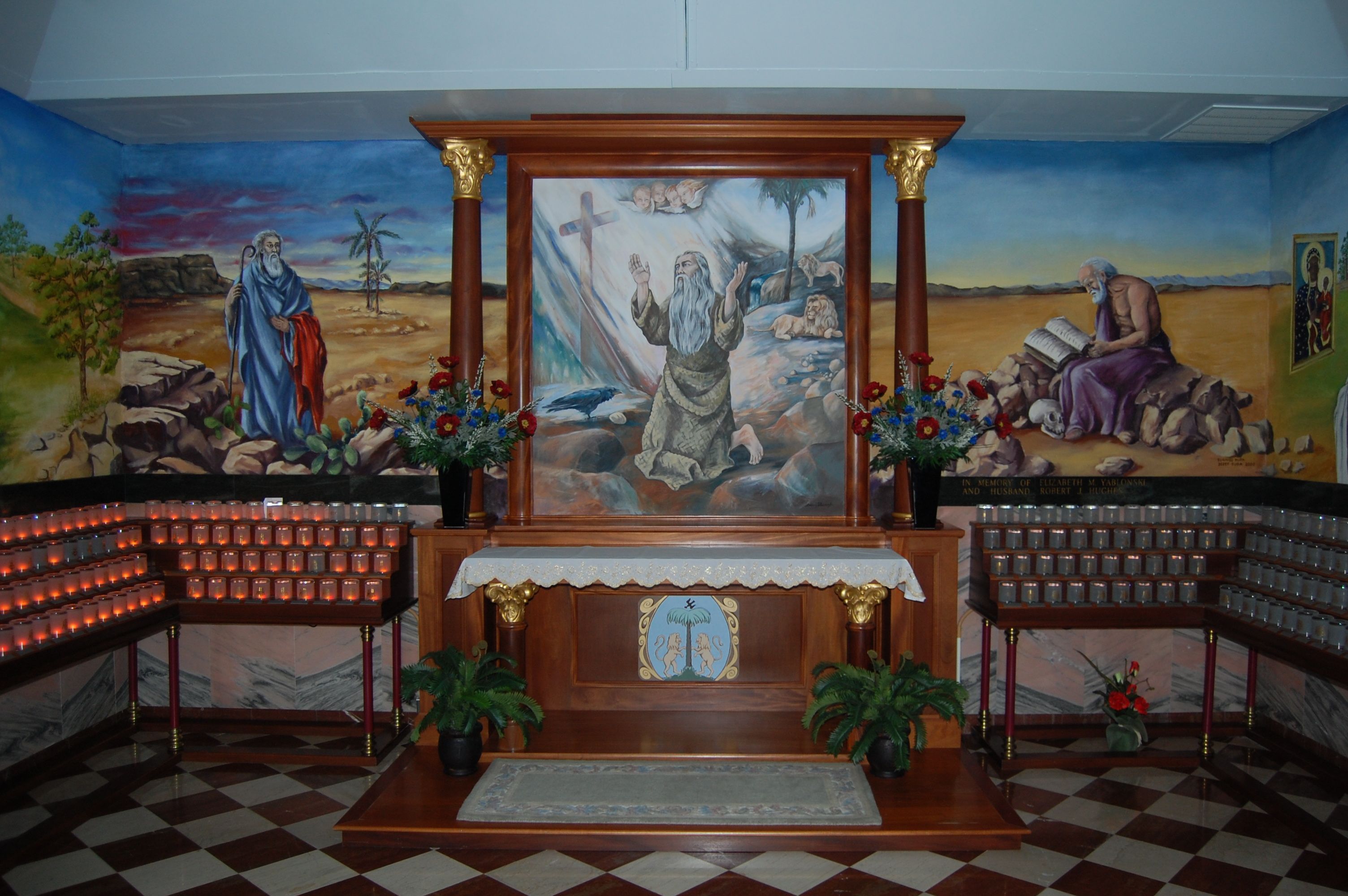
Paul the Hermit is also known as Saint Paul of Thebes, the First Hermit (230-343). The above painting of Paul the Hermit resides in a side chapel at Our Lady of Czestochowa Shrine in Doylestown (Philadelphia) Pennsylvania. The lions in the background are Paul’s protection. The chapel is dedicated to St. Paul the Hermit whose feast day is on January 15.

st. paul the first hermit St. Paul the Hermit at the entrance to Our Lady of Czestochowa Shrine.

The Pauline religious order was founded by Blessed Eusebius in 1250 in Hungary. The members of the order were hermits, living in caves in Hungary. For their patron saint they chose St. Paul the Hermit and are called the Pauline Fathers. “Alone with God alone” is the Pauline motto. The order adheres to the Rule of St. Augustine, which was given to them in the year 1308.

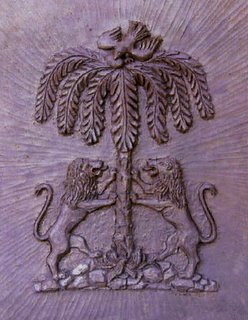
pauline order symbol From the coat of arms of the Paulines. The date palm represents how St. Paul the Hermit produced clothing using the leaves of the palm tree. The fruit of the palm tree helped sustain the Hermit in the desert. The Raven with a loaf of bread in its beak is the bird, through Gods intercession, brought half a loaf of bread to the Hermit every day for 90 years.

The monastic order spread throughout the countries of Hungary, Poland, Croatia, Austria and Bavaria. The Paulines have a strong devotion to the Blessed Virgin Mary, and reside and operate Our Lady of Czestochowa Shrine in Pennsylvania. The monks can be seen on the campus praying the rosary in their all white habit with a large five foot wooden rosary hanging on their sides.

DSC_0136 The Chapel of Saint Paul the Hermit, at Our Lady of Czestochowa Shrine in Pennsylvania. Three additional side chapels in the Lower Church are dedicated to Our Lady of Nazareth, Divine Mercy and Our Lady of Guadalupe.

lower church altar on adoration day Lower church altar on Adoration day. A replica of Our Lady’s Chapel from the Jasna Gora Monastery in Czestochowa Poland is above. The black and silver altar with the central replica painting of the Black Madonna. The original from 1382 resides in Poland.

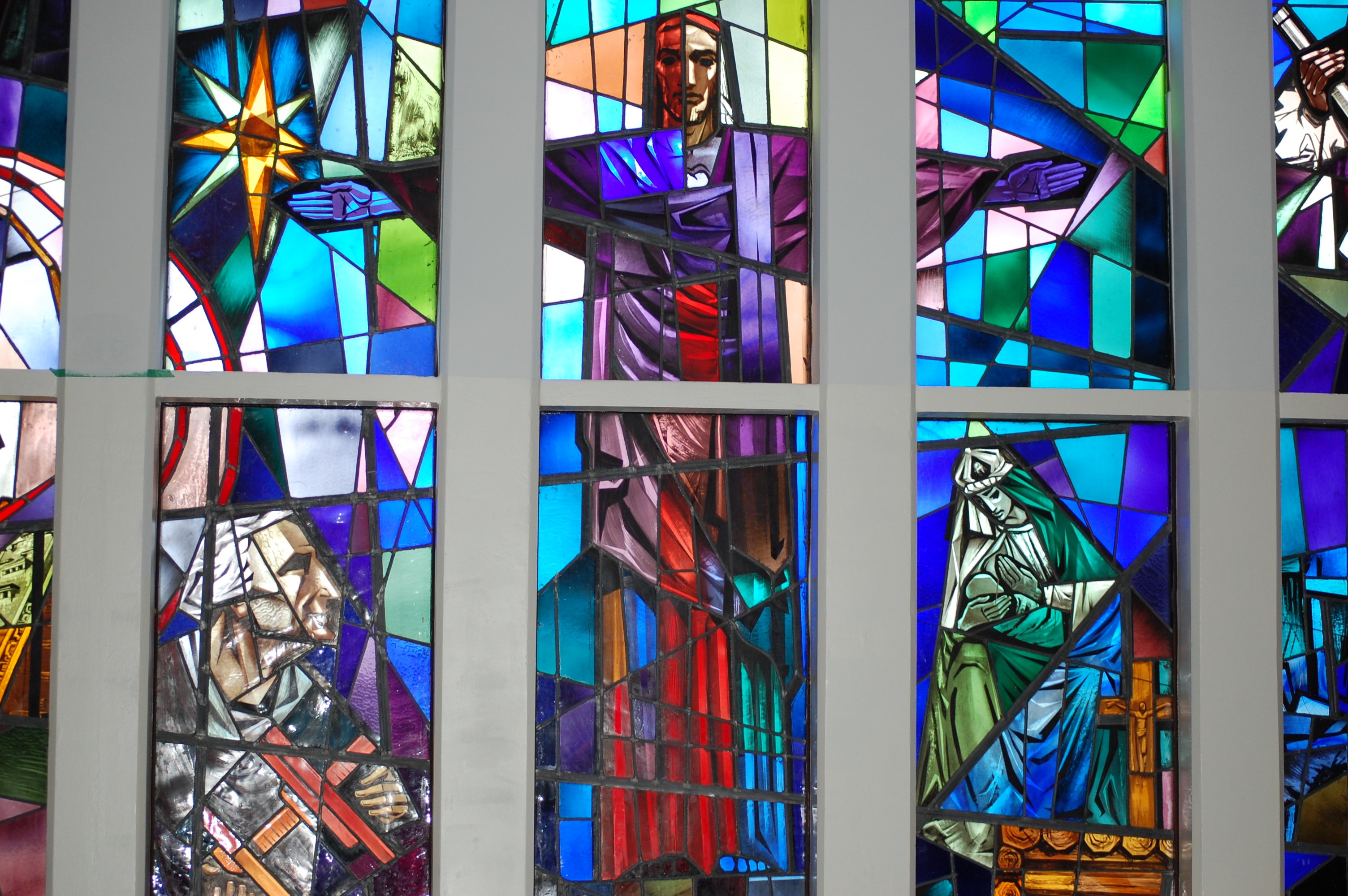
Jesus in the window Jesus in the stained glass window, from the Upper Church.

DSC_0442

story of A massive 100 foot high stained glass window with the storyline of Americas founding fathers, the Paulines, and St. John Paul II to name a few.

Blessed Pope Paul St. John Paul II looking out at the Pennsylvania countryside. How good it all is at the National Shrine of Our Lady of Czestochowa.

St. Thomas of Villanova: The Man, The Church, The University

22 Sunday Sep 2013

Posted by Brian in Parish Shrines, Saints

≈ 2 Comments

Tags

saints, Thomas of Villanova, Villanova University

st. thomas of villa statue

St. Thomas of Villanova, an Archbishop, educator and carer of the poor. The patron saint of Villanova University, shown in the plaza in front of St. Thomas of Villanova Monastary. He lived from 1488-1555. His feast day is September 22nd.

st. thomas of villa statue detail

Details depicts Thomas dressed as a bishop with crozier and mitre, giving alms to poor children.

DSC_0044

St. Thomas of Villanova Church on the campus of Villanova University, Philadelphia, Pennsylvania.

DSC_0018 copy

DSC_0120
St. Thomas attended Arts and Theology at the University of Alcala de Henares and eventually became a university professor. He decided to leave the university setting and entered an Augustinian monastery.

DSC_0036

Later in life St. Thomas received mystical encounters with God, having ecstatic visions during Mass. He sucumbed a heart condition in 1555 at the end of Mass. He is said to have died on the floor rather than in his bed, which he insisted on offering to a poor man who had come to his house.

DSC_0032 copy
He was a great preacher and Emperor Charles V, upon hearing him preach, exclaimed, “This monsignor can move even the stones!” He also had a great devotion to the Virgin Mary, whose heart he compared to the burning bush that is never consumed. He was canonized by Pope Alexander VII on November 1, 1658. His feast day is celebrated on September 22.

DSC_0101 copy

nova

DSC_0078

St. Augustine statue with his own heart set on fire with the love for Christ. The friars of his religious order founded Villanova University, where they administer today.
rita at villa
Another Augustinian, St. Rita of Cascia, shown here at one of the courtyards in the St. Augustine Center for Liberal Arts at Villanova University.

St. Augustine’s Philadelphia Storyboard

28 Wednesday Aug 2013

Posted by Brian in Parish Shrines, Saints

≈ Leave a comment

Tags

Augustinian religious order, Philadelphia, St. Augustine, St. Rita

close up augustine

A Bishop and Doctor of the Church, St. Augustine continues to wield influence.

outside 2013

St. Augustine R.C. Church is a historic shrine in downtown Philadelphia Pennsylvania. It was established in 1796 by the Irish Friars of the Order of St. Augustine and is the fourth oldest church in Philadelphia. The Augustine Academy founded in 1811 became Villanova University, the oldest Catholic school in Pennsylvania.

thomas of villanova
Thomas of Villanova, an Augustinian in the entrance to St. Augustine Church. Villanova University is currently staffed by and operated by Augustinians.

augustine4
It has been said that Augustine wrote over 100 books and 5,000,000,000 words, inspiring many theologians of his time and our time. He is one of the four Great Fathers of the Latin Church.

“In the midst of the Church he opened his mouth, / and the Lord filled him / with the spirit of wisdom and understanding / and clothed him in a robe of glory.”
Entrance Antiphon Cf. Sirach 15:5 Mass at St. Augustine Feast Day, Aug 28, 2013.

main altar st. augustine

Inside the historic shrine.
“The five external senses are the doors by which life and death enter the soul.” -St Augustine

rita
St. Rita of Cascia, an Augustinian nun, in the back of St. Augustine Church. The National Shrine of St. Rita of Cascia is nearby and is one of the five official shrines in the Archdiocese of Philadelphia.

heaven with Augustine
Heaven with Augustine. The ceiling frescoes depict scenes from “St. Augustine in Glory.”

teresa
Teresa of Avila, taught by Augustinian nuns, also at St. Augustine Church.

leaving
Leaving St. Augustine Church.

saying on entrance

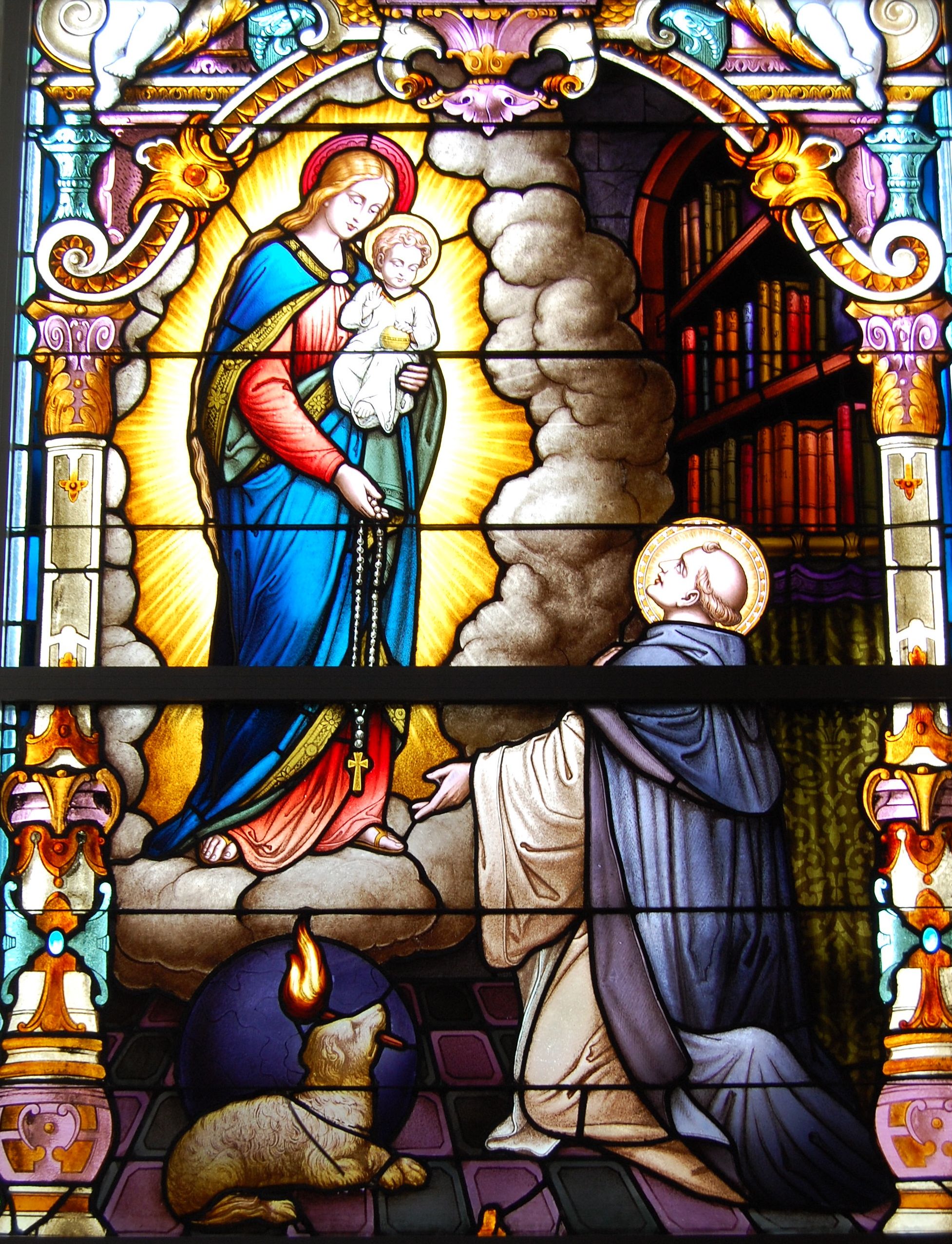
St. Dominic and the Rosary

08 Thursday Aug 2013

Posted by Brian in Saints

≈ Leave a comment

Tags

Dominic, Dominicans, Holy Rosary

dominic face 2 best

Dominic was a 13th century Spanish priest who founded the Dominicans. He and his followers lived an austere and pious lifestyle based on the original apostles lifestyle. Their contemporaries were the Benedictines. Rather than live in a monastery, they went out to the people on the open road. Without money, they would travel on foot from town to town preaching the Gospel. St. Dominic is the patron saint of astronomers. His feast day is August 8th.

Tradition holds that Dominic received the rosary structure from Mary, Mother of God in a vision. The 150 Hail Mary’s are said to honor the 150 psalms in the bible, with 15 decades of ten Hail Mary’s each.

Dominic and the Rosary
St. Dominic Receiving the Rosary, St. Basil the Great, Chester County PA.

“A man who governs his passions is master of the world. We must either command them, or be enslaved by them. It is better to be a hammer than an anvil.” (anvil in this sense is a heavy iron block)

Archbishop Fulton Sheen said, “The rosary is the book of the blind, where souls see and there enact the greatest drama of love the world has ever known; it is the book of the simple, which initiates them into mysteries and knowledge more satisfying than the education of other men; it is the book of the aged, whose eyes close upon the shadow of this world, and open on the substance of the next. The power of the rosary is beyond description.”

This writeup, A brief history of the Holy Rosary. explains the rosary foundation.

Ignatius of Loyola – Feast Day, Founder of Jesuits; Pope Francis religious order

31 Wednesday Jul 2013

Posted by Brian in Parish Shrines, Saints

≈ 1 Comment

Tags

Old St. Joes, saints, St. Ignatius of Loyola

Ignatius pic monkey
St. Ignatius Of Loyola (Author rendition).

“The goal of Ignatian prayer and ministry is not to find God but to allow God to find you”

The leading Jesuit voice in Philadelphia is at Old St. Joe’s with Father Duff Society of Jesus (SJ) presiding. The emphasis is certainly on the Jesuits today, from Pope Francis (a Jesuit) and his exuberance recently displayed from the World Youth Day in Rio, to James Martin SJ of America Magazine author of the famous book My Life With the Saints. And of course, it all started with the founder of the Jesuits, the great Ignatius of Loyola, whose feast is celebrated today.

DSC_0133
Entrance at Old St. Joseph’s National Shrine, Philadelphia PA

From Paul Coutinho, S.J.:

Ignatius is one of those Great Seers (Rishis) who attained Enlightenment (Satori in Zen Buddhism) on the banks of the river Cardoner. It was here that ““the eyes of his understanding began to be opened, not that he saw any vision, but he understood and learnt many things, both spiritual and earthly and this was so great an enlightenment that everything seemed new to him”” (Aut 30). From this moment on Ignatius was convinced that ““if there were no Scriptures to teach us these things of faith, he would be resolved to die for them, solely because of what he has seen”” (Aut 29). Ignatius found his own secret religion that helped him to scale mystical heights and also led him into constant conflict with people in power and institutions of his time.

We know that the Ignatian mysticism of service is nothing if not a deepening of our union and communion with the Divine. It is not so much doing things for God but it is a being in the Divine. Ignatian gazing or seeing is a spiritual method and exercise of contemplation where we open ourselves to what we contemplate and allow what we contemplate to seep into our hearts, filling us and transforming us into the mystery that we contemplate. Ignatius spent hours of his life gazing at the sky and through his contemplation would be moved to serve the Divine Majesty. ““It was his greatest consolation to gaze upon the heavens and the stars, which he often did, and for long stretches at a time, because when doing so he felt within himself a powerful urge to be serving Our Lord.”” (Aut 11).

What is Ignatius trying to tell us? If we have not shared our experiences of God with someone in one way or another, then we have lost them. But when we take the opportunity to share our experiences with someone, we will be confirmed and grow in those experiences.

Above excerpts from:
NUMBER 116 – Review of Ignatian Spirituality
IGNATIUS, AN ANCIENT SAGE WITH ETERNAL WISDOM, Paul Coutinho, S.J.
Editor: “IGNIS” Ignatian Spirituality, South Asia Gujarat, India

montserrat

From Brian O’Leary, SJ:

Ignatius chose to live with the tension between accepting both the validity of inner experience and the authority of the Church.

From his conversion onwards the element of movement played a central part in the spirituality of Ignatius. At Loyola he noticed how different spirits moved him and through this he learned the rudiments of discernment. When later he offered descriptive descriptions of consolation and desolation in the Spiritual Exercises (SpEx. 316, 317) the text can, according to some commentators, be best understood in terms of inner movements towards God (consolation) and inner movements away from God (desolation).

Within the Autobiography itself the centrality of movement can be demonstrated by a comparison between the very first sentence in the text and a statement referring to the time when Ignatius was dictating his story:
Up to his twenty-sixth year he was a man given to worldly vanities, and having a vain and overpowering desire to gain renown, he found special delight in the exercise of arms. (Aut 1)
He made a solemn avowal, the gist of which was to inform me that his intention had been to be sincere in all that he had related…and that his devotion, that is, his ease in finding God, was always increasing, now more than ever in his entire life. At whatever time or hour he wanted to find God, he found him. (Aut 99)

Above excerpts from:
THE MYSTICISM OF IGNATIUS OF LOYOLA
Brian O’Leary, SJ
Consultant in Ignatian Spirituality Dublin, Ireland

DSC_0115
Altar, Old St. Josephs Philadelphia, Pennsylvania

Here, the pastor of Old St. Joe’s, Fr. Dan Ruff, gives the “Ignatius Story”:

For many of you, this will be old news; but I am keenly aware that we constantly have new parishioners registering.  I am also often surprised to discover that some “old-timers” still have not heard the basic “Ignatius story.”  So here is the nickel version . . .

Iñigo Lopez de Loyola was born (we think) in 1491 in the little village of Azpeítia in northern Spain.  The village – now called Loyola, after its “favorite son” – is in the Basque Country; and Iñigo’s own family (he would not adopt the name Ignatius until adulthood) were of the Basque landed gentry.  The 13th child, he was orphaned very early in life and was raised by his older brother Pedro and his wife Maria.

Born into a world still dominated by the feudal system, the 13th child did not have much claim to family inheritance; so Iñigo no doubt counted himself fortunate when his brothers used their influence to place him, at the age of 15, as a page in the house of Juan Velásquez de Cuellar, the treasurer of King Ferdinand of Castile.  There, the young man received a formal courtly education, although the evidence suggests that he took to sword play and courtly rituals more than he did to book learning. 

When his patron died in 1517, Iñigo was able to secure a similar post in the retinue of Antonio Manrique, Duke of Nájera and Viceroy of Nazarre.  I like to think that if he were alive in theU.S.today, this whole “courtier” phase of Ignatius’ youth would correspond to his becoming a congressional “page” with business or political aspirations.  The real motivation was the chance to network, rub elbows with the powerbrokers, and enjoy the parties and “perks” along the way. 

Late in life, in his so-called “Autobiography,” Ignatius would characterize his youthful self as having been much given over to vanity and worldly ambition.  We also know that, like many a brash young man, Ignatius indulged in the occasional “youthful indiscretion,” relying on his political connections to protect his reputation and get him out of his self-made scrapes.  At one point, for instance, he was taken to court for having injured someone in a hot-headed brawl; and rumors persist about illegitimate children.
In 1521, when he was already 30 years old, Ignatius ‘ duties to the Duke of Nájera found him defending the fortress of Pamplona with a small contingent of Spaniards against an army of French invaders.  Ignatius and his comrades were greatly outnumbered, but our young hero – displaying great courage and pluck (bravado?!) – persuaded them that they could successfully defend the besieged fortress.  Things were going surprisingly well until a French cannonball came over the ramparts and seriously injured both of Ignatius’ legs.  With their “cheerleader” laid low, the Spaniards soon surrendered; and the French victors, impressed with Ignatius’ valor, agreed to transport the injured man to the family home in Azpeítia (Loyola).

DSC_0110
View of Organ, Old St. Joseph’s, founded 1733 in Philadelphia, Pennsylvania USA

Once there, Ignatius nearly died of infection; but that did not prevent his having the right leg rebroken and reset – not once, but twice (both times unsuccessfully)!  Why?  In hopes that he could once again wear the fashionable tight hose that would show off his fine calves to the ladies at court!  As the long lonely bedridden months stretched on, Ignatius was reduced by depression and boredom to reading the only two books available – a life of Christ and a collection of lives of the saints.  Attending to his daydreams, he began to find that his old ambitions for fame, glory, and the hand of a beautiful woman, while still attractive, left him unsatisfied.  By contrast, new thoughts of serving God and imitating Sts. Francis and Dominic seemed to offer him deeper and longer-lasting satisfaction.  Thus began Ignatius’ great conversion, and his discovery of what would become “discernment of spirits.”

In 1522, having recovered his health (but left with a permanent limp), the new convert went to the monastery at Montserrat where he made a 3-day general confession and kept a knightly vigil-at-arms at the altar of his new “Lady fair,” the black Virgin of Montserrat.  Leaving his armor behind there, he dressed in a pilgrim’s sackcloth, substituting a walking staff for his sword.  Intending to pass through the town ofManresa, he ended up instead residing in a cave for 10 months of solitude and prayer, living on alms and building a friendship with God and Jesus. 

His extensive notes would become the basis for his “Spiritual Exercises” – the famous manual which would ground Ignatian spirituality and eventually win its author the title of “patron saint of retreats.”  It is noteworthy that he wrote the “Exercises” and began to lead others through them while still a layman with no thoughts of religious life or priesthood.  His lay status would lead to repeated arrests by the Inquisition, which would eventually lead to theology studies at theUniversityofPariswith an eye toward ordination.  His school chums there, having made the “Exercises” under his guidance, would eventually become the first members of the Society of Jesus (the Order was given papal approval in 1540).

Ignatius envisioned a priestly order of well-trained men, distinguished in virtue, who would serve the universal (global) Church at the pope’s good pleasure, going wherever they might “help souls” – particularly where the need was greatest, and where others could not and would not go.  That sense of Jesuit mission would eventually dictate that a missionary, Fr. Joseph Greaton, S.J., would found a parish in colonial Philadelphia 279 years ago.  And here we are.  Come celebrate our Ignatian heritage on July 31!

Above excerpt from Fr. Daniel M. Ruff, S.J. “From the Pastor” Old St. Joseph’s Parish July 2012

A fine Ignatius blog is here.

“Go forth and set the world on fire.”

― St. Ignatius of Loyola

← Older posts
Newer posts →
Follow @shrinetower

Enter your email address to follow this blog and receive notifications of new posts by email.

Most Recent Posts

  • Theosis: Becoming Like God — “Be Attentive” to Divine Energy
  • St. Basil the Great, the Jesus Prayer, and the Wisdom of the Three Holy Hierarchs
  • From Elijah to Today: The Legacy of Mount Carmel
  • Celebrating St. Basil: Paths to Divine Union and the Essence of Eastern Christianity
  • J.S. Bach – Christmas Oratorio BWV 248
  • Merry Christmas to all!

Previous Posts

Tags

Eastern Christianity Gregory of Nyssa music Pope Francis Saint saints Shrine St. Basil St. Ignatius of Loyola St. Vincent de Paul

The Cover Art

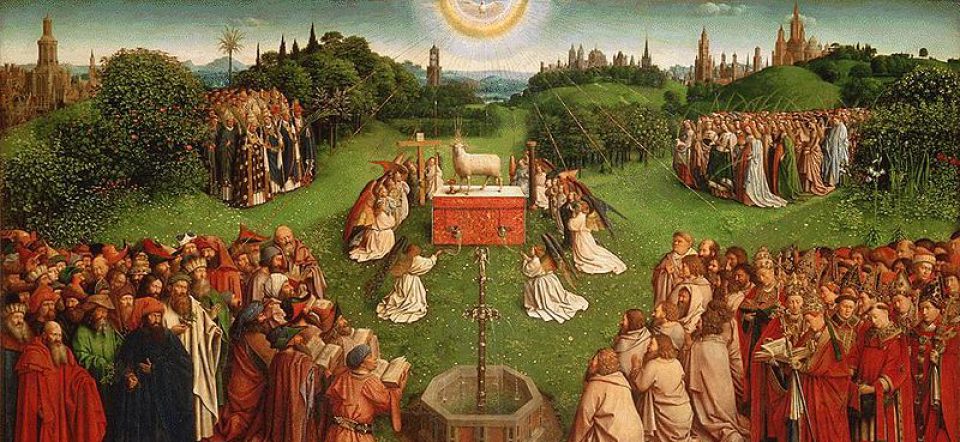
Jan Van Eyck, “The Adoration of the Lamb” 1432 from the Ghent Alterpiece. Detail: The red altar where the lamb stands reads, “Behold the Lamb of God, which taketh away the sins of the world” and “Jesus the way, the truth, and the life”, both quotes from Gospel of John. In this image and in the book of Revelation the Lamb is Jesus. Directly around the Lamb on the altar are angels who are carrying the instruments in the Passion scenes, like the cross and crown of thorns.

gichontree

Unknown's avatarThere's beauty in sacred spaces; from the stories they tell in architecture, stained glass windows and icons; to the rituals and liturgy that arises our soul. Inside a shrine, the angels and saints praise God with us. I hope to relay the message for the kingdom, power and glory of God, now and forever.

Blog at WordPress.com.

Privacy & Cookies: This site uses cookies. By continuing to use this website, you agree to their use.
To find out more, including how to control cookies, see here: Cookie Policy
  • Subscribe Subscribed
    • Shrine Tower
    • Join 76 other subscribers
    • Already have a WordPress.com account? Log in now.
    • Shrine Tower
    • Subscribe Subscribed
    • Sign up
    • Log in
    • Report this content
    • View site in Reader
    • Manage subscriptions
    • Collapse this bar
 

Loading Comments...