Tags
Marian Art, National Shrine of the Immaculate Conception, Onorio Marinari, Our Lady of Sorrows, Seven Sorrows of Mary
This post begins a 12-month ShrineTower series contemplating Mary through prayer and sacred art. Beginning with September, each monthly reflection will explore a Marian prayer, its meaning and origin and the artwork accompanying it.
September is traditionally associated with Our Lady of Sorrows, whose memorial the Catholic Church observes on September 15. This devotion remembers the sufferings Mary endured in union with her Son, particularly as she stood beneath the Cross.
Prayer to Our Mother of Sorrows
Father, as your Son was raised on the cross,
His Mother Mary stood by Him,
Sharing His sufferings.
May she, who is also our spiritual Mother
And Patroness in Heaven,
Help us to find renewed strength
At the Cross of Christ
And so come to share
In His rising to new life,
Who lives and reigns forever and ever.
Amen.
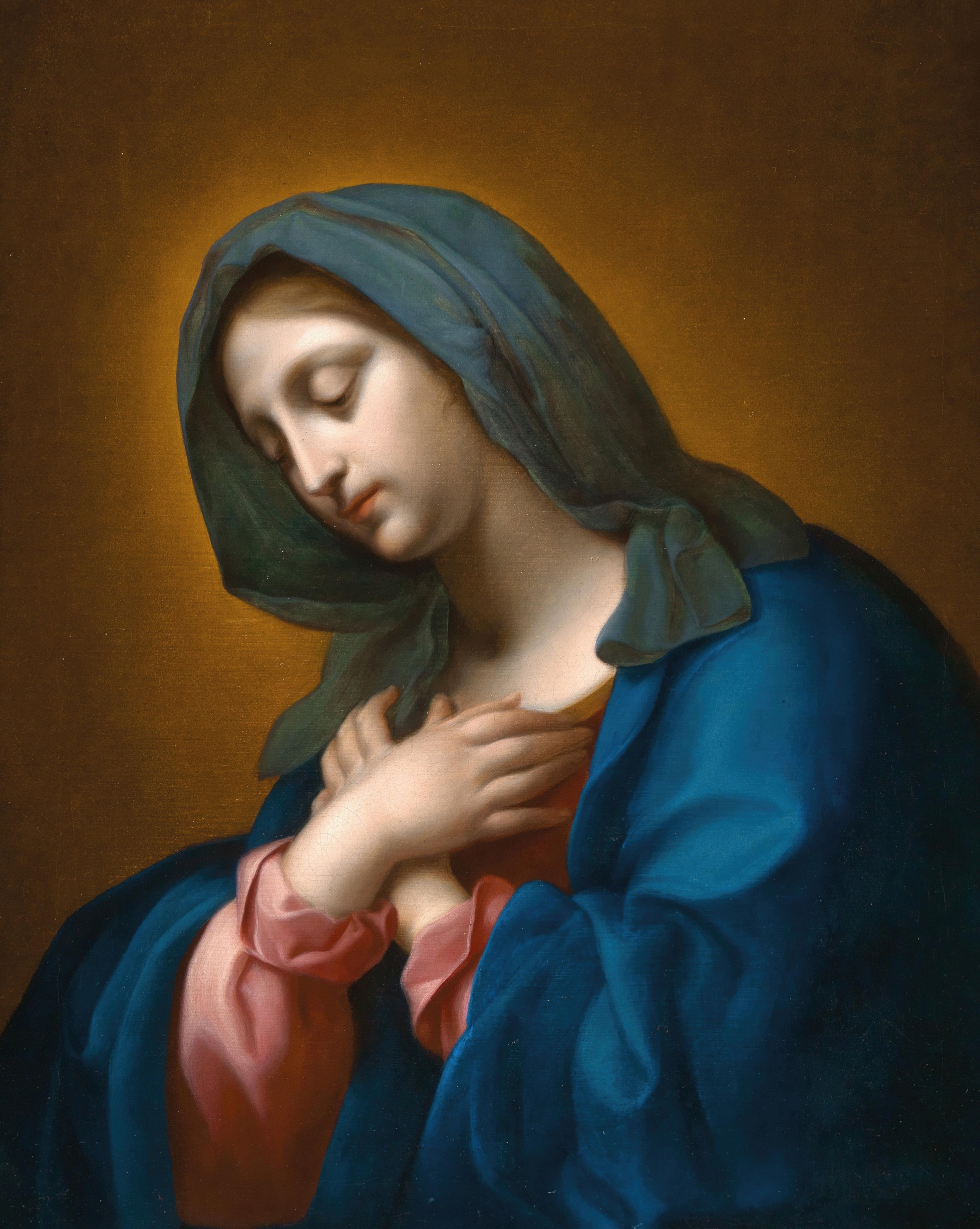
The Madonna by Onorio Marinari
The accompanying painting is The Madonna, an oil painting by the Florentine Baroque artist Onorio Marinari (1627–1715). Its attribution to Marinari was confirmed by art historian Sandro Bellesi when the painting appeared in a 2020 Dorotheum auction.
The stillness of the image is part of its power. Mary’s sorrow appears restrained rather than dramatic, becoming a quiet, persevering prayer. She remains faithful beneath the weight of suffering and waits in faith for what she cannot yet see—the Resurrection.
Marinari studied with his father before working in the studio of his cousin Carlo Dolci, one of Florence’s leading painters of devotional subjects. Although Marinari remained strongly influenced by Dolci, the Dorotheum catalogue describes this painting as possessing an individual quality of intense devotion and beauty.
Meaning of the Prayer
The prayer begins with one of the most sorrowful moments in Scripture:
“Standing by the cross of Jesus were his mother…”
—John 19:25
Mary could not remove her Son’s suffering, but she refused to abandon Him. She remained with Jesus when many of His followers had fled. Her presence beneath the Cross reveals a love that remains faithful even when it cannot change what is happening.
The title Our Lady of Sorrows also recalls Simeon’s prophecy when the infant Jesus was presented in the Temple:
“And you yourself a sword will pierce.”
—Luke 2:35
That prophecy reaches its fulfillment on Calvary. As St. John Paul II explained, Mary’s pilgrimage of faith, which began at the Annunciation, reached its culmination at the foot of the Cross. She continued to believe even as she witnessed the suffering and death of the Son promised to her.
The prayer also calls Mary “our spiritual Mother.” This comes from Christ’s words spoken from the Cross:
“Woman, behold, your son.”
Then he said to the disciple, “Behold, your mother.”
—John 19:26–27
The beloved disciple, traditionally identified as John, represents not only himself but all disciples of Christ. In entrusting Mary to John, Christ also gives her as a spiritual mother to the Church.
The Prayer’s Origin
The opening words of this prayer closely follow the former English translation of the collect used at Mass for the Memorial of Our Lady of Sorrows. That liturgical prayer asked that the Church, united with Christ in His suffering and death, might also share in His rising to new life. The prayer presented here adapts that petition by turning our attention toward Mary as our spiritual Mother and patroness in Heaven.
A closely related form of this prayer is displayed on a kneeler in the Chapel of Our Mother of Sorrows at the Basilica of the National Shrine of the Immaculate Conception in Washington, D.C.
At the center of the chapel is a marble Pietà depicting Mary holding the body of Jesus after He was taken down from the Cross. Although Marinari’s The Madonna is not part of the chapel, both contemplate the same mystery: Mary’s faithful love amid the suffering and death of her Son.
Our Lady of Sorrows — September 15
The Church celebrates the Memorial of Our Lady of Sorrows on September 15, remembering the sufferings Mary endured in union with her Son, particularly as she stood beneath the Cross.
In Loving Memory of Ma Wilde
This series is dedicated to my mother, Donna Ann Wilde, who entered eternal life on July 3, 2026. I affectionately called her “Ma Wilde.”
As her son, I find a particular meaning in contemplating the bond between Jesus and His Mother—a bond of love that remained unbroken through suffering, death and Resurrection. Through the Communion of Saints, I remain united with my mother in Christ.
Under the guidance of Mary, Mother of God, I offer this series in my mother’s loving memory and as a continuing prayer for the repose of her soul.
Eternal rest grant unto her, O Lord, and let perpetual light shine upon her. May she rest in peace. Amen.
Personal Reflection
This first reflection has particular meaning for me. My mother’s death has led me to contemplate more deeply the bond between a mother and her son. I approach Mary at the Cross as a son grieving his mother, while Mary stands there as a mother grieving her Son.
Our experiences are not the same, but they meet within the mystery of faithful love. Mary teaches us that grief and faith can exist together. She remained beside Jesus when she could not remove His suffering and she continued to trust when she could not yet see the Resurrection.
Those who grieve are invited to stand with Mary at the Cross. There, sorrow is neither dismissed nor given the final word. Through Christ, the Cross opens toward Resurrection and eternal life.
ShrineTower Connection
Our Lady of Sorrows appeared on ShrineTower in June 2015 in my post Norbertines “Sound the Bell of Holy Freedom” for World Meeting of Families 2015. The hymn was written for the World Meeting of Families held in Philadelphia that September during the visit of Pope Francis. Its lyrics were written by Norbertine Fr. Andrew D. Ciferni, O.Praem., of Daylesford Abbey, with music by Normand Gouin.
I knew Fr. Ciferni through Daylesford Abbey and attended a number of his popular lectures there. He died on August 21, 2025, at the age of 83.
In that 2015 ShrineTower post, I introduced the fifth verse as being about “Mary’s sorrow at the cross and all mothers sorrow shared.” Fr. Ciferni wrote:
At the cross a grieving mother, on the cross, her only son,
With all mothers and their children, Blessed Mary, you are one.
In our joys, and in our sorrows may we do as you have done.
Immediately beneath those words, I placed my photograph of an icon of Our Lady of Sorrows. The original ShrineTower post still preserves that pairing of Fr. Ciferni’s words and the image.
Returning to that ShrineTower post more than a decade later has a different resonance. Fr. Ciferni has since passed from this life and so has Ma Wilde. His words about a grieving mother, her son and the sorrows shared by mothers and their children now speak to me in a way they could not have when I first posted them in 2015.
A Closing Prayer
Our Mother of Sorrows, remain beside us in our suffering. Lead us to the Cross of your Son and strengthen our hope in His Resurrection. Remember especially those we love who have passed from this life and lead us all into the eternal presence of Christ. Amen.
Sources
- Basilica of the National Shrine of the Immaculate Conception — 2027 Our Lady in Art Calendar; the inspiration for this year-long ShrineTower exploration of Marian prayer and sacred art, with connections to liturgy, saints, sacred places and personal reflection.
- Basilica of the National Shrine of the Immaculate Conception — Our Mother of Sorrows Chapel — the chapel, the Seven Sorrows of Mary and the Memorial of Our Lady of Sorrows on September 15.
- St. John Paul II — Homily for the Memorial of Our Lady of Sorrows, September 15, 1987 — Mary’s pilgrimage of faith and her perseverance with Christ at the foot of the Cross.
- St. Paul VI — Marialis Cultus — identifies September 15 as the commemoration of Our Lady of Sorrows and describes Mary as the suffering Mother united with her Son at the Cross.
- ShrineTower — Norbertines “Sound the Bell of Holy Freedom” for World Meeting of Families 2015 — my June 10, 2015 ShrineTower post featuring Fr. Andrew D. Ciferni’s fifth verse on Mary’s sorrow at the Cross and my photograph of Our Lady of Sorrows.
- Daylesford Abbey — Fr. Andrew Ciferni, O.Praem. — remembrance of Fr. Ciferni, a renowned teacher and lecturer at Daylesford Abbey, who died August 21, 2025.

